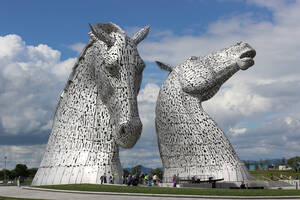
For this Mythology Monday, we’re going to talk about Kelpies. They are a mythical water spirit found in lochs in Scotland. They are shape shifters that look like horses but can become human. Kelpies are the dangerous kind of mythological creature, so be careful.
Etymology and Origin
The origin of the word is unclear but it could be from the Gaelic word ‘calpa’ or ‘cailpeach’ which means heifer or colt – words used to describe livestock. A heifer is a young cow, usually up until after she has her first calving. A colt is a young male horse aged 2-4 years.
The first recorded use for a mythological creature appears in an ode by William Collins before 1759, where it was spelled ‘kaelpie’.
Kelpie stories are associated with the majority of significant bodies of water in Scotland, especially Loch ness. The stories are, like many folklore and myths, warning children to stay away from dangers water and warning young women to be wary of handsome strangers.
What are Kelpies Like?
The common description of a kelpie is a stunning black horse. They inhabit the deep pools of rivers and streams, preying on any humans it encounters. Their hooves are reversed compared to normal horses, similar to the nykur of Iceland.
Local variations exist. In Aberdeenshire, kelpies are portrayed as having a mane of serpents, a bit like Medusa. The resident kelpie in the River Spey is white and entices victims onto its back by singing. A bit like siren song.
A similar creature known as each-uisge – literally ‘water horse’ is believed to be the creatures that live in lochs while kelpies live in rivers. The each-uisge is far more vicious.
Tales of the Kelpies
Most of the stories around kelpies involve them taking their victims into the water, eating them and leaving the entrails at the water’s edge. As an equine, a kelpie can extend its back to carry many riders down to the depths.
A common theme in the stories involves several children climbing onto the kelpies back, with one child remaining on the shore. The child pets the horse and his hand sticks to it. Some stories involve him cutting off his hand to get free and survive while the other children are taken and drowned. Several versions of these tales exist, in Glen Keltney in Perthshire, Thurso in Caithness and Sunart in the Highlands.
Kelpies could mate with horses and the offspring were impossible to drown and had shorter than normal ears.
Kelpies can shapeshift and appear to be human. They could be identified by having water weeds in their hair. Many tales describe a kelpie appearing as an old man and potentially attacking people in that form.
Barra’s Kelpie Story
There is a tale from Barra, an island in the Outer Hebrides, where a kelpie becomes a handsome young man to woo a young woman. She recognises him as a kelpie and removes his silver necklace (acts as a bridle) while he sleeps so he reverts to his equine form. She puts him to work on her father’s farm for a year.
The tale does have a happy ending. She rides the kelpie to a wise man for advice. He tells her to return the silver necklace and decides he wants to be a mortal man while she agrees she would be his wife if he was a man. They get married, and presumably live happily ever after. Cute.
In most stories about kelpies, they are male but there are a few tales featuring female ones. When Christianity came along in the 6th century, kelpies were associated with Satan due to their hooves, similar to the Greek god Pan.
Robert Burns refers to this in ‘Address to the Devil’ from 1786:
“When thowes dissolve the snawy hoord
An’ float the jinglin icy boord
Then, water-kelpies haunt the foord
By your direction
An’ nighted trav’llers are allur’d
To their destruction.”
It was believed that when a kelpie appeared as a horse with no tack, a halter stamped with the sign of a cross could capture it. The kelpie could then be put to work.
The Laird of Morphie
A story exists about the Laird(Lord) of Morhpie using a kelpie to carry stones to build his castle. He released the creature once the job was done and it cursed him in revenge.
“Sair back and sair banes/ Drivin’ the Laird o’ Morphies’s stanes,/ The Laird o’ Morphie’ll never thrive/ As lang’s the kelpy is alive”
Meaning that as punishment for the pain the kelpie endured, the Lord of Morphie wouldn’t survive. This is believed to have resulted in the extinction of his family.
Capturing and Killing a Kelpie
Kelpies might appear with full tack, a bridle and saddle, but if someone mounted them they would run off and drown the person. It was believed you could exorcise a kelpie by removing its bridle. The bridle could have magical properties and transform someone into a horse or pony.
Like many other mythological creatures, certain metals can harm them. They can be killed with a silver bullet, like a werewolf. There’s also a story of a blacksmith killing a kelpie that was scaring his family by stabbing it with two heated iron spears.
Some people believed the Loch Ness monster to be a kelpie and tales of monsters associated with Loch Ness and the River Ness have been around since the 6th century. See my previous article on the beloved Nessie for more details.
The equine aspect of this myth could have roots in horse sacrifices from ancient Scandinavia, according to Derek Gath Whitley.
Many stories of dangerous water spirits exist to keep children away from dangerous water. Many of Scotland’s lochs are dangerous to swim in with hidden currents and drop offs. Shape-shifters posing as handsome men were used to warn young women to be wary. Often these kinds of stories are used as moral lessons, so the creatures only harmed you if you did something wrong.

Kelpies appear in all kinds of places. There are images carved into Pictish stones that are believed to represent kelpies. This image on the right shows what that might look like. Source: By Book entitled “Bennachie” by Alexander Inkson McConnochie published 1890 – https://archive.org/stream/bennachie00mccogoog#page/n116/mode/1up, Public Domain, https://commons.wikimedia.org/w/index.php?curid=33374960
The Kelpies of Falkirk
If you visit Falkirk, you can see the Kelpies at The Helix park. Andy Scott designed the sculptures and the project was completed in October 2013. You can see them from the M9 motorway and they form a gateway of the Forth and Clyde Canal, which meets the River Carron. The Kelpies are 30m tall and at night they are lit up, making for a stunning view.
The project represents the horses that worked in Scottish industry and economy. The Falkirk area has a long history of mining and foundries. It has quite a fascinating history in general. I used to work in Falkirk and I recently visited Callendar House with a friend and learned a lot about it. If you are in the area, I highly recommend visiting the Kelpies for yourself.

Leave a Reply