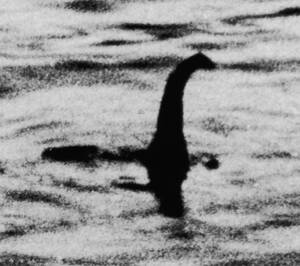

The Loch Ness Monster is probably one of Scotland’s most famous cryptids or mythological creatures. Affectionately known as Nessie, she lives in Loch Ness in the Highlands and many people have claimed to see her. Whether you believe she is real or not, she has captured the hearts of many Scottish folk and visitors alike.
The current name is pretty recent. The Courier published an account in 1933 of George Spicer’s alleged sighting, which brought the story to the public. Letters were sent in with different reports of sightings. All of them described a ‘monster fish,’ a ‘sea serpent’ or a ‘dragon.’ Eventually it became known as the Loch Ness Monster. The ‘Nessie’ nickname came about in the 1940’s.
Most depictions of Nessie resemble a plesiosaur, an extinct order of marine reptiles that lived during the Mesozoic era. They were wiped out in the extinction event that ended the Cretaceous period. They lived across the ocean but there were some species that at least partly lived in freshwater environments like lochs.
Loch Ness
Scotland only has one lake, the Lake of Menteith. All other fresh water ‘lakes’ are called lochs, unsurprisingly derived from the Gaelic word for lake. There are a few famous ones, notably Loch Lomond in the west near Dumbarton. And of course Loch Ness. Loch Ness is the second largest loch and one of the deepest in Scotland. It holds twice as much water as all of the lakes in England and Wales combined, by volume. Loch Lomond is larger by surface area but it’s not as deep.

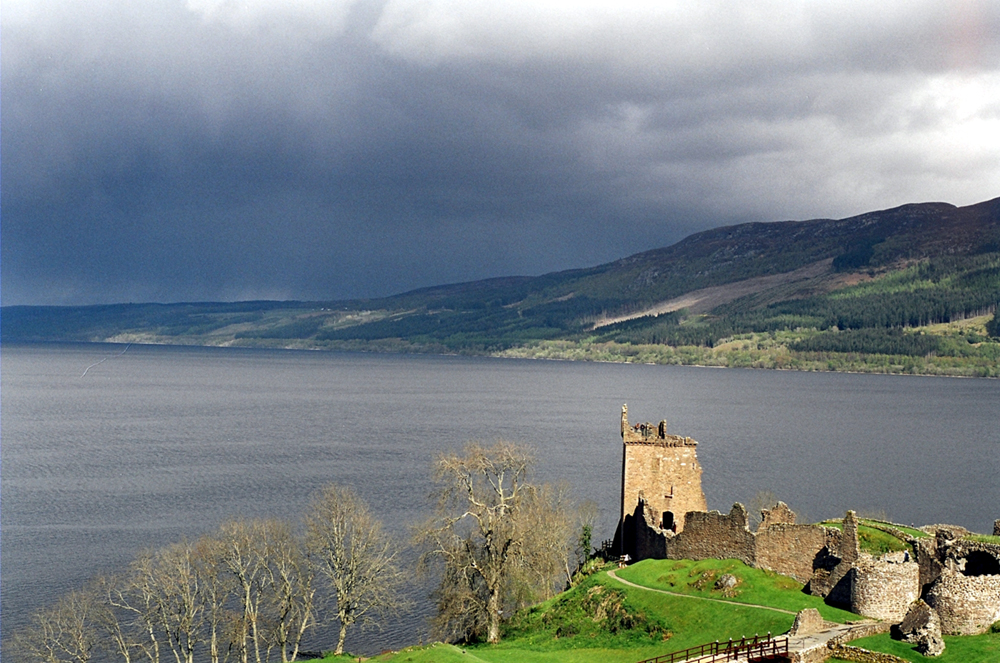
The deepest point of Loch Ness is 230m, 755ft or 126 fathoms, depending on your preferred unit of measurement. So it’s plenty of room for Nessie to be living her best life. The loch is situated in the Highlands, south of Inverness and it connects to the Moray Firth. Urquhart Castle sits on the northwest bank and Fort William sits on the southern bank. I’m sure the photo above is enough to convince you, but I highly recommend visiting if you get the chance. I have and it is a stunning view, as well as a potential chance for you to spot Nessie for yourself!
Sightings of Nessie
Like any good mythological creature or cryptid, there’s always a long history of reports. Odd events and weird sightings that defy explanation, at least with the technology and knowledge of the time. So let’s go back in time and see what we can learn about the earliest reports of the Loch Ness Monster.
The earliest report of a monster near Loch Ness is found in the Life of St. Columba by Adomnán, written in the 7th century AD about the Irish Monk Saint Columba. St. Columba visited the land of the Picts and encountered locals burying a man by the River Ness. They said the man was killed by a water beast while swimming in the river. Columba confronted the beast with a follower and made the sign of the cross, which stopped the creature. It fled in the face of God.
There’s not much evidence of such an event happening and the story was written a century after it supposedly happened. It could also be connected to later sightings of Nessie just because of the location. The story could also have been based on other tales like the kelpies or Irish myths.
In 1871-73 a D. Mackenzie reported seeing an object ‘wriggling and churning up the water,’ that looked like a log or upturned boat. This reported was not published until 1934 when interest in the monster became more popular. In 1888, Alexander Macdonald saw a large animal surfacing from the loch and propelling itself to the shore. He described it as ‘stubby-legged’ and said it looked like a salamander. Salamanders are a kind of amphibian related to newts, but they don’t tend to get big enough to fit the description of ‘monster.’
1933 Reports
The famous article in 1933 was published in the Inverness Courier about the sighting of a large ‘beast’ or ‘whale-like fish’ in the loch. Aldie Mackay reported seeing this creature rolling in the water while she and her husband drove along the A82. The A82 is a long trunk road that starts in Glasgow, travels west to Loch Lomond before turning north and eventually reaching the Highlands. Which is why it’s usually known as Great Western Road.
The article was written by Alex Campbell, the water bailiff for Loch Ness and a part time journalist. Both Aldie Mackay and Alex Campbell have said that there have been local tales of a monster in the loch for a long time.
Later that year, George Spicer and his wife saw an ‘extraordinary form of animal’ cross the road. They describe a creature with a large body, a long narrow neck, and no limbs. It lurched across the loch. And Spicer states it was the closest he’d seen to a dragon or prehistoric animal in his life. He is the first person to describe it as resembling a plesiosaur but his story appears to be fake. It may have been inspired by a long-necked dinosaur rising out of a lake in King Kong, a movie that was very popular in cinemas at the time.
The First Photograph of Nessie
The first photograph that was supposed to be the Loch Ness Monster was taken in November 1933 and it was slightly blurred. Hugh Gray took it while on a walk with his dog, so it is suspected that the photograph is of his dog fetching a stick from the loch. The original negative was lost. In 1963, Maurice Burton got two lantern slides that were made from the original negative and they showed an otter rolling at the surface of the lake.
In January 1934, a vet student named Arthur Grant claimed to have almost hit the creature with his motorcycle at 1am. He described it as a cross between a seal and a plesiosaur. Grant sketched what he saw and showed it to Maurice Burton, a zoologist. He stated it was consistent with an otter.
A Rational Explanation
Many of the photographs and films of Nessie can be explained as sightings of otters, seals, waterfowl or boats. the most famous photograph is the ‘surgeon’s photograph,’ which I included at the beginning of the article. It was printed in the Daily Mail on the 21st of April, 1934. It is often cropped before sharing, which makes it harder to compare the scale of the ‘monster’ compared to the surroundings.
By the 1990s, it is pretty much accepted that the photograph is a hoax. People got caught up in the excitement of the myth and wanted to get in on the attention. A bit like posting conspiracy theories on social media these days. Selling an exclusive story or photograph to a newspaper can be quite lucrative.
Many people have searched for Nessie over the years. Edward Mountain financed an expedition in 1934 but the only film they got showed a seal. The film has been lost.
Sonar readings have been used but have been inconclusive. One was reported in 1954 with a large object keeping pace with the boat but nothing else has been substantiated. Even more recently, in 2007, a recording showed something moving fast in the water. Experts believe it was an otter, seal or water bird.
Modern Searches for Nessie
The Loch Ness Phenomena Investigation Bureau was formed in 1962 to study the loch and identify the creature or find an explanation for the sightings.
Several sonar studies were carried out and some photographs appeared to show large tails or flippers, but the flipper photographs are suspected to have been retouched. Based on this, Sir Peter Scott gave Nessie the scientific name Nessiteras rhombopteryx which is Greek for Ness inhabitant with diamond shaped fin. This could put her on the British register of protected wildlife.
It was pointed out that the name was an anagram for ‘monster hoax by Sir Peter S.’ Another anagram is ‘Yes, both pix are monsters – R.’ So make of that what you will.
In 1987, a study using echo sounding equipment was deployed and there was something of unusual size found. It could be debris at the bottom but some of the pictures showed motion.
In 2018 there was even a DNA survey carried out. No DNA of large fish like sharks, sturgeons or catfish could be found. No otters or seals either but a lot of eel DNA. Eels of unusual size could exist in theory but none have been found. No reptilian DNA was found.
The Loch Ness Monster in Pop Culture

https://upload.wikimedia.org/wikipedia/commons/4/46/Lochneska_poboba_museumofnessie.jpg
Nessie has found her way into pop-culture, in films and television. One that certainly comes to mind for me is an animated film called Freddie FR07. An animated film released in 1992 as a parody of James Bond, where a prince is turned into a frog by his evil aunt after killing his parents. He joins the French Secret Service and travels to London to stop a villain stealing the UK’s famous landmarks.
He recruits his old friend Nessie to help prevent the theft of Big Ben. It’s wild. I admit I loved this film as a child, I almost wore out the VHS tape. I might have been the only person to like it though. It flopped with a budget of 9.9 million GBP (18 million USD) and a UK box office intake of £390,000. It was the lowest-grossing opening for an animated film at the US box office until the Ten Commandments in 2007. Funnily enough, Ben Kingsley starred in both of these films.
Whether you believe in Nessie or not, it’s a fun myth to think about and she has done a fair bit for Scotland’s tourism industry. She’s an iconic creature alongside haggises and highland coos. Scotland loves it’s mythological creatures, our national animal is the unicorn. And who knows, maybe we will find something in the Loch Ness. Considering we know more about space than we do about what’s at the depths of our waters on earth, you never know.
Leave a Reply