The cat-sìth (pronounced ‘cat-shee’) comes from Celtic mythology. It is the legendary spectral cat that haunts the Scottish Highlands. The cat-sìth resembles a large black cat with a white spot on its chest. When no-one is watching, it is capable of walking on its hindlimbs.
It is most common in Scottish folklore but it does feature in Irish folklore as well. They are attributed to the fairies. However, some stories speak of it as a witch that could transform into a cat nine times. This might be the source of the ‘cats have nine lives’ that most people have heard. After the ninth transformation, the witch would remain a cat for the rest of her days.
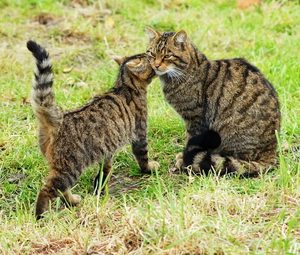
They might have been inspired directly by the Scottish Wildcat Felis silvestris. Wildcats are very similar to domestic cats but tend to be larger with bigger heads and thicker tails. They are typically brown tabby in appearance. However, melanistic specimens exist, like black jaguars.
There is also a hybrid species known as the Kellas cat. They are hybrids between wildcats and domestic cats Felis catus. Cross breeding with domestic cats is one of the reasons that wildcats have become endangered as bloodlines get diluted. There is a population of hybrids and they are larger than domestic cats. One was snared in 1984 and was found to be a hybrid. But tales of a cryptid large black cat still persist in the UK.
Common belief around these creatures was that they would steal the souls of the recently deceased before they crossed over. They did this by walking over the person’s body. It was traditional for bodies to be kept in the home or a barn so people could pay their respects, until morgues were available.
To prevent the person’s soul being stolen, people would hold a vigil, the Late Wake. They would attempt to distract the cat-sith with music, dancing, games or even catnip. They would avoid a fire nearby as the heat would attract the cat-sith. Makes sense, cats will always be cats.
Samhain is a festival on the 1st of November to mark the end of harvest and the beginning of autumn. Celebrations begin on the 31st of October and it was believed that the boundary between this world and the other world blurred so contact with the fairies was more likely.
A common custom at this time was to leave a saucer of milk out for the cat-sìth and you would get good luck for the year. If you didn’t do this, the cat-sìth would dry up the milk of your cows. As with many of these myths, they can be good or bad, depending on how you deal with them. So be careful.
For this Mythology Monday, we’re going to talk about Kelpies. They are a mythical water spirit found in lochs in Scotland. They are shape shifters that look like horses but can become human. Kelpies are the dangerous kind of mythological creature, so be careful.
Etymology and Origin
The origin of the word is unclear but it could be from the Gaelic word ‘calpa’ or ‘cailpeach’ which means heifer or colt – words used to describe livestock. A heifer is a young cow, usually up until after she has her first calving. A colt is a young male horse aged 2-4 years.
The first recorded use for a mythological creature appears in an ode by William Collins before 1759, where it was spelled ‘kaelpie’.
Kelpie stories are associated with the majority of significant bodies of water in Scotland, especially Loch ness. The stories are, like many folklore and myths, warning children to stay away from dangers water and warning young women to be wary of handsome strangers.
What are Kelpies Like?
The common description of a kelpie is a stunning black horse. They inhabit the deep pools of rivers and streams, preying on any humans it encounters. Their hooves are reversed compared to normal horses, similar to the nykur of Iceland.
Local variations exist. In Aberdeenshire, kelpies are portrayed as having a mane of serpents, a bit like Medusa. The resident kelpie in the River Spey is white and entices victims onto its back by singing. A bit like siren song.
A similar creature known as each-uisge – literally ‘water horse’ is believed to be the creatures that live in lochs while kelpies live in rivers. The each-uisge is far more vicious.
Tales of the Kelpies
Most of the stories around kelpies involve them taking their victims into the water, eating them and leaving the entrails at the water’s edge. As an equine, a kelpie can extend its back to carry many riders down to the depths.
A common theme in the stories involves several children climbing onto the kelpies back, with one child remaining on the shore. The child pets the horse and his hand sticks to it. Some stories involve him cutting off his hand to get free and survive while the other children are taken and drowned. Several versions of these tales exist, in Glen Keltney in Perthshire, Thurso in Caithness and Sunart in the Highlands.
Kelpies could mate with horses and the offspring were impossible to drown and had shorter than normal ears.
Kelpies can shapeshift and appear to be human. They could be identified by having water weeds in their hair. Many tales describe a kelpie appearing as an old man and potentially attacking people in that form.
Barra’s Kelpie Story
There is a tale from Barra, an island in the Outer Hebrides, where a kelpie becomes a handsome young man to woo a young woman. She recognises him as a kelpie and removes his silver necklace (acts as a bridle) while he sleeps so he reverts to his equine form. She puts him to work on her father’s farm for a year.
The tale does have a happy ending. She rides the kelpie to a wise man for advice. He tells her to return the silver necklace and decides he wants to be a mortal man while she agrees she would be his wife if he was a man. They get married, and presumably live happily ever after. Cute.
In most stories about kelpies, they are male but there are a few tales featuring female ones. When Christianity came along in the 6th century, kelpies were associated with Satan due to their hooves, similar to the Greek god Pan.
Robert Burns refers to this in ‘Address to the Devil’ from 1786:
“When thowes dissolve the snawy hoord An’ float the jinglin icy boord Then, water-kelpies haunt the foord By your direction An’ nighted trav’llers are allur’d To their destruction.”
It was believed that when a kelpie appeared as a horse with no tack, a halter stamped with the sign of a cross could capture it. The kelpie could then be put to work.
The Laird of Morphie
A story exists about the Laird(Lord) of Morhpie using a kelpie to carry stones to build his castle. He released the creature once the job was done and it cursed him in revenge.
“Sair back and sair banes/ Drivin’ the Laird o’ Morphies’s stanes,/ The Laird o’ Morphie’ll never thrive/ As lang’s the kelpy is alive”
Meaning that as punishment for the pain the kelpie endured, the Lord of Morphie wouldn’t survive. This is believed to have resulted in the extinction of his family.
Capturing and Killing a Kelpie
Kelpies might appear with full tack, a bridle and saddle, but if someone mounted them they would run off and drown the person. It was believed you could exorcise a kelpie by removing its bridle. The bridle could have magical properties and transform someone into a horse or pony.
Like many other mythological creatures, certain metals can harm them. They can be killed with a silver bullet, like a werewolf. There’s also a story of a blacksmith killing a kelpie that was scaring his family by stabbing it with two heated iron spears.
Some people believed the Loch Ness monster to be a kelpie and tales of monsters associated with Loch Ness and the River Ness have been around since the 6th century. See my previous article on the beloved Nessie for more details.
The equine aspect of this myth could have roots in horse sacrifices from ancient Scandinavia, according to Derek Gath Whitley.
Many stories of dangerous water spirits exist to keep children away from dangerous water. Many of Scotland’s lochs are dangerous to swim in with hidden currents and drop offs. Shape-shifters posing as handsome men were used to warn young women to be wary. Often these kinds of stories are used as moral lessons, so the creatures only harmed you if you did something wrong.
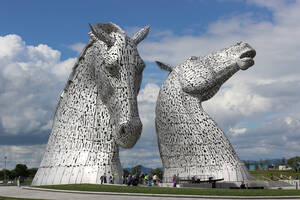
If you visit Falkirk, you can see the Kelpies at The Helix park. Andy Scott designed the sculptures and the project was completed in October 2013. You can see them from the M9 motorway and they form a gateway of the Forth and Clyde Canal, which meets the River Carron. The Kelpies are 30m tall and at night they are lit up, making for a stunning view.
The project represents the horses that worked in Scottish industry and economy. The Falkirk area has a long history of mining and foundries. It has quite a fascinating history in general. I used to work in Falkirk and I recently visited Callendar House with a friend and learned a lot about it. If you are in the area, I highly recommend visiting the Kelpies for yourself.
Steven Straiton, CC BY 2.0 , via Wikimedia Commons
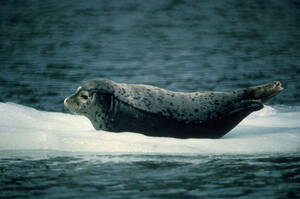
Harbor seal on an ice floe: Public Domain from U.S. Fish and Wildlife Service
I’m continuing my coverage of Scottish Mythology with the Selkies. Selkies are shapeshifters, an entire subgroup of mythological creatures that can change form. Often they have a human or human-like form and can change into something else. The change may be voluntary but it may not be, as is sometimes the case with werewolves.
The name comes from the Scots word for seal. It can be written as ‘silkies,’ ‘sylkies,’ or ‘selchies.’ The Scots language doesn’t have standardised spelling for most words. They are the seal folk and they are associated with the northern isles of Scotland: Shetland and Orkney. They also feature in many Celtic and Norse myths and stories are also told of them in Iceland and Ireland.
What Are Selkies?
Selkies are sometimes conflated with the finfolk and merfolk. In the Gaelic languages they are named as mermaids, most of the time.
Like many mythological creatures, especially in Scotland, they have a duality to their nature. They can be friendly and helpful to humans, but they are also capable of being dangerous or vengeful.
Selkies live as seals in the sea and shed or remove their skin to become human on land. They are depicted as beautiful and seductive in human form. Many stories involve them having romantic or sexual relationships with humans.
Many stories involve coercion or trickery, into marrying a human. Usually the human steals and hides their seal skin so they can’t return to the sea. This leaves them trapped in an unhappy marriage, unless they can find their skin and escape. Here’s an example from Orkney.
Male selkies exist and are handsome and seductive to human women. They tend to look for women who are unhappy with their lives, such as those married to fisherman who are at sea for long periods of time.
Superstitions About Selkies
Unsurprisingly, folk stories like this create superstitions. For example, there is a common belief that killing a seal would result in misfortune. This is why people living on the isles would only kill seals during hard times, if they had no other option.
One tale involves crofters grazing their sheep. It is common on the islands for crofters to have communal grazing for their livestock instead of fenced off fields. One man put seven sheep on the largest holm and killed a seal on his way home.
That night, all of his sheep disappeared, while the other crofter’s animals were safe and unharmed. It suggests that the selkies took the sheep as revenge.
Similar stories of seal shapeshifters are found across the world. A similar creature exists in Swedish legend and the Chinook people of North America have a similar tale of a boy who turns into a seal. Iceland also has a lot of selkie-type stories. If the story includes any offspring of a selkie and a human, the child is born with physical characteristics like webbed fingers.
Origins of Selkie Myths
The likely origin of these myths came from the early days of settlements when health conditions and congenital abnormalities were blamed on fairies or changelings. Before people had scientific explanations for these things, they would be attributed to deities or the supernatural.
The tales of seals removing their skins likely originated with early settlers in Scotland encountering Finnish and Sami women who wore sealskin clothing. They removed it and let it dry, when it got waterlogged. There is also lore that suggests selkies are supernaturally formed from the souls of drowned people.
Selkies have made frequent appearances in films and books. They have seen a resurgence in popularity in the last few years with novels and films featuring them. I love that, as long as the origins of the myths are preserved and respected.
The Loch Ness Monster is probably one of Scotland’s most famous cryptids or mythological creatures. Affectionately known as Nessie, she lives in Loch Ness in the Highlands and many people have claimed to see her. Whether you believe she is real or not, she has captured the hearts of many Scottish folk and visitors alike.
The current name is pretty recent. The Courier published an account in 1933 of George Spicer’s alleged sighting, which brought the story to the public. Letters were sent in with different reports of sightings. All of them described a ‘monster fish,’ a ‘sea serpent’ or a ‘dragon.’ Eventually it became known as the Loch Ness Monster. The ‘Nessie’ nickname came about in the 1940’s.
Most depictions of Nessie resemble a plesiosaur, an extinct order of marine reptiles that lived during the Mesozoic era. They were wiped out in the extinction event that ended the Cretaceous period. They lived across the ocean but there were some species that at least partly lived in freshwater environments like lochs.
Loch Ness
Scotland only has one lake, the Lake of Menteith. All other fresh water ‘lakes’ are called lochs, unsurprisingly derived from the Gaelic word for lake. There are a few famous ones, notably Loch Lomond in the west near Dumbarton. And of course Loch Ness. Loch Ness is the second largest loch and one of the deepest in Scotland. It holds twice as much water as all of the lakes in England and Wales combined, by volume. Loch Lomond is larger by surface area but it’s not as deep.
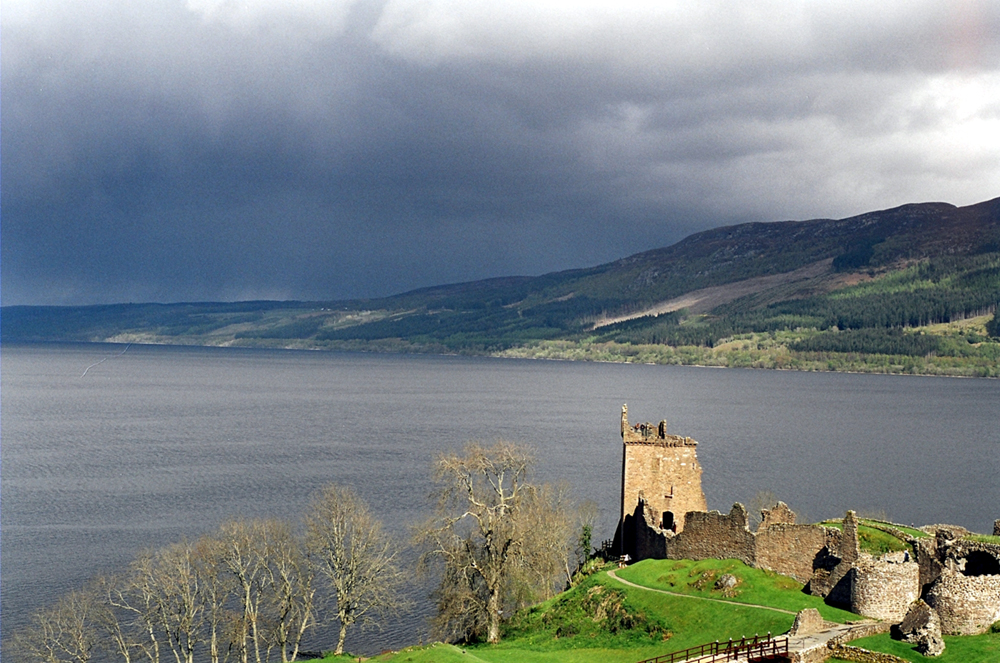
The deepest point of Loch Ness is 230m, 755ft or 126 fathoms, depending on your preferred unit of measurement. So it’s plenty of room for Nessie to be living her best life. The loch is situated in the Highlands, south of Inverness and it connects to the Moray Firth. Urquhart Castle sits on the northwest bank and Fort William sits on the southern bank. I’m sure the photo above is enough to convince you, but I highly recommend visiting if you get the chance. I have and it is a stunning view, as well as a potential chance for you to spot Nessie for yourself!
Sightings of Nessie
Like any good mythological creature or cryptid, there’s always a long history of reports. Odd events and weird sightings that defy explanation, at least with the technology and knowledge of the time. So let’s go back in time and see what we can learn about the earliest reports of the Loch Ness Monster.
The earliest report of a monster near Loch Ness is found in the Life of St. Columba by Adomnán, written in the 7th century AD about the Irish Monk Saint Columba. St. Columba visited the land of the Picts and encountered locals burying a man by the River Ness. They said the man was killed by a water beast while swimming in the river. Columba confronted the beast with a follower and made the sign of the cross, which stopped the creature. It fled in the face of God.
There’s not much evidence of such an event happening and the story was written a century after it supposedly happened. It could also be connected to later sightings of Nessie just because of the location. The story could also have been based on other tales like the kelpies or Irish myths.
In 1871-73 a D. Mackenzie reported seeing an object ‘wriggling and churning up the water,’ that looked like a log or upturned boat. This reported was not published until 1934 when interest in the monster became more popular. In 1888, Alexander Macdonald saw a large animal surfacing from the loch and propelling itself to the shore. He described it as ‘stubby-legged’ and said it looked like a salamander. Salamanders are a kind of amphibian related to newts, but they don’t tend to get big enough to fit the description of ‘monster.’
1933 Reports
The famous article in 1933 was published in the Inverness Courier about the sighting of a large ‘beast’ or ‘whale-like fish’ in the loch. Aldie Mackay reported seeing this creature rolling in the water while she and her husband drove along the A82. The A82 is a long trunk road that starts in Glasgow, travels west to Loch Lomond before turning north and eventually reaching the Highlands. Which is why it’s usually known as Great Western Road.
The article was written by Alex Campbell, the water bailiff for Loch Ness and a part time journalist. Both Aldie Mackay and Alex Campbell have said that there have been local tales of a monster in the loch for a long time.
Later that year, George Spicer and his wife saw an ‘extraordinary form of animal’ cross the road. They describe a creature with a large body, a long narrow neck, and no limbs. It lurched across the loch. And Spicer states it was the closest he’d seen to a dragon or prehistoric animal in his life. He is the first person to describe it as resembling a plesiosaur but his story appears to be fake. It may have been inspired by a long-necked dinosaur rising out of a lake in King Kong, a movie that was very popular in cinemas at the time.
The First Photograph of Nessie
The first photograph that was supposed to be the Loch Ness Monster was taken in November 1933 and it was slightly blurred. Hugh Gray took it while on a walk with his dog, so it is suspected that the photograph is of his dog fetching a stick from the loch. The original negative was lost. In 1963, Maurice Burton got two lantern slides that were made from the original negative and they showed an otter rolling at the surface of the lake.
In January 1934, a vet student named Arthur Grant claimed to have almost hit the creature with his motorcycle at 1am. He described it as a cross between a seal and a plesiosaur. Grant sketched what he saw and showed it to Maurice Burton, a zoologist. He stated it was consistent with an otter.
A Rational Explanation
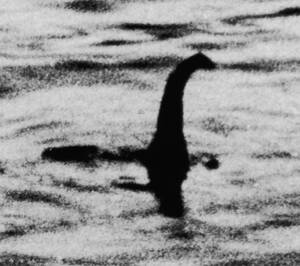
Many of the photographs and films of Nessie can be explained as sightings of otters, seals, waterfowl or boats. the most famous photograph is the ‘surgeon’s photograph,’ which I included at the beginning of the article. It was printed in the Daily Mail on the 21st of April, 1934. It is often cropped before sharing, which makes it harder to compare the scale of the ‘monster’ compared to the surroundings.
By the 1990s, it is pretty much accepted that the photograph is a hoax. People got caught up in the excitement of the myth and wanted to get in on the attention. A bit like posting conspiracy theories on social media these days. Selling an exclusive story or photograph to a newspaper can be quite lucrative.
Many people have searched for Nessie over the years. Edward Mountain financed an expedition in 1934 but the only film they got showed a seal. The film has been lost.
Sonar readings have been used but have been inconclusive. One was reported in 1954 with a large object keeping pace with the boat but nothing else has been substantiated. Even more recently, in 2007, a recording showed something moving fast in the water. Experts believe it was an otter, seal or water bird.
Modern Searches for Nessie
The Loch Ness Phenomena Investigation Bureau was formed in 1962 to study the loch and identify the creature or find an explanation for the sightings.
Several sonar studies were carried out and some photographs appeared to show large tails or flippers, but the flipper photographs are suspected to have been retouched. Based on this, Sir Peter Scott gave Nessie the scientific name Nessiteras rhombopteryx which is Greek for Ness inhabitant with diamond shaped fin. This could put her on the British register of protected wildlife.
It was pointed out that the name was an anagram for ‘monster hoax by Sir Peter S.’ Another anagram is ‘Yes, both pix are monsters – R.’ So make of that what you will.
In 1987, a study using echo sounding equipment was deployed and there was something of unusual size found. It could be debris at the bottom but some of the pictures showed motion.
In 2018 there was even a DNA survey carried out. No DNA of large fish like sharks, sturgeons or catfish could be found. No otters or seals either but a lot of eel DNA. Eels of unusual size could exist in theory but none have been found. No reptilian DNA was found.
Nessie has found her way into pop-culture, in films and television. One that certainly comes to mind for me is an animated film called Freddie FR07. An animated film released in 1992 as a parody of James Bond, where a prince is turned into a frog by his evil aunt after killing his parents. He joins the French Secret Service and travels to London to stop a villain stealing the UK’s famous landmarks.
He recruits his old friend Nessie to help prevent the theft of Big Ben. It’s wild. I admit I loved this film as a child, I almost wore out the VHS tape. I might have been the only person to like it though. It flopped with a budget of 9.9 million GBP (18 million USD) and a UK box office intake of £390,000. It was the lowest-grossing opening for an animated film at the US box office until the Ten Commandments in 2007. Funnily enough, Ben Kingsley starred in both of these films.
Whether you believe in Nessie or not, it’s a fun myth to think about and she has done a fair bit for Scotland’s tourism industry. She’s an iconic creature alongside haggises and highland coos. Scotland loves it’s mythological creatures, our national animal is the unicorn. And who knows, maybe we will find something in the Loch Ness. Considering we know more about space than we do about what’s at the depths of our waters on earth, you never know.