Survival Strategies Using Colour

Animals use colour strategies in all kinds of ways to avoid being detected, eaten or to express themselves in some way. Some creatures can see colours we can’t, like infra-red and ultraviolet, which are not on the ‘visible spectrum’ of light. The visible spectrum is defined as what we can see as humans. For animals, and some people, the range of colours they can see vary from this ‘default’ setting. So let’s have a look at some of the ways animals can use colour.
Camouflage Strategy
The obvious, and best known reason animals have the colours and coat patterns they have is to blend in to their environment. Blending in is advantageous for both predator and prey species. This is why you see a lot of browns and greys in the colouration of many species. Colour strategies involving camouflage are a huge part of why animals look the way they do.

Of course some species can actually change their colouration to blend in. A lot of octopus and squid species are extremely skilled at this, as are chameleons but we’ll get into them a bit more later. They have specialised chromatophore cells that can change what wavelength of light the skin reflects, which changes the colour. Chromatophore cells are the cells containing pigment, such as melanocytes, the cells in human skin that contain melanin.
Disruptive colouration uses contrasting markings that don’t repeat to break up the outline of an animal or hide features like their eyes to hide in their environment. This is employed by a lot of cats, the spots or stripes helping them blend in to get close to their prey without being spotted, as well as ambush predators and prey species.

Some species can stop themselves from producing shadows to hide. The horned lizards found in North America can flatten their bodies against the ground, the fringing along their sides disrupting the shadows and allowing them to blend in to the ground.
Decorating themselves with material from the environment can help with blending in and hiding their body parts. Decorator crabs employ this, covering their body with sponges. The Ghillie suit used by military snipers uses this same principle.
Underwater Camouflage

Transparency is another method, particularly seen in marine animals such as jellyfish. Their bodies are gelatinous with a similar refractive index to sea water so they are almost invisible. This is a trade-off as it means their mobility is poor. Another cool example are glass frogs, which are transparent around their main body, which helps them blend in to the environment around them.
A lot of fish have reflective scales, called ‘silvering’ which uses guanine crystals to give a reflective surface. The marine hatchet fish is a notable example of this. For deep sea fish, ultra black colouration absorbs light and allows the animal to hide in the depths. This is used by anglerfish, which improves the effectiveness of their bioluminescent lure to attract prey into their ambush.
Mimicing another object involves both colour and body shape. Either to hide or to lure prey into an ambush. A lot of insects mimic leaves or twigs to hide in the plants they live in. Some preying mantises make themselves look like flowers to attract insects.
Danger! Warning! Aposematism Strategies
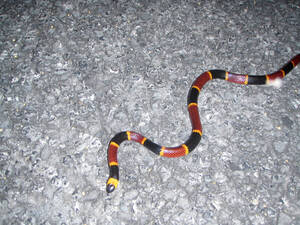
Some animals have colouration that makes them stand out, instead of blending in. This is called aposematism, and the idea is that the animal is noticed and avoided by potential predators. Colour is used to warn that the animal is dangerous and not worth eating.
The colours used are often the same, with combinations of red, yellow, black and white employed. We use these same colours for warning signs. Wet floor signs, stop signs, police tape!

The colours can indicate a number of things, from tasting bad like the cinnabar moth, foul-smelling like skunks, aggressive like honey badgers, or venomous like the coral snake. Aposematism works because either predators have the instinct to avoid animals with these colours or they have learned the hard way to avoid them.
Some species will mimic this kind of colouration to fool predators into avoiding them. Batesian mimicry is where an edible animal looks like a dangerous one such as hoverflies who resemble bees but have no sting. Müllerian mimicry means a number of species that resemble each other and are dangerous, so they’ve evolved in a similar way. This kind is common among bees and wasps, who are capable of stinging.
Chameleons, Nature’s Mood Ring – Communication Strategies
Anyone who grew up in the 80s or 90s will remember ‘mood rings’, the cheap rings with a gem that changed colour to indicate your mood. They weren’t exactly accurate but chameleons have this ability and it works really well.

While they do use their colour changing abilities to blend in, the main purpose for colour changing is to indicate their mood and feelings. The males are more flamboyant than the females but they can display a wide range of colours.
Bright greens and yellows or blues usually indicate a happy chameleon. Black indicates anger, fear or distress. Reds and oranges can indicate excitement or readiness to mate. Again this is down to the presence of guanine crystals within the skin cells. Changing the distance between these nanocrystals shifts the wavelengths of light reflected and thus changes the colour of the skin.
It’s such a cool ability, and it’s surprising how quickly the change happens. As a vet, I treated a few chameleons and they’re one of my favourite reptile species. The black colour means pain or anger, and it can be localised. If you give a chameleon an injection or if they have a wound, the skin around the area will turn black.
Other reptiles have some capability for this colour change. Bearded dragons can turn their beard black and puff it out if they feel threatened. But none are more spectacular than the chameleon.
Looking for Love?
The most common reason for bright and flamboyant colours in animals is for selection of suitable mates. Most notably this happens with a lot of birds, you only need to look at the different kinds of bird-of-paradise and the peafowl. These colour strategies can make them more vulnerable to predators in exchange for sex appeal!

Peafowl have dramatic sexual dimorphism (where the male and female look different). Peacocks are brightly coloured with the distinctive massive fan tail, while peahens are brown and drab looking.
You could spend hours looking at the different species of bird-of-paradise and see the fabulous fashion styles of the males compared to the females. They put on elaborate displays to impress the females enough to be allowed to mate with them.
Another favourite of mine is the eclectus parrot. These birds have such dramatic sexual dimorphism that they were believed to be different species at one point. The males are bright green with red and blue highlights and an orange beak, while the females are red and purple with a black beak.
Thanks for Reading!
As you can see, the animal world uses colour strategies in so many ways. It’s a really interesting topic and worth considering if you are featuring creatures in your writing. Or designing your own. So have a think about the creatures environment, role in the ecosystem and diet before deciding which colours you should use.
Leave a Reply