Category: Storytelling In Video Games

  • How Games Tell Their Stories

    Cutscenes

    Games have many ways to tell you their stories. Most RPGs and narrative games open with a cutscene to introduce the inciting incident and give some background.

    Dragon Age Origins opens with the history of the darkspawn and the Blight. Fallout games open by telling us about the bombs and how people survived in the Vaults. Players need context, especially in the first game of a series.

    Some opening cutscenes are better than others, of course. If you don’t give the player enough information, it can be hard to get them to care about the main storyline. Equally, too much exposition can get boring and tedious. As much as I love Fallout New Vegas, I think the opening cutscenes give us too much information about the NCR and the Legion.

    We could learn this in the early game, to my mind. We meet NCR soldiers in Primm, and could easily get a bit of detail about the NCR from talking to them. When we reach Nipton and talk to Vulpes Inculta, we could get a brief rundown of who the Legion are. This would be more impactful, since we would just see a bunch of Roman cosplayers coming out of the town hall. But we were told about them before, so it’s less of a surprise.

    It was a bold choice for Benny to shoot you in the head at the beginning of the game. It’s unexpected, because it would be a very short game indeed if this was fatal. Skyrim does something similar with a dragon saving the protagonist from execution.

    Dialogue

    Like novels, movies and plays, dialogue is a huge part of storytelling in games. Pretty much every RPG that has ever existed requires you to find information by talking to every NPC you can find. A lot of this dialogue is for flavour, which improves immersion, but you will find secrets and important details through this method in most RPGs.

    An example from Fallout New Vegas is Rotface. He’s a ghoul you will find in Freeside, easily overlooked. However, if you pay him one bottlecap (the currency of Fallout) he will give you a random tip or some gossip. He has hints which aid the player in certain side quests. For example, the NCR send the player to assassinate a man called Pacer.

    Pacer is The King’s second in command, the gang who run Freeside, and is problematic for the NCR. Rotface will tell you that Pacer uses Jet but has a heart condition. Getting this tip allows you to spike Pacer’s Jet stash with another drug, Psycho, which will kill him. No-one will know who did the deed, it’s a proper sneaky way to assassinate someone.

    A lot of RPGs have the option to speak to important characters and ask questions. These dialogue trees can be very involved and you will learn a lot about the world and the characters. Dragon Age and Mass Effect are both great for this. The party camp or the Normandy is a place to regroup and you can go around and chat to your companions. You get to know them, their opinions on your choices and alter their disposition towards you. You can even initiate romance with some of them!

    Games Tell Their Stories

    These are the more direct ways games tell their stories. They are effective for the most part, but a balance needs to be found. If you don’t give enough information, the player will lose interest. However, it’s possible to overdo it and a massive exposition dump can turn the player off too.

    Next time we’ll talk about the less direct methods, such as collecting lore and environmental storytelling. What do you think about cutscenes in games? Do you have a favourite? Or is there one you dislike? Let me know in the comments!

  • Storytelling Without Words

    Storytelling Without Words

    Some games don’t use text or dialogue to tell you the story. Games can achieve storytelling without words. There’s a game called Virginia, which tells a story with no dialogue. It involves an FBI investigation in a small town in Virginia, and there is no spoken dialogue at all. You have to piece together what’s going on from locations, body language and actions. It’s a bizarre experience.

    Unpacking – Storytelling Without Words

    One of my favourites for this is a game called Unpacking. This is a game where each level is you unpacking moving boxes and putting everything away. It has literally no dialogue at all. You start with a child’s bedroom, and learn that the person likes to draw and paint, play soccer and collect plushies.

    You move through each stage of their life, from university to living in their first apartment with friends. Then they move in with their partner and there’s a sad moment where their degree certificate must be hidden away and you struggle to fit everything in alongside the stuff that is already there.

    Suddenly you’re moving back into your childhood bedroom. You also see more and more medications, mobility aids and other things that indicate chronic pain or illness. Finally you get your own place and settle in. Then someone moves in with you, and you can fit all their stuff beside yours easily. Then finally you both move into a larger house and set up a nursery for a baby.

    You literally learn about the people through their posessions, and the first relationship that fell apart was with a man, but the second relationship that went well was with another woman. Then you discover the nursery and unpack all the baby stuff, so you know they are bringing a child into their family. There’s sad moments when you realise the character has developed chronic health issues, and that they aren’t able to show off their achievements when they live with the man.

    Show, Not Tell

    It’s amazing how much you can learn about someone’s life just from the things they own. You see what is kept over the years, which shows you what matters most to them. I highly recommend Unpacking. It’s a lovely experience and it’s really amazing what you can learn about a story with no words to give it away. One of the common rules about storytelling is to ‘show, not tell.’  While I don’t believe this is an absolute rule, Unpacking shows that it is possible to tell a compelling story without using any words at all. Indeed this is the appeal for a lot of gamers. They want to explore and discover things for themselves instead of having everything spoon fed to them.

  • Visual Novels as Games

    By Team Salvato - https://satchely.deviantart.com/art/Doki-Doki-Literature-Club-701394578, Fair use, https://en.wikipedia.org/w/index.php?curid=55571864
    By Team Salvato – https://satchely.deviantart.com/art/Doki-Doki-Literature-Club-701394578, Fair use, https://en.wikipedia.org/w/index.php?curid=55571864

    Some games have little gameplay, such as the ‘walking simulators’ and visual novels which usually take the form of ‘dating simulators’. They are two different kinds of visual novels and are very popular. Let’s take a look at them in kind.

    The ‘walking simulators’ are games where you mainly spend your time walking around, exploring and solving some light puzzles to get the story bit by bit. They are particularly effective for horror experiences or at least unsettling experiences. They can set up for good twist endings or a properly scary experience.

    A game in this vein I really enjoyed is called Gone Home where a young woman returns to her family home and finds the place empty. She must explore the house and piece together what happened and where her family members are. It’s non linear, but you must find certain things to unlock new areas to explore. I won’t spoil the ending but it’s worth your time.

    Other games in this vein include Firewatch, What Remains of Edith Finch and the Stanley Parable (which is a humorous take on these kinds of games).

    Dating Simulators

    Dating simulators and visual novels usually are formatted as static artwork with an overlay where conversations happen and the player makes choices about what to say or who to spend time with. Not all of them are dating simulators. Games like Ace Attorney being an adventure centered around investigations and courtroom trials.

    These kinds of games are especially popular in Japan and many of them feature anime style artwork. They often have a few different endings, usually based on the choice of which character to date and form a relationship with. They range from the sweet and benign to the outright bizarre like Panzermadels. This is one where the girls you can date are actually tanks. Yeah. Really.

    Unsurprisingly there are a bunch of these which are firmly in the NSFW category. Which is fair enough if that’s what you’re into. Some of them include some other kind of game mechanics as well. They have branching story paths, again for the replayability value of the games. They range in quality as well, with some of them being really good and others less so.

    Horror Visual Novels

    They can be effective for a horror experience too. They do lend themselves well to that kind of atmosphere. One I came across randomly is called Cooking Companions. It is very strange and makes good use of sounds and visuals to give you goosebumps. It’s not the best story I’ve ever come across. That said, it definitely gets under your skin and is very uncomfortable at times.

    One of the best in this category, however, is Doki Doki Literature Club. This game doesn’t appear to be a horror experience at first. However, if you play through it, it will get under your skin. It’s a lot, and it does involve some very heavy subject matters. So heed the warnings if you chose to play it. If you like horror, you’ll enjoy it.

  • Storytelling In Gaming

    Storytelling In Gaming

    Let’s talk about storytelling in gaming. A lot of video games tell a story in some fashion. These stories can be extremely simple and linear, or they can be massively long and complex. One of the more important aspects of video game stories is that you, as the player, can ‘choose your own adventure.’

    Who remembers the ‘choose your own adventure’ books? Where you made a decision at the bottom of the page, and the book told you to turn to a specific page. Thus you got a different story every time based on making different choices. This is how most video game stories work too. It is something players value, especially in role-playing games and narrative focused action games.

    Why Story Matters

    Just like watching a movie or reading a novel, a compelling and engaging story makes a huge difference in games. After all, if you make a video game, presumably you want people to buy it and play it. So you need to keep players interested and engaged to keep them playing your game.

    People play video games for much the same reason as they enjoy reading fiction or watching movies and TV shows. They want an experience, an escape from their real lives for a while. The main difference is that gamers are actively involved, controlling the protagonist’s actions and making decisions.

    If a story is boring, or seems like nonsense, this breaks the immersion and the player loses interest. They may stop playing, and probably won’t buy the sequel. So it’s important that narrative driven games have a storyline that players want to follow. Of course, some games like Tetris don’t really need a complex plot.

    Mundane Simulation Games

    There has been a huge rise in simulation games in recent years. It’s fascinating that games where you repeatedly carry out a mundane task have become so popular. As an example, Power Wash Simulator, developed by FuturLab and published by Square Enix, has overwhelmingly positive reviews on Steam. Unsurprisingly, the point of the game is to power wash things and clean them.

    There is a story, a simple one but it’s enough to flesh out the game and make it feel interesting. You are opening a power-washing business and you start by cleaning your work van. You then get new jobs after each one you take on, and during the jobs you get text messages to add a little flavour. There’s an upgrade system, where you spend money you’ve earned on buying better power-washing equipment and clothing. So it sounds boring and mundane, you’re just power-washing things, but its very relaxing to play and satisfying to clean up all that dirt. Little bits of flavour text allow you to get to know the world of the game and keep it interesting. So it’s clear that you don’t always need a big complex storyline to keep players interested.

  • Environmental Storytelling in Games

    Environmental Storytelling

    Let’s talk about environmental storytelling. This is something unique to visual and interactive media formats. Stories are told by the placement of certain items in the world. There’s no dialogue or written notes telling you what happened.

    For example, in Concord in Fallout 4 you can hack your way into the vault of a bank. When you do, you find a huge hole in the external wall and a skeleton hanging out of it. If you jump out to the ground you find a car, another skeleton and a duffle bag full of ‘pre-war money.’ So, what happened? Clearly this bank was in the process of being robbed when the bombs fell, and the robbers died where they were.

    SOMA – Masterful Environmental Storytelling

    SOMA is a game that excels at environmental storytelling. It is a narrative horror experience that examines what it means to be human and what it means to be alive. The bare bones of the story are told through dialogue and cutscenes, but if you explore carefully, you can really get to know the people of Pathos II.

    I won’t spoil the ending of SOMA, you should play it if you haven’t already. However, in the first section of the game, you must turn on the power to find your way to Catherine. Exploring, you find lots of doodles and drawings and a sketchbook belonging to Amy Azarro. When you reach the shuttle train, you find Amy, kept alive by a strange machine.

    She says, “It won’t let me die. Nothing is allowed to die.” You need to disconnect her to power up the shuttle so you can leave. Depending on your choice here, Amy either ends up in a coma, or dead. So, you’ve killed a human for your own benefit. You care a lot more about this, if you’ve seen all of Amy’s drawings. Or if you listened to the recording, where she destroys one of the robots after it kills her colleague, Carl. You even find a video message from her husband on the surface, who is long dead at this point.

    Why Would You Care?

    Because you’ve got to know her. Without speaking to her, you’ve learned about her last few days and her previous life. You know she has a husband. Her friendship with Carl, and her fascination with the ocean life. She is a good artist and clearly enjoyed drawing in her free time. Yet you must end her existence in order to progress.

    Simon has his own emotional response to the situation, and a player who is rushing through probably won’t. SOMA isn’t about the ending, it’s about the journey. It wants you to slow down, explore and absorb the atmosphere. It gives you time to think about the issues it presents. The story is more complete when you take the time to listen and observe.

    What do you think about this kind of storytelling? Do you have a favourite example? Let me know in the comments.

  • Choose Your Own Adventure

    opened book

    Options: Choose Your Own Adventure

    Some narrative games have one single storyline for you to follow. Sometimes, these games are referred to as ‘walking simulators’, where you wander the game world and experience the story. Maybe there are some light puzzles to solve to find your way through. These types of game are good for experiencing a narrative, and can be very effective like SOMA. Other games are like the old ‘choose your own adventure’ books, allowing you options.

    RPGs however often have stories with branching paths, where the player makes decisions that send them down one of these paths and block off the other. This is what makes a game a roleplaying game, because you take the role of a character and make decisions based on what they would do. So you can choose to be a nice and kind person, or an evil person, or something in between. It means you can tell the story the way you want to. Many RPGs have multiple endings depending on the choices the player makes.

    Options Galore

    Having branching paths like this is good for games. The player can replay the game and make different choices, to experience all of the story points. For example, Fallout New Vegas has four endings, and each one has different consequences for the wasteland.

    Dragon Age Origins has essentially one ending with two possible outcomes for the player character. But it has six different origin stories, with one having two different perspectives dependent on gender. The prologue you play at the beginning depends on the choice of race and class. Each one is different narratively, as well as having unique events during the game related to the chosen origin.

    Many games with main and side quests have different options for resolving the quests. Usually a peaceful option, a violent option or a choice between who to save and who to let die. Some of them have unique options for certain skills or character aspects. This gives the player more agency and allows them to experience the story the way they want to. This is the unique thing video games bring to story telling, they don’t have to be told one way. I do like to reread my favourite books and rewatch movies and TV shows. But the story is the same every single time. It doesn’t change, unless you write fanfiction. With games, that’s not the case, I can play an RPG and have a different experience every time. That’s what I love about these types of games.

  • Indirect Storytelling In Games

    Indirect Storytelling In Games

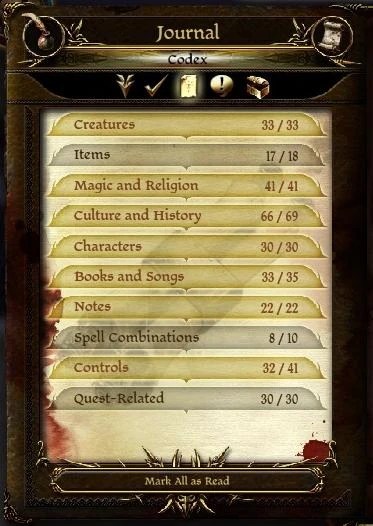
    Dragon Age Origins Codex

    Lore And Codex Entries

    One method of indirect storytelling in games involves finding bits of lore in the world. Examples include notes or voice recordings. Books, journals and emails on computers as well. This lore is not essential to the story, only giving background and additional details. This makes the world seem more real and adds interest to the game.

    It can be handled in different ways. For example, Dragon Age Origins has a codex where notes and books are recorded in your codex. You can read it at any time. This lore can lead you to secrets and side quests.

    In Fallout, you store notes in your Pip-Boy on paper or holotape. They point to unmarked side quests. In the Elder Scrolls games there are books you can find and read, and store in your player home.

    All of this expands on the history and details of the game world. It’s usually optional but for players like me who love exploring and learning everything about the lore, it’s a huge part of the appeal of these games.

    Side Quests

    I’ve mentioned side quests a few times. So, what are they? Side quests are extra quests that are not essential to progress the main story. They result in extra small stories, and reward the player with experience points, money or items. They can also improve your reputation in games that have some kind of reputation system, which can affect other parts of the story.

    For example, in Old World Blues in Fallout New Vegas, you can do a handful of simple side quests with the brains of the Think Tank. You can use your stats and skills to befriend all of the brains other than Dr Klein. You don’t have to, but if you do, it opens up the option of a peaceful resolution at the end of the main story. If the four of them are on side, you can talk Dr Klein down and avoid fighting them.

    There’s a common meta joke about video game protagonists being overly helpful. That every time you visit a new town, you go around and fix all the problems of the people in that town. A lot of RPG gamers are completionists who want to get everything that the game has to offer and will spend hours avoiding the main plot. Side quests and side stories improve immersion too, as the player is spending more time engaging with and learning about the game world.

    Thanks for reading. Next time we’re going to explore environmental storytelling and other ways games use indirect storytelling methods. Don’t forget to subscribe to get an update every time a post goes live!