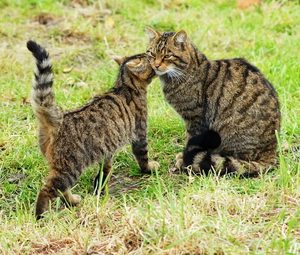
The cat-sìth (pronounced ‘cat-shee’) comes from Celtic mythology. It is the legendary spectral cat that haunts the Scottish Highlands. The cat-sìth resembles a large black cat with a white spot on its chest. When no-one is watching, it is capable of walking on its hindlimbs.
It is most common in Scottish folklore but it does feature in Irish folklore as well. They are attributed to the fairies. However, some stories speak of it as a witch that could transform into a cat nine times. This might be the source of the ‘cats have nine lives’ that most people have heard. After the ninth transformation, the witch would remain a cat for the rest of her days.

They might have been inspired directly by the Scottish Wildcat Felis silvestris. Wildcats are very similar to domestic cats but tend to be larger with bigger heads and thicker tails. They are typically brown tabby in appearance. However, melanistic specimens exist, like black jaguars.
There is also a hybrid species known as the Kellas cat. They are hybrids between wildcats and domestic cats Felis catus. Cross breeding with domestic cats is one of the reasons that wildcats have become endangered as bloodlines get diluted. There is a population of hybrids and they are larger than domestic cats. One was snared in 1984 and was found to be a hybrid. But tales of a cryptid large black cat still persist in the UK.

Beliefs About the Cat-sìth
Common belief around these creatures was that they would steal the souls of the recently deceased before they crossed over. They did this by walking over the person’s body. It was traditional for bodies to be kept in the home or a barn so people could pay their respects, until morgues were available.
To prevent the person’s soul being stolen, people would hold a vigil, the Late Wake. They would attempt to distract the cat-sith with music, dancing, games or even catnip. They would avoid a fire nearby as the heat would attract the cat-sith. Makes sense, cats will always be cats.
Samhain is a festival on the 1st of November to mark the end of harvest and the beginning of autumn. Celebrations begin on the 31st of October and it was believed that the boundary between this world and the other world blurred so contact with the fairies was more likely.
A common custom at this time was to leave a saucer of milk out for the cat-sìth and you would get good luck for the year. If you didn’t do this, the cat-sìth would dry up the milk of your cows. As with many of these myths, they can be good or bad, depending on how you deal with them. So be careful.
Leave a Reply