Can You See Me?
Camouflage is a big deal in the natural world. It’s employed by both predators and prey species for a variety of reasons. They employ many techniques to mask their presence to hide from other animals. So if you’ve ever wondered why zebras have stripes or how a chameleon can change colour, you’re in the right place. Let’s get into it!
Some Definitions
- Crypsis: the ability of an organism to avoid observation or detection.
- Disruptive colouration: a form of camouflage that works by breaking up the outlines with a strongly contrasting pattern. Military camouflage uses this.
- Countershading: where the colouration is darker on top and lighter on the underside, which counters the effect of light coming from above on a 3D object, making it harder to detect.
- Counterillumination: a related mechanism that uses illumination to match the brightness of a background, often employed by marine organisms like squid that have bioluminescence.
- Mimicry: some animals have evolved to look like other things in order to hide from prey or predators, especially common in insects.
Background Matching

Background matching is what it sounds like, animals that have colouration and patterns that match the background of their natural environment. So animals that live in the desert are coloured in sand, buff, ochre and brownish grey colours. Lions, gerbils, fennec foxes and desert reptiles like skinks or horned vipers are great examples.
Disruptive Colouration
This method uses strongly contrasting, non-repeating markings to break up the outline of the animal to help it blend in. This is the same principle behind military camouflage, which uses irregular patches of contrasting colours to hide their presence, matched to the environment they are in.
Leopards use it to hide from prey while many prey species use it to hide from predators. So let’s play a little game, shall we? The image below is a ptarmigan and its chicks that are hiding in plain sight. Can you count how many chicks are in this photograph? (I’ll put the answer at the end!)

They’re very well hidden, aren’t they? It is incredibly effective. These features evolve due to natural selection. Animals that can evade predators better as babies will have a better chance to survive and pass on those traits to their own offspring.
Counter Shading

This image demonstrates how countershading works. It’s a method that reduces the animal’s shadow and makes it look flatter. The light hitting a darker part will create the flat colour and we see this in gazelles, sharkes and dolphins among others. This is known as Thayer’s Law and he created the next image.
Thayer painted two model birds. The one the left is painted in the same colours as the background. The one on the right is there, I promise. You can make out an impression of the circular wire base to the right of the visible model, if you look closely. This model bird is counter shaded and makes it almost entirely invisible.


Animals use other measures to eliminate their shadows. Horned lizards can flatten their bodies and their sides thin to an edge to blend in and avoid creating shadows at all. The horned lizards are found in North America. Bearded dragons also have this capability and they come from Australia. It’s obviously an effective technique for two species that have evolved so far apart.
Crypsis
This is a catch-all term for organisms that have methods of avoiding detection from other animals, such as camouflage, nocturnal living, underground living and mimicry. Concealment involves visual, olfactory or auditory concealment, or a combination of them.

Richard Ling, CC BY-SA 2.0 https://creativecommons.org/licenses/by-sa/2.0, via Wikimedia Commons
Decorator crabs collect items from the local area and add them to their carapace (shell) in order to blend in.
Olfactory concealment involves hiding scents to avoid detection by prey or predators, or even trick other species. The large blue butterfly caterpillar can mimic ants to trick them into feeding the caterpillar. Puff adders make use of this type of crypsis as well.
The reason most mammals lick their new-borns clean and eat the placenta is to mask the scenes. The idea is to make it less obvious that there are new-born animals around. So if anyone tells you that they eat the placenta for nutrients, that’s not quite correct. It has nutrients in it, of course, but it’s not essential. Humans have no natural predators so you do not have to eat your own baby’s placenta, unless you really want to.
Mimicry

Can you see the mantis in this image? It is on top of the flowers closes to the camera. Stick insects, flower mantises like the orchid mantis, and even cuckoos employ mimicry.
Cuckoos lay their eggs in the nests of other, smaller bird species. The egg looks similar so it won’t be rejected by the nest owner. Then the chick hatches and kicks out the other babies from the nest, so only it survives and is fed by the parent. Cuckoos are the real deadbeats of nature.
Motion Dazzle
Most of the camouflage methods we’ve discussed are broken by movement. Bold, contrasting markings help them hide by making it difficult to estimate their speed and direction when they move. The stripy horses, zebras, use this. They are striking to see as an individual but with an entire herd huddled together, it’s incredibly difficult to pick out one prison pony from the crowd. You have to really focus your eyes, even when they are moving. Nature invented optical illusions first.
Colour Changing

Some animals can change colour. They have specialised chromatophore cells in their skin that can alter the wavelength of light they absorb, which creates the change in colour. This might be used to blend in to the environment, a trick octopuses use a lot.
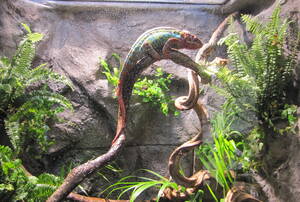
However, it can also be a form of signalling and communication. Meet nature’s mood ring: the chameleon. They usually change colour to show their mood. The change is very quick, before your eyes.
There are some mammals that change colour but it’s far slower and generally seasonal. Arctic animals are brown or grey in the summer but they turn white in winter, via a seasonal moult that responds to changing temperatures and daylengths. Arctic foxes, arctic hares and stoats are great examples.
Hiding
Many animals burrow or hide their nests in remote spots. Maybe even using objects around them to disguise it’s presence. They might be more active at night when it’s easier to hide. Or they can disguise themselves underwater to ambush prey like alligators and crocodiles do. That’s why they don’t tend to chase you, they lunge at prey as it stops next to the water. If they miss, they give up quickly and wait for the next possible lunch to come along.
Just to give ostriches some credit here. The whole ‘burying their head in the sand’ thing is not an indication that they’re so stupid they think they’re invisible when they do this. Yes, their brains are smaller than their eyeballs but they’re not that stupid. They dig in the sand to build their nests for their gigantic eggs.
Ostriches don’t need to hide. They can run up to 45mph/72kmph. Even better, they can sustain 30mph/48kmph for a long time. They are faster than lions and they are faster than Usain Bolt. Why hide when you can run faster than basically anything else? Except maybe cheetahs. So let’s stop laughing at ostriches because they don’t deserve it.
Aposematism – The Opposite of Camouflage
Now for something completely different. Aposematism is the opposite of camouflage. There are some creatures that want you to see them. They want you to know they are there. And they want you to leave them the heck alone!
Aposematism is defined by bold, bright colouration to serve as a warning. It means ‘I am dangerous. Go away. Get lost. I will destroy you.’ It is a warning you absolutely need to take seriously. In most cases.
The danger could be a number of things. They might be poisonous – you die if you eat them. They might be venomous – you die if they bite or sting you. Or they might taste bad. Or they might just be very aggressive and want to give you a fair warning in rainbow hues. It’s nature’s way of saying FAFO. You shouldn’t want to find out.
See wasps, poison dart frogs and nature’s own most fearless animal. The honey badger. Yes, really, this large mustelid will destroy you with prejudice. It is found across Africa, Southwest Asia and the Indian subcontinent. They are so feared that the people of Somalia believe one bite will make a man infertile! I’m sure the honey badger wants to make sure you know this is true, as well.

The colours involved are often yellow, red and black in high contrast patterns but there’s a whole rainbow of danger out there. Here’s one of my favourite examples, the blue-ringed octopus. One of the deadliest sea creatures out there. He’s just a little guy but do not touch! No matter how small and cute it is. Blue means death. Like an old PC.
I know the name’s not the most creative but it’s accurate and that makes it easily identifiable. Blue rings on an octopus means potential death. If in doubt, no matter how small, cute or colourful, just leave them be. Or call in an expert if there’s immediate danger.
Which Snake Is Safe?

Another example is the milk snake and the coral snake. These snake species can resemble each other very closely. One is venomous and the other isn’t. Coral snake venom is rarely deadly to humans but it’s still useful to learn the difference if you live where they live.
This is the milk snake. The yellow bands are surrounded by black bands, with the red ones in between them.
The next image is of a coral snake, and this is the venomous version. It also has red, yellow and black bands but the pattern is different. However, I would always advise caution if you cannot confidently identify a snake species and leave them alone. Snakes rarely attack unprovoked.

Copying the Aposematism
Some species have caught on to the aposematism and use it to their advantage. They mimic similar species that have aposematism to share in the ‘back off’ message even though they are actually harmless. The hoverfly mimics wasps to deceive potential predators and be left alone. This is what’s known as Batesian mimicry.
There is also Müllerian (note the u should have an umlaut) mimicry where harmful species have evolved to resemble each other. Many bee and wasp species do this and it is honest because both of them can sting. The yellow and black striping is common to many bee and wasp species. Batesian mimicry is deceptive, in contrast.
Evolution of Camouflage
It’s all pretty amazing stuff. Animals evolve in response to environmental pressures, in order to keep surviving. Many of these traits came about as random chance, mutations that were beneficial to survival. That allowed them to be genetically passed down and eventually shaped the species’ appearance or behaviour. Remember that evolution is a very slow process. It takes many, many generations to happen.
It’s faster in simpler organisms like bacteria, because their reproductive generation takes hours. They’re single cells, mitosis is fast. Bacterial growth is exponential, their numbers double at regular intervals, depending on the kind of bacteria but it’s a matter of minutes. If you get a swab done for bacteria, entire colonies can grow within 24 hours on a petri dish. A colony is millions of bacteria.
Larger organisms produce a new generation more slowly. In humans it’s around twenty years, give or take. So my grandmother is part of the Silent Generation (1928-1945ish), my parents are Boomers (1946-1964ish) and I’m an elder Millennial (1981-1996). That’s not a lot of generations for evolution to occur. It’s about 70 years for three generations to exist. But what will humanity look like in 10,000 years? Will we still have appendices (probably because it turns out they do have a function)? What about in 500,000 years? A million? We’ll not be around to see it, but maybe we can leave our mark on the world for future generations to learn from.
Answer to the Ptarmigan Chick Question
I didn’t forget, don’t worry. There are five chicks hidden in plain sight. Let me show you where they are. I have placed blue circles around the adult ptarmigan and the five chicks so you can see where they are. How many did you find?

Leave a Reply