Tag: storytelling

  • Creature Features: Snake Senses and Physiology

    Creature Features: Snake Senses and Physiology

    Snake Senses and Physiology

    Snake Eyes

    Close up view of a python's face showing an orange eye with a slit pupil and the labial pits
    Python Close Up showing eyes and labial pits
    Alias 0591 from the Netherlands, CC BY 2.0 https://creativecommons.org/licenses/by/2.0 , via Wikimedia Commons

    No, not when you roll a one on a dice. Actual snake eyes, on actual snakes. We’re talking about snake senses and physiology. Snakes generally have good vision, some of them have slitted pupils like cats. All snakes lack eyelids, instead they have a clear scale covering the eye called the spectacle.

    You can tell if a snake is due to shed its skin because the eyes go cloudy. Fluid is secreted under the old skin to lift it off to be shed, and this causes the cloudiness. Snakes are vulnerable during this process so they can be more aggressive than usual if disturbed as they are blind.

    Some snakes also have the ability to ‘see’ infrared to find prey in the dark. Pythons, boas and pit vipers have indentations on their upper lips called the ‘labial pits’ which sense infrared. The image shows the little holes along the top lip of the snake, these are the labial pits. Each group of species evolved these things separately, and they are also believed to play a role in temperature regulation as well as hunting. Like night-vision goggles essentially, isn’t that cool?

    Snake Tongue and Sense of Smell

    Snakes use their tongues to detect scents. So when you see their little forked tongue flicker out, that’s what they’re doing. Most people know this. The tongue collects airborne particles and feeds them to the ‘vomeronasal organ’ also known as the ‘Jacobson’s organ’ inside the mouth. This organ is present in most animals, but not humans and aids in scent detection, especially pheromones. So it’s important for detecting prey, predators and potential mates.

    Snake Skin

    Snake skin is highly specialised to protect their bodies and provide grip for their unique form of movement. Lacking legs means that snakes must move flat along the ground, so their scales help them grip the surfaces. Many species can make use of this to climb trees as well and even smoother surfaces to an extent.

    A colourful rainbow boa that is wrapped around tree branches showing the scales of a snake's skin.
    Rainbow Boa showing it’s beautiful scales
    Damien Farrell, CC BY 3.0 https://creativecommons.org/licenses/by/3.0 , via Wikimedia Commons

    Snakes are covered in scales – some are smoother, others are ‘keeled’, meaning they have a ridge down the centre. Their dorsal scales, the upper body scales, are usually loosely diamond-shaped and arranged in interlocking rows. Their ventral scales (belly scales) are usually singular and wide until the vent, after which they are paired until the end of the tail.

    Ecdysis means shedding of the skin. This is something all snakes go through as they grow. Younger snakes will shed more frequently than older snakes. The process takes a bit of time. The new scales grow underneath, and fluid lifts off the old scales.

    This is when the spectacle goes cloudy. The snake will not feed during this process, but usually will feed soon after. Normally the snake sheds its skin in one long piece. They rub their chin on something rough like a rock or tree, and slowly wiggle their way out of the skin.

    Rattlesnakes have a unique set of scales on the end of their tails. They build up from previous sheds and form a hardened collection of scales which makes a sound when shaken. They use this as a warning to predators, and it gives them the name.

    Reproduction

    Snakes reproduce sexually, with internal fertilisation. Most species lay a clutch of eggs, which are left to hatch and fend for themselves. Some species stay with the eggs and care for them until they hatch, like pythons.

    A few species are classed as ‘ovoviviparous’, which means they keep the eggs inside until they hatch and are ‘born’. So this is a kind of inbetween egg layers and live birthers, if you will. Rattlesnakes are an example of this.

    There are a couple of species that have true live births. The boa constrictor and green anaconda both have placentas as well as yolk sacs for their young and give birth to live snakes. They don’t produce eggs.

    A phenonemon called parthenogenesis is seen in a couple of snake species. Parthenogenesis is a form of asexual reproduction, where a female animal can produce fertile eggs without mating. Copperheads and Cottonmouths are capable of this, although they can also do it the old-fashioned way.

    Feeding Snakes

    Snakes are carnivores and eat animals, occasionally eggs but mostly smaller animals. They eat their prey whole and take a while to digest their meal. Some even eat other snakes in some cases. Snakes can’t bite off or chew their food, and are specialised towards this as discussed last week.

    Snakes tend to be ambush predators and will strike quickly to catch their prey. Venomous snakes bite and inject venom to kill their prey before eating it. Other snakes will use constriction – wrapping their bodies around the prey and squeezing it until it dies before they slowly swallow it.

    A cobra demonstrating it's hood which is used in aggression.
    Cobra showing it’s hood
    © Patrick JEAN / muséum d’histoire naturelle de Nantes, Attribution, via Wikimedia Commons

    They then go and rest to digest their prey. Ideally they would keep their body temperature around 30 °C (86 °F) and as they are ectothermic they will move to a location to keep their temperature around that level. It takes some time to digest but they can digest everything but hair, feathers and claws. These indigestible parts are excreted within the faeces of the snake. Snakes don’t eat often, depending on the species and size of the previous meal this can range from once a week to a couple of times a year! Younger snakes need to eat more frequently so they have energy for growth. In captivity it’s important not to overfeed snakes. But they can also go a long time without food as well, over a year in some cases.

    Thanks for reading!

    Thanks for reading this rundown of snake senses and physiology. Next week we’re going to talk about venomous snakes and the dangers snakes can pose to us. If you missed the first part, you can read about snake anatomy here. Don’t forget to subscribe to be updated when a new post is live and find me on my social media channels.

    Proudly powered by WordPress
  • Creature Features: Colour Strategies

    Creature Features: Colour Strategies

    Survival Strategies Using Colour

    A tarantula hawk wasp sitting on some plants and showing the brilliant colouration of some insects. It has a blue-green iridescent body with bright orange wings.
    Tarantula Hawk Wasp

    Animals use colour strategies in all kinds of ways to avoid being detected, eaten or to express themselves in some way. Some creatures can see colours we can’t, like infra-red and ultraviolet, which are not on the ‘visible spectrum’ of light. The visible spectrum is defined as what we can see as humans. For animals, and some people, the range of colours they can see vary from this ‘default’ setting. So let’s have a look at some of the ways animals can use colour.

    Camouflage Strategy

    The obvious, and best known reason animals have the colours and coat patterns they have is to blend in to their environment. Blending in is advantageous for both predator and prey species. This is why you see a lot of browns and greys in the colouration of many species. Colour strategies involving camouflage are a huge part of why animals look the way they do.

    An octopus on the sandy ocean floor.
    Octopus on the sea floor

    Of course some species can actually change their colouration to blend in. A lot of octopus and squid species are extremely skilled at this, as are chameleons but we’ll get into them a bit more later. They have specialised chromatophore cells that can change what wavelength of light the skin reflects, which changes the colour. Chromatophore cells are the cells containing pigment, such as melanocytes, the cells in human skin that contain melanin.

    Disruptive colouration uses contrasting markings that don’t repeat to break up the outline of an animal or hide features like their eyes to hide in their environment. This is employed by a lot of cats, the spots or stripes helping them blend in to get close to their prey without being spotted, as well as ambush predators and prey species.

    A flat-tailed horned lizard flattening its body to blend in with the ground.
    A flat-tailed horned lizard blocking its shadows

    Some species can stop themselves from producing shadows to hide. The horned lizards found in North America can flatten their bodies against the ground, the fringing along their sides disrupting the shadows and allowing them to blend in to the ground.

    Decorating themselves with material from the environment can help with blending in and hiding their body parts. Decorator crabs employ this, covering their body with sponges. The Ghillie suit used by military snipers uses this same principle.

    Underwater Camouflage

    white jellyfish digital wallpaper
    Jellyfish with a transparent body

    Transparency is another method, particularly seen in marine animals such as jellyfish. Their bodies are gelatinous with a similar refractive index to sea water so they are almost invisible. This is a trade-off as it means their mobility is poor. Another cool example are glass frogs, which are transparent around their main body, which helps them blend in to the environment around them.

    A lot of fish have reflective scales, called ‘silvering’ which uses guanine crystals to give a reflective surface. The marine hatchet fish is a notable example of this. For deep sea fish, ultra black colouration absorbs light and allows the animal to hide in the depths. This is used by anglerfish, which improves the effectiveness of their bioluminescent lure to attract prey into their ambush.

    Mimicing another object involves both colour and body shape. Either to hide or to lure prey into an ambush. A lot of insects mimic leaves or twigs to hide in the plants they live in. Some preying mantises make themselves look like flowers to attract insects.

    Danger! Warning! Aposematism Strategies

    Some animals have colouration that makes them stand out, instead of blending in. This is called aposematism, and the idea is that the animal is noticed and avoided by potential predators. Colour is used to warn that the animal is dangerous and not worth eating.

    The colours used are often the same, with combinations of red, yellow, black and white employed. We use these same colours for warning signs. Wet floor signs, stop signs, police tape!

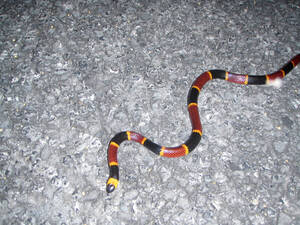
    A brightly coloured coral snake with red and black bands and yellow stripes to indicate it is dangerous.
    A coral snake showing it’s bright warning colours

    The colours can indicate a number of things, from tasting bad like the cinnabar moth, foul-smelling like skunks, aggressive like honey badgers, or venomous like the coral snake. Aposematism works because either predators have the instinct to avoid animals with these colours or they have learned the hard way to avoid them.

    Some species will mimic this kind of colouration to fool predators into avoiding them. Batesian mimicry is where an edible animal looks like a dangerous one such as hoverflies who resemble bees but have no sting. Müllerian mimicry means a number of species that resemble each other and are dangerous, so they’ve evolved in a similar way. This kind is common among bees and wasps, who are capable of stinging.

    Chameleons, Nature’s Mood Ring – Communication Strategies

    Anyone who grew up in the 80s or 90s will remember ‘mood rings’, the cheap rings with a gem that changed colour to indicate your mood. They weren’t exactly accurate but chameleons have this ability and it works really well.

    Panther Chameleon in Sapporo Maruyama Zoo, Japan

    While they do use their colour changing abilities to blend in, the main purpose for colour changing is to indicate their mood and feelings. The males are more flamboyant than the females but they can display a wide range of colours.

    Bright greens and yellows or blues usually indicate a happy chameleon. Black indicates anger, fear or distress. Reds and oranges can indicate excitement or readiness to mate. Again this is down to the presence of guanine crystals within the skin cells. Changing the distance between these nanocrystals shifts the wavelengths of light reflected and thus changes the colour of the skin.

    It’s such a cool ability, and it’s surprising how quickly the change happens. As a vet, I treated a few chameleons and they’re one of my favourite reptile species. The black colour means pain or anger, and it can be localised. If you give a chameleon an injection or if they have a wound, the skin around the area will turn black.

    Other reptiles have some capability for this colour change. Bearded dragons can turn their beard black and puff it out if they feel threatened. But none are more spectacular than the chameleon.

    Looking for Love?

    The most common reason for bright and flamboyant colours in animals is for selection of suitable mates. Most notably this happens with a lot of birds, you only need to look at the different kinds of bird-of-paradise and the peafowl. These colour strategies can make them more vulnerable to predators in exchange for sex appeal!

    photo of blue and green peacock demonstrating colour strategies to attract a mate
    A Handsome Peacock

    Peafowl have dramatic sexual dimorphism (where the male and female look different). Peacocks are brightly coloured with the distinctive massive fan tail, while peahens are brown and drab looking.

    You could spend hours looking at the different species of bird-of-paradise and see the fabulous fashion styles of the males compared to the females. They put on elaborate displays to impress the females enough to be allowed to mate with them.

    Another favourite of mine is the eclectus parrot. These birds have such dramatic sexual dimorphism that they were believed to be different species at one point. The males are bright green with red and blue highlights and an orange beak, while the females are red and purple with a black beak.

    Thanks for Reading!

    As you can see, the animal world uses colour strategies in so many ways. It’s a really interesting topic and worth considering if you are featuring creatures in your writing. Or designing your own. So have a think about the creatures environment, role in the ecosystem and diet before deciding which colours you should use.

  • Prey vs Predators: Creature Features

    Prey vs Predators: Creature Features

    Predators either ambush or chase prey
Predators have adaptations for catching prey such as strong teeth or claws
Predators will aim for injured, sick or young as they are easier to catch
Prey animals often live in large groups for safety
Prey animals will try to hide or flee if a predator is detected
Some animals are both prey and predator - like domestic cats!
Behaviour is always about ensuring survival

    Prey vs Predators

    I’m back with another creature feature for writers. Today we are looking at prey vs predators. I will discuss the difference between prey and predatory animals, and how this affects their behaviours and physiology. There’s a lot of interesting biology going on here, so let’s get into it.

    Predators

    Predators are defined by their feeding behaviour, where they kill and eat another organism. It is different from scavenging or carrion eating, meaning they eat animals that are already dead, although many predatory animals do this as well.

    There are two main types of strategy predators use to hunt their prey. Ambush predation means they lie in wait, often hidden or camouflaged and strike when the prey passes by their hiding place. Crocodiles are a great example of this, as they hide in the water, and catch animals as they stop to drink.

    The other method is pursuit predation, where the predator will stalk the prey and give chase. Sometimes this is solitary, other species work as a group such as we see with wolves and hyenas. Team work makes the dream work, at least if you want to take down larger prey animals!

    Predators are often opportunists, taking advantage of weakened or injured animals in a group of prey. Or seeking out younger animals that can’t spot them or evade them as quickly.

    Predatory species have a huge number of different adaptations to aid them in getting their prey. I’ll cover the details in a future article. They employ sharp teeth and/or claws, speed, strength and camouflage techniques to be able to hunt. Their senses are geared towards making hunting easier as well.

    Wild predatory species are used to not eating every single day and consume as much as possible at each meal to keep them going until their next catch. For this reason, many of these species are not fed every single day when kept in captivity such as zoo collections.

    Prey

    Prey species have two main aims in their lives. To avoid being eaten, and to reproduce enough to ensure their species continues. Prey species have a number of adaptations and tricks to keep themselves safe.

    Prey animals almost always live in large groups or herds, because there’s safety in numbers. A large group means more eyes, ears and noses on alert for nearby predators. It also helps if you can run faster than another member of your group.

    A lot of prey species will either hide when predators are active or flee. A lot of the larger animals like goats, deer, wildebeest, giraffes and other ungulates have speed on their side. Their offspring must be able to get up and walk within hours of birth, to ensure they can keep up with the herd.

    Smaller prey species will often hide underground in burrows or warrens, where their predators may not be able to reach them. Especially if they have young, as they are more vulnerable to predation.

    You may hear people touting the ‘benefits’ of eating the placenta after birth because animals do it. I’m afraid the reason for this isn’t because of any nutritional benefit. It’s because the mother wants to hide any evidence that there are newborn animals around, to protect them from predation. That’s why, so you really don’t need to eat your placenta if you don’t want to. I promise.

    Why Not Both?

    You might be surprised to learn that some animals are both prey and predator. I know, I know, Zootopia/Zootropolis made it clear it was one or the other. But plenty of animals are both, and this means there behaviour reflects this.

    Want an example? You might well have one or two of these fuzzy little chaos gremlins yourself. Yup, I’m talking about cats. I mean, all cats are cats, but specifically I mean small cats, including Felis domesticus. Cats prey on small rodents, birds, house spiders and hair ties. But larger predators can and will hunt cats, especially if you live somewhere where there are wolves, larger cats or really big snakes.

    Why does it matter? Because a lot of feline behaviour we find odd, is reflective of the dual role that cats play. If you ever wondered why your cat likes to sleep inside your sock drawer, or hide in that cardboard box… this is why. The reason a lot of cats bite if you rub their belly, is because they feel vulnerable.

    The cat-nap, or cats being light sleepers is another indication. They need to be able to be alert to flee or fight at any time, especially when they are vulnerable. This can be the reason for them burying their droppings in the litter tray too.

    Plenty of other species fit in to the ecosystem as both prey and predator. Seals are another example, as they eat fish but are also a common prey species for polar bears and orcas. Welcome to the real circle of life, it’s not as cute as Mufasa would have us believe. Nature is beautiful, but brutal.

    Why Does This Matter?

    A number of reasons. All animal behaviours are geared towards survival and reproduction. Survival meaning finding food, water and shelter. Reproduction obviously means mating, rearing offspring and the species continues to exist. Every aspect of their behaviour and physiology is designed to maximise these things.

    It can help in real life, if you have behaviour problems with a pet. But as a writer, it’s also quite important if you are going to include animals in your stories, whether real world ones or magical, mythical ones. If you are creating your own, you need to figure out where they fit in to the ecosystem of your world.

    Over the coming weeks I’ll discuss some of these strategies in more detail, with real world and possibly fictional examples of things that demonstrate these points. Even if you don’t believe in the Theory of Evolution (which is called that because there’s plenty of scientific evidence it is a thing, by the way), there’s no denying that each species has its role to play.

    I hope you find this useful when considering the creatures to include in your world. There will always be a prey vs predators scenario somewhere in the ecosystem so it’s worth considering how to include it. For more useful tips on creatures, check out my quick tips. Subscribe for more and check back regularly as the website will be updated monthly with new information for you. I also talk about this kind of thing on my YouTube channel, focusing on gaming.

  • Fallout: Episode Two Review – The Target

    Episode Two – The Wasteland Is Dangerous

    person holding short-coated black puppy

    Episode two opens on some tiny newborn puppies, which do look fairly realistic to me. I’ve seen my fair share of newborn puppies. I cringed when one gets put in the incinerator, then we see the sign stating all newborns weighing under 10 ounces must be incinerated. We get no explanation. So where in the wasteland are we? It’s an Enclave facility, although this isn’t stated outright.

    We see Dr Siggi Wilzig push the scales so it goes over the 10oz mark, then the puppy is branded CX404. Wilzig has clearly become fond of this particular dog. The door says “Behavioral Engineering,” which is something we know the Enclave do. There’s a glimpse of a gurney with a large green hand sticking out from under the sheet. Fallout gamers will know this is probably a supermutant.

    A montage of CX404 growing up shows she is a dogwith a mind of her own, rather like all the iterations of Dogmeat in the games. He keeps a space for the dog hidden in the broken wall. She clearly cares for Wilzig as she defends him readily.

    Wilzig injects something into his head, and it’s clearly painful. We have no idea what it is at this point in time.. Note the use of whiskey as an anaesthetic. When they discover he’s keeping CX404 hidden, he defects from the Enclave. I’m not sure where this is in the world because there is snow on the ground, so it can’t be that close to where our main characters are. 

    Vault-Tec Plan D for Death

    Lucy is exploring and she goes into a ruined house to find a family of skeletons seated around the dining table, including a little one in a high-chair. A reminder for the viewers, that millions of people died. She finds a bottle on the table, with a skull and crossbones on it, the international symbol of ‘poison’. The label says “Vault-Tec Plan D, Econo Savings Pack.”

    ‘The most humane product Vault-Tec ever created.’

    What is Plan D, you might wonder. Well, the D clearly stands for ‘Death’. They are cyanide pills and they are banana flavoured, apparently. Honestly, I’d hate banana to be the last thing I taste before I go out. This is an economy pack, so presumably plenty for the whole family. Places in the Vaults were insanely expensive. There were some exceptions to this. Most people paid huge amounts of money for the privilege of being experimented on.

    But this is Vault-Tecs solution for people who couldn’t afford a place in a Vault. Here’s a cheaper option, just kill yourself quickly and painlessly. It may not seem like it to those who haven’t played the games, but this is very on-brand for Vault-Tec.

    Giant Roaches…?

    When Lucy first meets Wilzig, he doubts she is willing to do what she must do to survive. This meeting at her camp gives us a lot of insight. Wilzig mentions the radroaches and how they have changed from the pre-War cockroaches, showing us how dangerous wildlife has become in this world. Wilzig urges Lucy to go home, and tells her she will need to adapt to life on the surface if she plans to stay up here.

    “Question is, will you still want the same things… when you have become a different animal altogether?”

    This quote really carries a lot of weight. It really highlights the story of pretty much every Fallout protagonist. Venturing into the wasteland changes a person, in so many ways. Those who cannot adapt will succumb to the dangers of the wasteland, and the wasteland does not care.

    Wasteland Wildlife

    We cut back to Maximus who is now on the Vertibird with Knight Titus. Maximus tries to make conversation with Titus, who replies by telling Max to clean his codpiece. This tells us a lot about the attitude of many members of the Brotherhood, and the hazing and bullying. It’s so disrespectful and shows a complete lack of care.

    Wilzig and CX404 are in a forest near what looks like a toxic waste dump site. He stops to rest, but becomes concerned when the dog brings a disembodied human hand to him. We hear a growl and then it cuts away. This episode teaches us about the dangers of the wasteland.

    The next scene is in the same location, but with Titus and Maximus, where they find evidence of Wilzig. Then they see all the bones and realise something is up. Titus sends Max to look further in, to ‘test his bravery’. We get a nice “it’s behind you” moment with what looks like a mangy bear. This is a Yao Guai. They are ghoulified and mutated black bears and can be very dangerous.

    I’d like to note that this bear shows real intelligence. It goes for Titus’ assault rifle first and destroys it. This tells me that this Yao Guai has fought with people before and probably won. It also highlights the animal’s intelligence. If they are ghoulified, it’s likely that the bear has been around for a long time, possibly since pre-War. It also seems to know how to use brute force to remove the power armor.

    A Real Turning Point

    Maximus manages to kill it, which is quite impressive that a 10mm can take one down with a couple of headshots. But this is an important turning point for Maximus. Titus is badly injured and is clearly bitter about how bad the wasteland is. He demands a stimpak, which is a healing item that isn’t really explained in this or in game. He throws out plenty of abusive language, telling Maximus the Brotherhood will hang him.

    Maximus points out that the Knights are supposed to make the world better, and that he believes Titus is not worthy of the power armor. Max makes a decision at this point, and sits down to watch Titus die. He could help Titus, but he chooses not to.

    There’s a Two-legged Animal…

    Max is trying out the power armor for the first time. The armor is basically a walking tank. It takes some getting used to, indeed in Fallout 3 and New Vegas you must be trained to use the power armor. Also the use of music is absolutely spot on. This scene has “It’s A Man” by Betty Hutton over it, and it’s perfect. The vast majority of songs used in the show are also in one of the games, and are perfectly thematic. The use of music in the show is absolutely perfect every time.

    Maximus collapses a wall and realises the extra strength the armor gives him. He intervenes in a fight between two men. We can see Max is enjoying this extra power. The man with the fedora is a bit odd, but we’ll get back to him later. The other man is scared but tells us the reason for the fight was the weird guy was doing things to his chickens. I don’t know if this was intentionally a reference to South Park. There’s an old episode from 1998 titled Chickenlover. Certainly that’s what came to my mind, and Fallout is full of easter eggs and cheeky nods to other pop culture.

    Filly – Wasteland Civilisation

    Lucy finds her way to Filly, and it’s her first look at wasteland “civilisation”. The market place is built from old vehicles and planes. We see people wearing some interesting outfits and selling things like ‘dog meat’ and roasted iguana on a stick. It looks like a proper Fallout town. It’s reminiscent of Megaton, Diamond City and even Junktown. It’s all cobbled together from what is there, rusty vehicles, old neon signs and other scrap.

    We see The Ghoul sitting in a chair, like he’s waiting for something. Inside ‘Ma’s Rarities’ Lucy learns what wastelanders really think about the Vault Dwellers. Again Lucy is urged to go back home to her vault. Keep the comment about “all ten fingers” in mind for later. Lucy is struggling to understand the attitude of the shop owner. She is clearly upset and disheartened by what she learned.

    Wilzig arrives in Filly with the dog, and surprises Lucy with how much he knows about her Vault. Ma June interrupts Lucy’s questioning. Then The Ghoul makes his move. Everyone is looking for this man that escaped the Enclave, there’s a bounty from six agencies. The Brotherhood are also looking for him.

    The fight begins, and it is more of the brutal and over the top violence we know and love. This scene serves to highlight how skilled The Ghoul is, and how conflicts work in the wasteland. Lucy’s intervention is hilarious, it clearly comes straight out of the Vault Dweller’s Survival Guide.

    Wasteland Medicine

    Luckily Maximus turns up just in time to intervene and save Lucy from being shot. He distracts The Ghoul and allows Ma June and Lucy to sort Wilzig out with a prosthetic leg. This is absolutely brutal, but this is wasteland medicine. Jim’s Limbs is a great pun though. It’s agreed that Lucy will help Wilzig get to Moldaver, after some debate. Ma June knows her way around the Pip Boy and gives Lucy the location.

    The scene where The Ghoul gives CX404 a stimpack and heals her is adorable. It shows a very different side to him, and this care for a dog will make more sense later. It’s a sweet little moment though, maybe he feels a little guilty for injuring her.

    Just My Head

    Lucy and Wilzig stop near what looks like a crashed satellite which is red and bears the hammer and sickle symbol. The initials CCCP suggest this could be a Chinese satellite, so presumably it came down after the bombs fell.

    It’s obvious Wilzig won’t survive. He tells Lucy to take only his head to Moldaver and reveals he’s taken one of Vault-Tec’s Plan D cyanide pills. Banana flavoured, apparently. So Lucy is set on her main quest, beginning with decapitating this man. He hands her a Ripper, which is basically a mini chainsaw. He took the cyanide so she could wait until he was dead.

    Wilzig reveals that he knows who Lucy is but he dies before she can get an explanation. Lucy is clearly disturbed and upset, but she braces herself and gets on with it. The Inkspots come in just in time, another classic Fallout song.

    Final Thoughts

    Episode two was great, it really set up the main plotline with everyone looking for Dr Wilzig. It’s also the first time our three main characters encounter each other. There’s some foreshadowing of things to come. There are important events for both Maximus and Lucy.  Lucy realises that she is naïve about the surface and will have to learn quickly to make it.

    Maximus makes the choice to let Knight Titus die, proving he is out for himself first and foremost. Also given the actor who plays Titus is known to be racist and misogynistic, it’s good to see the bear doing what’s right. I found that quite satisfying. As I mentioned, I like how the yao guai went straight for Titus’ gun, really highlighting the bears intelligence. They are called yao guai after a creature from Chinese mythology. Descendants of people held in Chinese internment camps gave them this name. I will be covering them in more detail in my Science of Fallout series on YouTube so look out for that. Otherwise, have fun exploring the wasteland.

  • How Games Tell Their Stories

    Cutscenes

    Games have many ways to tell you their stories. Most RPGs and narrative games open with a cutscene to introduce the inciting incident and give some background.

    Dragon Age Origins opens with the history of the darkspawn and the Blight. Fallout games open by telling us about the bombs and how people survived in the Vaults. Players need context, especially in the first game of a series.

    Some opening cutscenes are better than others, of course. If you don’t give the player enough information, it can be hard to get them to care about the main storyline. Equally, too much exposition can get boring and tedious. As much as I love Fallout New Vegas, I think the opening cutscenes give us too much information about the NCR and the Legion.

    We could learn this in the early game, to my mind. We meet NCR soldiers in Primm, and could easily get a bit of detail about the NCR from talking to them. When we reach Nipton and talk to Vulpes Inculta, we could get a brief rundown of who the Legion are. This would be more impactful, since we would just see a bunch of Roman cosplayers coming out of the town hall. But we were told about them before, so it’s less of a surprise.

    It was a bold choice for Benny to shoot you in the head at the beginning of the game. It’s unexpected, because it would be a very short game indeed if this was fatal. Skyrim does something similar with a dragon saving the protagonist from execution.

    Dialogue

    Like novels, movies and plays, dialogue is a huge part of storytelling in games. Pretty much every RPG that has ever existed requires you to find information by talking to every NPC you can find. A lot of this dialogue is for flavour, which improves immersion, but you will find secrets and important details through this method in most RPGs.

    An example from Fallout New Vegas is Rotface. He’s a ghoul you will find in Freeside, easily overlooked. However, if you pay him one bottlecap (the currency of Fallout) he will give you a random tip or some gossip. He has hints which aid the player in certain side quests. For example, the NCR send the player to assassinate a man called Pacer.

    Pacer is The King’s second in command, the gang who run Freeside, and is problematic for the NCR. Rotface will tell you that Pacer uses Jet but has a heart condition. Getting this tip allows you to spike Pacer’s Jet stash with another drug, Psycho, which will kill him. No-one will know who did the deed, it’s a proper sneaky way to assassinate someone.

    A lot of RPGs have the option to speak to important characters and ask questions. These dialogue trees can be very involved and you will learn a lot about the world and the characters. Dragon Age and Mass Effect are both great for this. The party camp or the Normandy is a place to regroup and you can go around and chat to your companions. You get to know them, their opinions on your choices and alter their disposition towards you. You can even initiate romance with some of them!

    Games Tell Their Stories

    These are the more direct ways games tell their stories. They are effective for the most part, but a balance needs to be found. If you don’t give enough information, the player will lose interest. However, it’s possible to overdo it and a massive exposition dump can turn the player off too.

    Next time we’ll talk about the less direct methods, such as collecting lore and environmental storytelling. What do you think about cutscenes in games? Do you have a favourite? Or is there one you dislike? Let me know in the comments!

  • Storytelling Without Words

    Storytelling Without Words

    Some games don’t use text or dialogue to tell you the story. Games can achieve storytelling without words. There’s a game called Virginia, which tells a story with no dialogue. It involves an FBI investigation in a small town in Virginia, and there is no spoken dialogue at all. You have to piece together what’s going on from locations, body language and actions. It’s a bizarre experience.

    Unpacking – Storytelling Without Words

    One of my favourites for this is a game called Unpacking. This is a game where each level is you unpacking moving boxes and putting everything away. It has literally no dialogue at all. You start with a child’s bedroom, and learn that the person likes to draw and paint, play soccer and collect plushies.

    You move through each stage of their life, from university to living in their first apartment with friends. Then they move in with their partner and there’s a sad moment where their degree certificate must be hidden away and you struggle to fit everything in alongside the stuff that is already there.

    Suddenly you’re moving back into your childhood bedroom. You also see more and more medications, mobility aids and other things that indicate chronic pain or illness. Finally you get your own place and settle in. Then someone moves in with you, and you can fit all their stuff beside yours easily. Then finally you both move into a larger house and set up a nursery for a baby.

    You literally learn about the people through their posessions, and the first relationship that fell apart was with a man, but the second relationship that went well was with another woman. Then you discover the nursery and unpack all the baby stuff, so you know they are bringing a child into their family. There’s sad moments when you realise the character has developed chronic health issues, and that they aren’t able to show off their achievements when they live with the man.

    Show, Not Tell

    It’s amazing how much you can learn about someone’s life just from the things they own. You see what is kept over the years, which shows you what matters most to them. I highly recommend Unpacking. It’s a lovely experience and it’s really amazing what you can learn about a story with no words to give it away. One of the common rules about storytelling is to ‘show, not tell.’  While I don’t believe this is an absolute rule, Unpacking shows that it is possible to tell a compelling story without using any words at all. Indeed this is the appeal for a lot of gamers. They want to explore and discover things for themselves instead of having everything spoon fed to them.

  • Visual Novels as Games

    By Team Salvato - https://satchely.deviantart.com/art/Doki-Doki-Literature-Club-701394578, Fair use, https://en.wikipedia.org/w/index.php?curid=55571864
    By Team Salvato – https://satchely.deviantart.com/art/Doki-Doki-Literature-Club-701394578, Fair use, https://en.wikipedia.org/w/index.php?curid=55571864

    Some games have little gameplay, such as the ‘walking simulators’ and visual novels which usually take the form of ‘dating simulators’. They are two different kinds of visual novels and are very popular. Let’s take a look at them in kind.

    The ‘walking simulators’ are games where you mainly spend your time walking around, exploring and solving some light puzzles to get the story bit by bit. They are particularly effective for horror experiences or at least unsettling experiences. They can set up for good twist endings or a properly scary experience.

    A game in this vein I really enjoyed is called Gone Home where a young woman returns to her family home and finds the place empty. She must explore the house and piece together what happened and where her family members are. It’s non linear, but you must find certain things to unlock new areas to explore. I won’t spoil the ending but it’s worth your time.

    Other games in this vein include Firewatch, What Remains of Edith Finch and the Stanley Parable (which is a humorous take on these kinds of games).

    Dating Simulators

    Dating simulators and visual novels usually are formatted as static artwork with an overlay where conversations happen and the player makes choices about what to say or who to spend time with. Not all of them are dating simulators. Games like Ace Attorney being an adventure centered around investigations and courtroom trials.

    These kinds of games are especially popular in Japan and many of them feature anime style artwork. They often have a few different endings, usually based on the choice of which character to date and form a relationship with. They range from the sweet and benign to the outright bizarre like Panzermadels. This is one where the girls you can date are actually tanks. Yeah. Really.

    Unsurprisingly there are a bunch of these which are firmly in the NSFW category. Which is fair enough if that’s what you’re into. Some of them include some other kind of game mechanics as well. They have branching story paths, again for the replayability value of the games. They range in quality as well, with some of them being really good and others less so.

    Horror Visual Novels

    They can be effective for a horror experience too. They do lend themselves well to that kind of atmosphere. One I came across randomly is called Cooking Companions. It is very strange and makes good use of sounds and visuals to give you goosebumps. It’s not the best story I’ve ever come across. That said, it definitely gets under your skin and is very uncomfortable at times.

    One of the best in this category, however, is Doki Doki Literature Club. This game doesn’t appear to be a horror experience at first. However, if you play through it, it will get under your skin. It’s a lot, and it does involve some very heavy subject matters. So heed the warnings if you chose to play it. If you like horror, you’ll enjoy it.

  • Storytelling In Gaming

    Storytelling In Gaming

    Let’s talk about storytelling in gaming. A lot of video games tell a story in some fashion. These stories can be extremely simple and linear, or they can be massively long and complex. One of the more important aspects of video game stories is that you, as the player, can ‘choose your own adventure.’

    Who remembers the ‘choose your own adventure’ books? Where you made a decision at the bottom of the page, and the book told you to turn to a specific page. Thus you got a different story every time based on making different choices. This is how most video game stories work too. It is something players value, especially in role-playing games and narrative focused action games.

    Why Story Matters

    Just like watching a movie or reading a novel, a compelling and engaging story makes a huge difference in games. After all, if you make a video game, presumably you want people to buy it and play it. So you need to keep players interested and engaged to keep them playing your game.

    People play video games for much the same reason as they enjoy reading fiction or watching movies and TV shows. They want an experience, an escape from their real lives for a while. The main difference is that gamers are actively involved, controlling the protagonist’s actions and making decisions.

    If a story is boring, or seems like nonsense, this breaks the immersion and the player loses interest. They may stop playing, and probably won’t buy the sequel. So it’s important that narrative driven games have a storyline that players want to follow. Of course, some games like Tetris don’t really need a complex plot.

    Mundane Simulation Games

    There has been a huge rise in simulation games in recent years. It’s fascinating that games where you repeatedly carry out a mundane task have become so popular. As an example, Power Wash Simulator, developed by FuturLab and published by Square Enix, has overwhelmingly positive reviews on Steam. Unsurprisingly, the point of the game is to power wash things and clean them.

    There is a story, a simple one but it’s enough to flesh out the game and make it feel interesting. You are opening a power-washing business and you start by cleaning your work van. You then get new jobs after each one you take on, and during the jobs you get text messages to add a little flavour. There’s an upgrade system, where you spend money you’ve earned on buying better power-washing equipment and clothing. So it sounds boring and mundane, you’re just power-washing things, but its very relaxing to play and satisfying to clean up all that dirt. Little bits of flavour text allow you to get to know the world of the game and keep it interesting. So it’s clear that you don’t always need a big complex storyline to keep players interested.

  • Environmental Storytelling in Games

    Environmental Storytelling

    Let’s talk about environmental storytelling. This is something unique to visual and interactive media formats. Stories are told by the placement of certain items in the world. There’s no dialogue or written notes telling you what happened.

    For example, in Concord in Fallout 4 you can hack your way into the vault of a bank. When you do, you find a huge hole in the external wall and a skeleton hanging out of it. If you jump out to the ground you find a car, another skeleton and a duffle bag full of ‘pre-war money.’ So, what happened? Clearly this bank was in the process of being robbed when the bombs fell, and the robbers died where they were.

    SOMA – Masterful Environmental Storytelling

    SOMA is a game that excels at environmental storytelling. It is a narrative horror experience that examines what it means to be human and what it means to be alive. The bare bones of the story are told through dialogue and cutscenes, but if you explore carefully, you can really get to know the people of Pathos II.

    I won’t spoil the ending of SOMA, you should play it if you haven’t already. However, in the first section of the game, you must turn on the power to find your way to Catherine. Exploring, you find lots of doodles and drawings and a sketchbook belonging to Amy Azarro. When you reach the shuttle train, you find Amy, kept alive by a strange machine.

    She says, “It won’t let me die. Nothing is allowed to die.” You need to disconnect her to power up the shuttle so you can leave. Depending on your choice here, Amy either ends up in a coma, or dead. So, you’ve killed a human for your own benefit. You care a lot more about this, if you’ve seen all of Amy’s drawings. Or if you listened to the recording, where she destroys one of the robots after it kills her colleague, Carl. You even find a video message from her husband on the surface, who is long dead at this point.

    Why Would You Care?

    Because you’ve got to know her. Without speaking to her, you’ve learned about her last few days and her previous life. You know she has a husband. Her friendship with Carl, and her fascination with the ocean life. She is a good artist and clearly enjoyed drawing in her free time. Yet you must end her existence in order to progress.

    Simon has his own emotional response to the situation, and a player who is rushing through probably won’t. SOMA isn’t about the ending, it’s about the journey. It wants you to slow down, explore and absorb the atmosphere. It gives you time to think about the issues it presents. The story is more complete when you take the time to listen and observe.

    What do you think about this kind of storytelling? Do you have a favourite example? Let me know in the comments.

  • Choose Your Own Adventure

    opened book

    Options: Choose Your Own Adventure

    Some narrative games have one single storyline for you to follow. Sometimes, these games are referred to as ‘walking simulators’, where you wander the game world and experience the story. Maybe there are some light puzzles to solve to find your way through. These types of game are good for experiencing a narrative, and can be very effective like SOMA. Other games are like the old ‘choose your own adventure’ books, allowing you options.

    RPGs however often have stories with branching paths, where the player makes decisions that send them down one of these paths and block off the other. This is what makes a game a roleplaying game, because you take the role of a character and make decisions based on what they would do. So you can choose to be a nice and kind person, or an evil person, or something in between. It means you can tell the story the way you want to. Many RPGs have multiple endings depending on the choices the player makes.

    Options Galore

    Having branching paths like this is good for games. The player can replay the game and make different choices, to experience all of the story points. For example, Fallout New Vegas has four endings, and each one has different consequences for the wasteland.

    Dragon Age Origins has essentially one ending with two possible outcomes for the player character. But it has six different origin stories, with one having two different perspectives dependent on gender. The prologue you play at the beginning depends on the choice of race and class. Each one is different narratively, as well as having unique events during the game related to the chosen origin.

    Many games with main and side quests have different options for resolving the quests. Usually a peaceful option, a violent option or a choice between who to save and who to let die. Some of them have unique options for certain skills or character aspects. This gives the player more agency and allows them to experience the story the way they want to. This is the unique thing video games bring to story telling, they don’t have to be told one way. I do like to reread my favourite books and rewatch movies and TV shows. But the story is the same every single time. It doesn’t change, unless you write fanfiction. With games, that’s not the case, I can play an RPG and have a different experience every time. That’s what I love about these types of games.