Tag: animals

  • Wild Wednesday: Camouflage

    Wild Wednesday: Camouflage

    Can You See Me?

    Camouflage is a big deal in the natural world. It’s employed by both predators and prey species for a variety of reasons. They employ many techniques to mask their presence to hide from other animals. So if you’ve ever wondered why zebras have stripes or how a chameleon can change colour, you’re in the right place. Let’s get into it!

    Some Definitions

    • Crypsis: the ability of an organism to avoid observation or detection.
    • Disruptive colouration: a form of camouflage that works by breaking up the outlines with a strongly contrasting pattern. Military camouflage uses this.
    • Countershading: where the colouration is darker on top and lighter on the underside, which counters the effect of light coming from above on a 3D object, making it harder to detect.
    • Counterillumination: a related mechanism that uses illumination to match the brightness of a background, often employed by marine organisms like squid that have bioluminescence.
    • Mimicry: some animals have evolved to look like other things in order to hide from prey or predators, especially common in insects.

    Background Matching

    Bjørn Christian Tørrissen, CC BY-SA 4.0 https://creativecommons.org/licenses/by-sa/4.0, via Wikimedia Commons

    Background matching is what it sounds like, animals that have colouration and patterns that match the background of their natural environment. So animals that live in the desert are coloured in sand, buff, ochre and brownish grey colours. Lions, gerbils, fennec foxes and desert reptiles like skinks or horned vipers are great examples.

    Disruptive Colouration

    This method uses strongly contrasting, non-repeating markings to break up the outline of the animal to help it blend in. This is the same principle behind military camouflage, which uses irregular patches of contrasting colours to hide their presence, matched to the environment they are in.

    Leopards use it to hide from prey while many prey species use it to hide from predators. So let’s play a little game, shall we? The image below is a ptarmigan and its chicks that are hiding in plain sight. Can you count how many chicks are in this photograph? (I’ll put the answer at the end!)

    Paxson Woelber, CC BY-SA 3.0 https://creativecommons.org/licenses/by-sa/3.0, via Wikimedia Commons

    They’re very well hidden, aren’t they? It is incredibly effective. These features evolve due to natural selection. Animals that can evade predators better as babies will have a better chance to survive and pass on those traits to their own offspring.

    Counter Shading

    Original: Ian AlexanderVector version: CheChe, CC BY-SA 4.0 https://creativecommons.org/licenses/by-sa/4.0, via Wikimedia Commons

    This image demonstrates how countershading works. It’s a method that reduces the animal’s shadow and makes it look flatter. The light hitting a darker part will create the flat colour and we see this in gazelles, sharkes and dolphins among others. This is known as Thayer’s Law and he created the next image.

    Thayer painted two model birds. The one the left is painted in the same colours as the background. The one on the right is there, I promise. You can make out an impression of the circular wire base to the right of the visible model, if you look closely. This model bird is counter shaded and makes it almost entirely invisible.

    An image of two model birds. The left is painted to match the background while the right one has countershading which makes it invisible.
    Abbot Thayer, Public domain, via Wikimedia Commons
    A horned lizard flattening its body to eliminate its shadow and blend into the sandy background.
    A horned lizard flattening itself – Public Domain

    Animals use other measures to eliminate their shadows. Horned lizards can flatten their bodies and their sides thin to an edge to blend in and avoid creating shadows at all. The horned lizards are found in North America. Bearded dragons also have this capability and they come from Australia. It’s obviously an effective technique for two species that have evolved so far apart.

    Crypsis

    This is a catch-all term for organisms that have methods of avoiding detection from other animals, such as camouflage, nocturnal living, underground living and mimicry. Concealment involves visual, olfactory or auditory concealment, or a combination of them.

    Decorator crabs grappling with each other, showing items they have attacked to their shells from the local environment.
    A pair of Sponge Decorator Crabs (Hyastenus elatus) grappling. Pipeline, Port Stephens, NSW
    Richard Ling, CC BY-SA 2.0 https://creativecommons.org/licenses/by-sa/2.0, via Wikimedia Commons

    Decorator crabs collect items from the local area and add them to their carapace (shell) in order to blend in.

    Olfactory concealment involves hiding scents to avoid detection by prey or predators, or even trick other species. The large blue butterfly caterpillar can mimic ants to trick them into feeding the caterpillar. Puff adders make use of this type of crypsis as well.

    The reason most mammals lick their new-borns clean and eat the placenta is to mask the scenes. The idea is to make it less obvious that there are new-born animals around. So if anyone tells you that they eat the placenta for nutrients, that’s not quite correct. It has nutrients in it, of course, but it’s not essential. Humans have no natural predators so you do not have to eat your own baby’s placenta, unless you really want to.

    Mimicry

    Philipp Psurek, CC BY-SA 3.0 DE https://creativecommons.org/licenses/by-sa/3.0/de/deed.en, via Wikimedia Commons

    Can you see the mantis in this image? It is on top of the flowers closes to the camera. Stick insects, flower mantises like the orchid mantis, and even cuckoos employ mimicry.

    Cuckoos lay their eggs in the nests of other, smaller bird species. The egg looks similar so it won’t be rejected by the nest owner. Then the chick hatches and kicks out the other babies from the nest, so only it survives and is fed by the parent. Cuckoos are the real deadbeats of nature.

    Motion Dazzle

    Most of the camouflage methods we’ve discussed are broken by movement. Bold, contrasting markings help them hide by making it difficult to estimate their speed and direction when they move. The stripy horses, zebras, use this. They are striking to see as an individual but with an entire herd huddled together, it’s incredibly difficult to pick out one prison pony from the crowd. You have to really focus your eyes, even when they are moving. Nature invented optical illusions first.

    Colour Changing

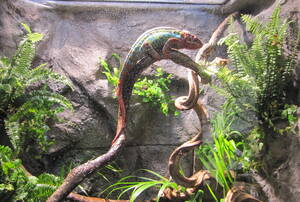
    A panther chameleon is perched on a branch in an enclosure full of rocks and ferns. The chameleon has green, yellow, blue and red colouring across his body.
    Panther Chameleon – Sapporo Maruyama Zoo (Public Domain)

    Some animals can change colour. They have specialised chromatophore cells in their skin that can alter the wavelength of light they absorb, which creates the change in colour. This might be used to blend in to the environment, a trick octopuses use a lot.

    However, it can also be a form of signalling and communication. Meet nature’s mood ring: the chameleon. They usually change colour to show their mood. The change is very quick, before your eyes.

    There are some mammals that change colour but it’s far slower and generally seasonal. Arctic animals are brown or grey in the summer but they turn white in winter, via a seasonal moult that responds to changing temperatures and daylengths. Arctic foxes, arctic hares and stoats are great examples.

    Hiding

    Many animals burrow or hide their nests in remote spots. Maybe even using objects around them to disguise it’s presence. They might be more active at night when it’s easier to hide. Or they can disguise themselves underwater to ambush prey like alligators and crocodiles do. That’s why they don’t tend to chase you, they lunge at prey as it stops next to the water. If they miss, they give up quickly and wait for the next possible lunch to come along.

    Just to give ostriches some credit here. The whole ‘burying their head in the sand’ thing is not an indication that they’re so stupid they think they’re invisible when they do this. Yes, their brains are smaller than their eyeballs but they’re not that stupid. They dig in the sand to build their nests for their gigantic eggs.

    Ostriches don’t need to hide. They can run up to 45mph/72kmph. Even better, they can sustain 30mph/48kmph for a long time. They are faster than lions and they are faster than Usain Bolt. Why hide when you can run faster than basically anything else? Except maybe cheetahs. So let’s stop laughing at ostriches because they don’t deserve it.

    Aposematism – The Opposite of Camouflage

    Now for something completely different. Aposematism is the opposite of camouflage. There are some creatures that want you to see them. They want you to know they are there. And they want you to leave them the heck alone!

    Aposematism is defined by bold, bright colouration to serve as a warning. It means ‘I am dangerous. Go away. Get lost. I will destroy you.’ It is a warning you absolutely need to take seriously. In most cases.

    The danger could be a number of things. They might be poisonous – you die if you eat them. They might be venomous – you die if they bite or sting you. Or they might taste bad. Or they might just be very aggressive and want to give you a fair warning in rainbow hues. It’s nature’s way of saying FAFO. You shouldn’t want to find out.

    See wasps, poison dart frogs and nature’s own most fearless animal. The honey badger. Yes, really, this large mustelid will destroy you with prejudice. It is found across Africa, Southwest Asia and the Indian subcontinent. They are so feared that the people of Somalia believe one bite will make a man infertile! I’m sure the honey badger wants to make sure you know this is true, as well.

    Mark Norman, CC BY 4.0 https://creativecommons.org/licenses/by/4.0, via Wikimedia Commons

    The colours involved are often yellow, red and black in high contrast patterns but there’s a whole rainbow of danger out there. Here’s one of my favourite examples, the blue-ringed octopus. One of the deadliest sea creatures out there. He’s just a little guy but do not touch! No matter how small and cute it is. Blue means death. Like an old PC.

    I know the name’s not the most creative but it’s accurate and that makes it easily identifiable. Blue rings on an octopus means potential death. If in doubt, no matter how small, cute or colourful, just leave them be. Or call in an expert if there’s immediate danger.

    Which Snake Is Safe?

    Image is of a snake on a white background. The snake has yellow bands with black bands on either side, with red in between throughout the full length of its body.
    A Milk Snake – The original uploader was Dawson at English Wikipedia., CC BY-SA 2.5 https://creativecommons.org/licenses/by-sa/2.5, via Wikimedia Commons

    Another example is the milk snake and the coral snake. These snake species can resemble each other very closely. One is venomous and the other isn’t. Coral snake venom is rarely deadly to humans but it’s still useful to learn the difference if you live where they live.

    This is the milk snake. The yellow bands are surrounded by black bands, with the red ones in between them.

    The next image is of a coral snake, and this is the venomous version. It also has red, yellow and black bands but the pattern is different. However, I would always advise caution if you cannot confidently identify a snake species and leave them alone. Snakes rarely attack unprovoked.

    A snake is lying on the ground. It has black stripes with yellow stripes on either side, and red in between. It has similar colouration to the harmless milk snake, but the pattern of stripes is different and this helps identify if it is a venomous snake or not.
    A Coral Snake – Public Domain

    Copying the Aposematism

    Some species have caught on to the aposematism and use it to their advantage. They mimic similar species that have aposematism to share in the ‘back off’ message even though they are actually harmless. The hoverfly mimics wasps to deceive potential predators and be left alone. This is what’s known as Batesian mimicry.

    There is also Müllerian (note the u should have an umlaut) mimicry where harmful species have evolved to resemble each other. Many bee and wasp species do this and it is honest because both of them can sting. The yellow and black striping is common to many bee and wasp species. Batesian mimicry is deceptive, in contrast.

    Evolution of Camouflage

    It’s all pretty amazing stuff. Animals evolve in response to environmental pressures, in order to keep surviving. Many of these traits came about as random chance, mutations that were beneficial to survival. That allowed them to be genetically passed down and eventually shaped the species’ appearance or behaviour. Remember that evolution is a very slow process. It takes many, many generations to happen.

    It’s faster in simpler organisms like bacteria, because their reproductive generation takes hours. They’re single cells, mitosis is fast. Bacterial growth is exponential, their numbers double at regular intervals, depending on the kind of bacteria but it’s a matter of minutes. If you get a swab done for bacteria, entire colonies can grow within 24 hours on a petri dish. A colony is millions of bacteria.

    Larger organisms produce a new generation more slowly. In humans it’s around twenty years, give or take. So my grandmother is part of the Silent Generation (1928-1945ish), my parents are Boomers (1946-1964ish) and I’m an elder Millennial (1981-1996). That’s not a lot of generations for evolution to occur. It’s about 70 years for three generations to exist. But what will humanity look like in 10,000 years? Will we still have appendices (probably because it turns out they do have a function)? What about in 500,000 years? A million? We’ll not be around to see it, but maybe we can leave our mark on the world for future generations to learn from.

    Answer to the Ptarmigan Chick Question

    I didn’t forget, don’t worry. There are five chicks hidden in plain sight. Let me show you where they are. I have placed blue circles around the adult ptarmigan and the five chicks so you can see where they are. How many did you find?

    The same image of a ptarmigan and its chicks blending into the ground and background of rocks and plants. The adult bird and the five chicks have been highlighted with blue circles.
    Paxson Woelber, CC BY-SA 3.0 https://creativecommons.org/licenses/by-sa/3.0, via Wikimedia Commons – Circles added to highlight where the chicks are in the image.

  • Wild Wednesday – Temperature Regulation in Animals

    Wild Wednesday – Temperature Regulation in Animals

    Too Hot, Too Cold or Just Right

    Just like Goldilocks and the Three Bears taught us, for life to exist things need to be just right. Temperature regulation in animals is essential. Bodily functions and physiological processes require specific temperatures to work properly. Too hot or too cold, and these functions will fail.

    Our planet is at the perfect distance from the sun to have temperatures capable of sustaining life. We have liquid water and an oxygen rich atmosphere which only exists because the temperature is perfect, more or less. There is a temperature gradient where it is hottest around the equator and coldest at the poles. Climate change is also creating a shift in the average temperatures.

    Living things function due to a whole range of biochemical reactions which need specific temperatures to be effective and efficient. The specific temperatures needed depend on species and the function in question. For example, many mammals have external testicles because sperm generation is more efficient at temperatures a couple of degrees below the normal body temperature.

    Ecosystem Adaptations

    The various ecosystems in the world are well adapted to their native environment. Species have evolved all kinds of ways to maintain their optimum temperature. That’s why a polar bear couldn’t survive in the Sahara Desert. Climate change is impacting this, as global temperatures rise. We have many species under threat of extinction, if not extinct already.

    For other species, the climate shift might be beneficial. A current example is two different species that live in the Atlantic Ocean. The Atlantic Horseshoe Crab is declining in number as the ocean warms. In contrast, Atlantic Blue Crabs are thriving and their numbers are actually increasing.

    So what does this mean? One of my goals with these articles is to help fellow writers understand various factors in the natural world. That way when you are including animals in your writing, whether they are real, mythological or original, they can fit into the right ecological niche. Let’s start with some definitions.

    Definitions

    • Thermoregulation: physiological or behavioural methods for regulating the body temperature.
    • Endotherm: organisms that can generate their own body heat through their metabolism – colloquially referred to as ‘warm-blooded.’
    • Ectotherm: organisms that rely on external heat sources to keep their body temperature where it should be and regulate it through behaviours – colloquially ‘cold-blooded.’ It can be used interchangeably with poikilotherm but there are distinctions. Ectotherms generally want to stay at a constant temperature and use the environment to maintain it.
    • Poikilothermic: this is another term used to describe ectothermic organisms. It comes from the Greek word poikilos which means ‘various’ or ‘spotted.’ There is some crossover with ectotherms but poikilotherms are species that seek to vary their temperature dependent on physiological needs. Most reptiles, amphibians and fish fit this category. Mammals that are poikilothermic include the naked mole-rat and sloths.
    • Hyperthermia: A physiological state where the body temperature is too high from external means like an abnormally high environmental temperature or failure of the body’s cooling mechanisms. Heat stress or heat stroke are clear examples. Hyperthermia is dangerous as many enzyme reactions fail above a certain temperature and it can result in damage, especially to the brain.
    • Hypothermia: the opposite, the body is too cold and eventually the normal physiology that attempts to maintain core temperature high enough will fail and this leads to physical damage. It is equally serious and potentially fatal.
    • Fever/Pyrexia: both words mean the same thing. Fever is different from hyperthermia. The body raises its temperature in response to an infection, which can hinder the infectious agents while boosting the function of the immune system. Fever is unpleasant but it doesn’t always need treatment.

    How Endotherms Regulate Their Temperatures

    The simplest answer is that endotherms generate heat via their metabolism to maintain their body temperature. It does come with an energy cost, but they are less vulnerable to external temperature changes.

    They employ mechanisms that help maintain the right temperature. In cold climates shivering and using up brown adipose tissue (brown fat.) Brown fat can be metabolised much faster than white fat. Many new-born mammals have this fat to keep them warm until they have dried off and had their first feed. For hot climates, things like sweating and panting can help keep the body cool. The circulation system can alter blood flow to lose or retain heat as well.

    Endotherms are less vulnerable to external temperature fluctuations such as the day and night cycle. Many deserts get very cold at night, despite being very hot in the daytime.

    The downside is having a higher metabolic rate and increased energy demands. This requires more food intake. Endotherms can’t last as long in periods of starvation, in general. Some endotherms will bask in the sun and rest a lot to reduce energy demand. This is why cats enjoy snoozing in sunny spots!

    Only birds and mammals are true endotherms but there are some species can become endothermic during their reproductive season. Some endotherms will enter temporary hypothermia, a controlled physiological state that can be part of the normal circadian rhythm.

    Hibernation

    Hibernation is a longer seasonal cycle, usually to survive over winter when food is less available. It involves lowered metabolic rate, low body temp, slowed breathing and heart rate. Some species will eat a lot of food before winter to store the energy as fat. Smaller animals will use food caching, hiding stores of food nearby. Some of them carry a pregnancy through their hibernation period, such as black bears. They give birth shortly before or after they wake up.

    The exact changes differ between species but hibernation is a way of surviving harsh winter weather and prevents a period of starvation. Especially since energy is required to maintain body temperature and if food is less available, it would be difficult to maintain the caloric intake required.

    Sloths

    Sloths are mammals that behave more like ectotherms. Their body temperature fluctuates according to their environment. This means they are capable of starving to death with a full stomach of food. If the temperature drops too low, they can’t digest their food and it can then rot and produce toxins. This can happen in reptiles too.

    Polar Species

    Image is a compilation of pinnipeds: a grey spotted seal at the top, middle row has a dark grey seal with its mouth open and a large brown seal. The bottom row has a walrus and another kind of seal.
    https://commons.wikimedia.org/wiki/File:Pinnipeds_vertical_version_montage.jpg
    From a variety of images credited above., CC0, via Wikimedia Commons

    Polar animals have specialised structures that help them maintain their temperature in cold conditions. Features like insulating fur, waterproof feathers or blubber under their skin help them stay warm.

    Penguins have specialised blood vessels that act as heat exchangers where the veins sit next to the arteries where the blood is warmer, so heat is exchanged to warm the blood returning to the heart.

    Hot Climates

    Animals that are native to hot climates have peripheral blood vessels that allow them to lose heat – elephants have these in their ears. It’s also why fennec foxes have such large ears compared to their body size. Panting is a common way of losing heat as well, especially in canine species. Some species like humans and horses sweat to lose heat with evaporation. Dogs are at risk of hyperthermia because they don’t really sweat, they only have sweat glands on their paw-pads so panting is their main way of losing heat.

    Ectotherm Temperature Regulation

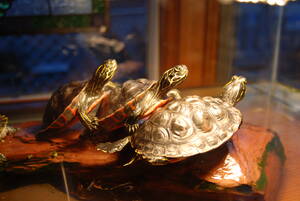
    Image shows three turtles on a rocky platform basking under a heat lamp in a glass enclosure.
    https://commons.wikimedia.org/wiki/File:Basking_turtles.JPG
    Oxlamb, Public domain, via Wikimedia Commons

    Ectothermic species don’t produce much internal heat from their metabolism and so they rely on the environment to keep their body at the right temperature. Reptiles, amphibians and fish are generally all ectotherms. Most insects are too.

    Most deep sea aquatic species are adapted for the temperature of where they live, such as in the abyss level of the ocean. Water temperature is stable and constant so they rarely need to do anything.

    Reptiles especially keep warm by basking in the sun to raise their temperature or seeking shade to cool down. They also employ reduced metabolism in the cold to maintain their body and minimise energy usage when food is more scarce. Most reptiles do have body fat stores, usually within the coelomic cavity (abdominal cavity in essence) or sometimes in extremities like the tail. Leopard geckos store a lot of fat in their tails, for example.

    Due to this, many ectothermic species are slower at night or early in the morning. They need to warm up before going about their day! They tend to be more active in the daytime although nocturnal species exist. Geckos are usually nocturnal and they wait for food to pass by rather than searching for it as this uses less energy.

    Ectotherms can last much longer without food because they are capable of slowing down their metabolism when it is cold. However, if they are unable to find a suitable basking spot and heat, they can starve to death even if food is plentiful. They need to warm themselves to digest and metabolise their food – kind of like the sloths we mentioned earlier. Sadly I have seen this happen in captive reptiles – such as a snake whose basking lamp and heating system broke down after it had been fed and the prey began to rot and made the snake sick. Very sad.

    This is the reason that reptiles are not found in the polar areas. Many that live in temperate regions will hibernate or ‘brumate’ over winter. Species that live in the equatorial areas like most of Africa, do not hibernate as there’s no need for it. It never gets cold enough.

    Antifreeze

    There are naturally occurring anti-freeze proteins. Yes, really. Some species of fish, amphibians and reptiles can freeze in the winter and wake up in the spring. They survive with the help of antifreeze proteins that prevent ice crystals forming in the body. These crystals would damage the organs and kill the animal without these proteins. Just like the radiator of a car!

    Some plants also have this capability. Many of the cabbage related vegetables can do this like kale, spinach, brussels sprouts. Hellebores, pansies, cornflowers, poppies and lavender produce antifreeze proteins.

    An image of the sacred lotus flower with leaves in the background.
    https://commons.wikimedia.org/wiki/File:Nelumbo_nucifera1romainguy.jpg
    Romain Guy from Lyon, France, CC BY-SA 2.0 https://creativecommons.org/licenses/by-sa/2.0, via Wikimedia Commons

    Interestingly the sacred lotus, an aquatic plant that grows in ponds and deltas, or in flood plains. It is the national flower of India and has the ability to regulate the temperature of its flowers just like an endothermic animal. This seems to be a way of attracting insect pollinators by promising a cosy environment, I suppose!

    Species have adaptations to suit their native environments and make sure they can survive the conditions they live in. This is why introducing non-native species can be difficult and detrimental to the local ecosystem. Animals that live in colder climates will struggle when it is hot, and vice versa. That’s why huskies love being outside in the snow and ice, while a greyhound will hate it and usually require a coat of some kind to go outside in winter. Just like us, we don’t have much body hair to insulate us, which is one reason we wear clothes.

    Hyperthermia

    This is defined as overheating, where body temperature is elevated above normal. It is due to a failure in thermoregulation or temperature extremes beyond what the body can cope with. This is not the same as a fever, or pyrexia, which we’ll get to.

    Hyperthermia is a medical emergency in both humans and animals as it can result in death and significant damage, particularly brain damage. Heat stroke where the body temperature is elevated from excessive heat exposure that overwhelms the body’s temperature regulation. Severe cases will result in blood pressure drops, confusion, dehydration and even seizures. Organ failure and death will result if not attended to.

    Heat stroke is very serious, especially in young or elderly people. Dogs are also very vulnerable to it, especially the brachycephalic (flat faced breeds) like bulldogs. They struggle to pant enough to cool down because of their restricted airways and I have seen dogs die from heat stroke, or suffer permanent damage from it. PSA – do not leave dogs, young children or animals in a hot car in summer. Exertion in hot weather is also a risk for both people and animals so avoid long walks, running about or doing anything strenuous when it is excessively hot.

    Hypothermia

    The opposite – remember your prefixes. Hyper- means too high, while hypo- means too low. Hypothermia occurs when the body temperature drops too low and the body cannot maintain internal heat generation to sustain it. It can be serious and risks death in some cases too.

    Mild cases will show confusion and shivering – this is muscle contractions to try and generate some heat. Once hypothermia progresses the shivering stops. Severe cases can result in hallucinations and a risk of death. People will often show paradoxical undressing in severe hypothermia. This is likely due to the blood flow. In cold temperatures, the peripheral vessels (arms and legs) contract to keep blood pressure and heat in the core of the body. They become exhausted and relax, allowing blood to flow and make the person feel warm, so they start stripping off. Which makes the whole thing worse. Very scary.

    Hypothermia can be caused by exposure to cold weather, especially cold water immersion like falling through the ice of a frozen lake. Being wet increases heat loss from the skin. There are other factors that can impact temperature regulation. Low body fat, old age and low blood sugar increase the risk of hypothermia. So does alcohol intoxication – it’s not uncommon in winter for people to present with hypothermia after a night out where they have overindulged. Alcohol can make you feel warmer and thus not notice the cold.

    It should be noted that the heart rate drops and respiratory rate also slows down. If you’ve watched Grey’s Anatomy, you will have heard the phrase: “They’re not dead until they’re warm and dead.” That is true, as even if there’s no detectable pulse, with aggressive rewarming and medical care, people can be revived. The same applies to some small animals where they can appear to be dead when cold but recover when warm – hamsters are notorious for this one! So you should always attempt to warm them up in case they can recover.

    Fever

    Finally, fevers are a different thing altogether. The body has it’s internal regulation system that keeps the temperature at a ‘set point’ in endothermic animals. The hypothalamus is responsible for this. In case of infection and an immune response, this set point is increased to raise the body temperature. Fever is thought to improve effectiveness of white blood cells and hinder the reproduction of pathogens like bacteria.

    It’s a common symptom of illnesses, particularly infections. This can range from the common cold, where recovery will happen in a few days, and sepsis which is much more serious and requires intensive intervention. It is important to distinguish a fever from hyperthermia, as hyperthermia is much more life threatening.

    Treating a fever may not always be necessary or recommended but there isn’t much evidence that treating the fever with antipyretics like paracetamol improves or affects outcomes in sepsis. Fever is uncomfortable and unpleasant to experience but it is rarely life threatening in itself, even if the cause is serious. Rarely young children can experience ‘febrile seizures’. Fever makes you miserable and can affect cognition. It is not the same as hyperthermia, though, and fevers do seem to be beneficial in aiding the body fighting off pathogens.

    Regarding animals, normal temperatures vary by species. So the threshold for a fever is different in dogs to chickens. Normal human body temperature is accepted to be around 37°C or 98.6°F. Fever would be above 38°C or 100.4°F. In dogs the normal temperature is between 38.3°C to 39.2°C or 101°F to 102.5°F. Fever is above 39.4°C or 103°F. In chickens normal temperature is 40.6°C to 41.7°C (105°F to 107°F). Anything above 43°C or 110°F is a fever in this species.

  • Rodents for Writers: Squirrels

    Rodents for Writers: Squirrels

    Rodents for writers: squirrels. The final part of the series on common rodents, to help writers better understand them. This time we’re covering the other major class of rodents, the squirrel family of rodents.

    This family includes tree squirrels, ground squirrels (chipmunks and prairie dogs) and flying squirrels. The focus of this article is the most common tree squirrels. The eastern gray squirrel (Sciurus carolinensis) and the Eurasian red squirrel (Sciurus vulgaris).

    Biology

    Squirrels eat tree bark, buds, flowers, berries, seeds, acorns, nuts, fungi and truffles as the main part of their diet. They will forage from garden crops like wheat, tomatoes, corn and strawberries and eat insects, frogs, small rodents, small birds and eggs, making them omnivores.

    In urban areas they will raid bins and trash cans and steal food from bird feeders in people’s gardens. They stash excess food away in the ground or inside trees for later. These stashes are known as ‘middens’, although they sometimes lose track of them.

    Since they are rodents, their incisors are open-rooted and grow continuously, while their molars do not. Squirrels have sharp claws to grip tree bark and climb, gray squirrels can even turn their hind feet in order to climb down a tree head first. Unlike most other climbing animals, who are incapable of doing this.

    Their long fluffy tails help them with balance and steering when climbing and running, as well as being adorable. Squirrels build nests in trees or take over abandoned bird nests, which they then line with moss, dry grass and feathers for warmth.

    Interestingly, in warm weather, squirrels exhibit a behaviour, they ‘sploot’ or lie flat on the ground with their limbs spread out. Apparently, this helps them lose heat.

    a grey squirrel splooting on a path, lying face down to keep itself cool
    FASTILY, CC BY-SA 4.0 https://creativecommons.org/licenses/by-sa/4.0, via Wikimedia Commons

    Invasive Species and Conservation

    Gray squirrels were introduced to the UK in the 1870s from North America. They quickly established themselves across England, Wales and southern Scotland. Unfortunately, they displaced the native red squirrels by taking over habitats, competing for food sources and transmitting squirrel pox. The squirrel pox virus is often fatal to the red squirrels, however, it doesn’t harm the gray squirrels.

    A red squirrel crouching at the base of a tree.
    hedera.baltica from Wrocław, Poland, CC BY-SA 2.0 https://creativecommons.org/licenses/by-sa/2.0, via Wikimedia Commons

    Because of this, conservation programs were implemented to protect the native red squirrels and the population has stabilised in Scotland and on the Isle of Wight.

    Culture, Mythology and Folklore

    In Norse mythology, a red squirrel plays an important role. Ratatoskr runs up and down the world-tree Yggdrasil, bringing messages between the hawk at the top of the tree and the dragon at the roots.

    Beatrix Potter’s children’s literature features many UK native wildlife species. Squirrel Nutkin the red squirrel features in her works. Denmark’s national mammal is the red squirrel.

    Thank you for reading, I hope you enjoyed this series. Stay tuned for next months themes, I’m excited to bring you more useful content in April. I’m also participating in a new writing challenge, ZAPWHAMPOW. For updates, follow my socials.

    Proudly powered by WordPress

  • Creature Features: Snakes Cultural Impact

    Creature Features: Snakes Cultural Impact

    Snake’s Cultural Impact

    Photograph of a cobra with its hood raised.
    © Patrick JEAN / muséum d’histoire naturelle de Nantes, Attribution, via Wikimedia Commons

    Let’s discuss the cultural impact of snakes. Snakes form an important part of many cultures in the world, both modern and historical. Ophidiophobia (phobia of snakes) is commonplace. Last week, we discussed the potential dangers certain snakes pose. The main risks include venomous bites and the largest constrictors. Non-venomous snakes are not a threat to humans.

    Snake Charming

    You will know this from various cartoons and movies. Snake charming is an Indian roadside show where the charmer plays a flute-like instrument and the snake responds to the music. Typically, the Indian cobra species.

    The snake is actually responding to the movement of the instrument, they lack external ears so they don’t hear in the conventional sense. Animal welfare laws prohibit snake charming.

    Snake Catchers

    The Irula tribe from India have been catching snakes for generations professionally. The snake skin industry was outlawed in 1972. The Irula tribe now catch the snakes to milk their venom. The venom is collected and used for producing antivenom, biomedical research and other medicinal products.

    There are modern day experts elsewhere in the world, who specialise in catching snakes both for study and to remove them from homes and property.

    Consumption

    Many people eat snakes, especially in Asia: China, Taiwan, Thailand, Indonesia, Vietnam and Cambodia. Snakes are believed to have health benefits and aphrodisiac properties. Snake wine, which is wine infused with whole snakes, is used in Chinese traditional medicine.

    Pets

    People keep snakes as pets, especially the more docile smaller snakes like the corn snake and the ball python. Snakes require specialist housing for optimum health but usually only need fed once every week or two. You need to seek expert veterinary care for snakes as well, not all vets are knowledgable or comfortable handling them.

    Symbolism and Mythology of Snakes

    Ancient Mesopotamia

    Nirah means ‘little snake’ in Sumerian. Nirah is a messenger god and may be lord of the underworld. Sumerian art features representations of two intertwined serpents. Ancient deities iconography in Assyria and Babylon feature snakes.

    Hopi Tribe of Arizon

    The Hopi Native American tribe celebrate snakes as a symbol of fertility. They release snakes into the fields to guarantee good crops. So they represent the umbilical cord joining all humans to mother Earth.

    Egypt

    Ancient Egyptian iconography commonly incorporates snakes. The Nile Cobra adorns the crown of the pharaoh. Snake iconography associated with Ra, Wadjet, Renenutet, Nehebkau and Meretseger.

    More sinister purposes for snakes exist in Ancient Egypt – using them to murder an adversary or to comit a ritual suicide. Cleopatra is famous for allowing an asp (Egyptian Cobra) to bite her, according to popular belief.

    Ouroboros

    Found in Ancient Egyptian iconography and Greek magical tradition, the symbol of a snake eating its own tail. Gnosticism, Hermeticism and alchemy adopted the ouroboros icon.

    The ouroboros represents the eternal cyclic renewal, or a cycle of life, death and rebirth. Snake’s shed their skin as they grow, hence this is representative of the transmigration of souls or immortality.

    The act of biting its own tail is a fertility symbol in some religions: the tail is a phallic symbol and the mouth is a yonic or womb-like symbol. So, the ouroborous represents sexual intercourse and reproduction.

    Ancient Greece: Medusa

    The legend of Medusa depicts a monster with snakes for hair that can turn those who look at her into stone. The hero Perseus slayed Medusa. She had two sisters, Stheno and Euryale who were both gorgons as well. Her image symbolises warding off evil.

    In Ovid’s Metamorphoses the tale of Medusa is a bit different by comparison. Medusa, a priestess of Athena and suffered sexual assault by Poseidon, the god of the sea. Athena turned her into a gorgon after this. Some say as punishment, others believe it was so she could protect herself. Because of this, Medusa is an important symbol for sexual assault survivors in the modern day.

     Asclepius

    The Greek god of healing, Asclepius, represented by a rod or staff with a serpent wrapped around it. The sick and injured went to Asclepius’ temples for healing and care. Hence, the staff of Asclepius became a symbol for medicine.

    Similarly, Hermes’ staff, Caduceus has wings and two serpents intertwined around it. With a V included in the symbol, it represents veterinary medicine. Hermes was messenger to the Olympian gods.

    India

    Indian traditions and deities feature snakes a lot. Shiva has a cobra around the neck. Vishnu is sometimes depicted as sleeping on a seven-headed snake or within the coils of a serpent.

    Temples dedicated to cobras called Nagraj are common. Snakes symbolise fertility and people celebrate them during the Hindu festival of Nag Panchami.

    China

    The Chinese Zodiac features snakes as one of the twelve celestial animals. 2025 is the year of the snake, hence my choice of topic for this month. Snakes associate with traits like intelligence and unscrupulousness. Ancient China related snakes to the river deities.

    Christianity and Judaism

    The Garden of Eden

    We can’t talk about snakes in culture and society without discussing this. In the book of Genesis, a serpent tempts Eve to eat the forbidden fruit from the Tree of Knowledge. God throws Adam and Eve out of the Garden as punishment and this confers the concept of ‘Original Sin’ on humanity. Whether you believe it or not, nobody can deny the importance of this story on shaping our society and culture. Genesis doesn’t name the serpent, but it is a common belief that the serpent is the Devil.

    Moses

    In the book of Exodus, Moses turns his staff into a snake as proof of God’s power. In the book of Kings, God instructed Moses to create the Nehushtan – a bronze snake on a pole that cured people of snake bites in the desert.

    Satan

    The final book in the New Testament, the book of Revelation contains the final mention of serpents in the Bible. There, serpents are symbolic of Satan, the fallen angel who tempts people towards sin. He plays a role in the apocalypse described by the book of Revelation.

    It’s clear that snakes represent evil and sin in Christianity. There is less of this in Judaism and Islam.

    Conclusion

    It’s clear that snakes play an important role in a lot of cultures. They can symbolise fertility, the cycle of life, rebirth, evil and temptation. People fear and revere snakes across the world. Often maligned and misunderstood, yet they have played an important role in shaping society as it is today.

    However, snakes also represent healing, recovery and caring for people and animals alike. I love snakes, they are fascinating creatures and get a bad rap. They have personalities, unique abilities and an important place in the ecosystem.

    I hope you enjoyed this summary of the snakes cultural impact and why they matter so much. They have a number of representations which you can use in your writing to symbolise different things. As always, if you have any thoughts or questions, I’d love to hear them.

    Proudly powered by WordPress

  • Creature Features: Snake Senses and Physiology

    Creature Features: Snake Senses and Physiology

    Snake Senses and Physiology

    Snake Eyes

    Close up view of a python's face showing an orange eye with a slit pupil and the labial pits
    Python Close Up showing eyes and labial pits
    Alias 0591 from the Netherlands, CC BY 2.0 https://creativecommons.org/licenses/by/2.0 , via Wikimedia Commons

    No, not when you roll a one on a dice. Actual snake eyes, on actual snakes. We’re talking about snake senses and physiology. Snakes generally have good vision, some of them have slitted pupils like cats. All snakes lack eyelids, instead they have a clear scale covering the eye called the spectacle.

    You can tell if a snake is due to shed its skin because the eyes go cloudy. Fluid is secreted under the old skin to lift it off to be shed, and this causes the cloudiness. Snakes are vulnerable during this process so they can be more aggressive than usual if disturbed as they are blind.

    Some snakes also have the ability to ‘see’ infrared to find prey in the dark. Pythons, boas and pit vipers have indentations on their upper lips called the ‘labial pits’ which sense infrared. The image shows the little holes along the top lip of the snake, these are the labial pits. Each group of species evolved these things separately, and they are also believed to play a role in temperature regulation as well as hunting. Like night-vision goggles essentially, isn’t that cool?

    Snake Tongue and Sense of Smell

    Snakes use their tongues to detect scents. So when you see their little forked tongue flicker out, that’s what they’re doing. Most people know this. The tongue collects airborne particles and feeds them to the ‘vomeronasal organ’ also known as the ‘Jacobson’s organ’ inside the mouth. This organ is present in most animals, but not humans and aids in scent detection, especially pheromones. So it’s important for detecting prey, predators and potential mates.

    Snake Skin

    Snake skin is highly specialised to protect their bodies and provide grip for their unique form of movement. Lacking legs means that snakes must move flat along the ground, so their scales help them grip the surfaces. Many species can make use of this to climb trees as well and even smoother surfaces to an extent.

    A colourful rainbow boa that is wrapped around tree branches showing the scales of a snake's skin.
    Rainbow Boa showing it’s beautiful scales
    Damien Farrell, CC BY 3.0 https://creativecommons.org/licenses/by/3.0 , via Wikimedia Commons

    Snakes are covered in scales – some are smoother, others are ‘keeled’, meaning they have a ridge down the centre. Their dorsal scales, the upper body scales, are usually loosely diamond-shaped and arranged in interlocking rows. Their ventral scales (belly scales) are usually singular and wide until the vent, after which they are paired until the end of the tail.

    Ecdysis means shedding of the skin. This is something all snakes go through as they grow. Younger snakes will shed more frequently than older snakes. The process takes a bit of time. The new scales grow underneath, and fluid lifts off the old scales.

    This is when the spectacle goes cloudy. The snake will not feed during this process, but usually will feed soon after. Normally the snake sheds its skin in one long piece. They rub their chin on something rough like a rock or tree, and slowly wiggle their way out of the skin.

    Rattlesnakes have a unique set of scales on the end of their tails. They build up from previous sheds and form a hardened collection of scales which makes a sound when shaken. They use this as a warning to predators, and it gives them the name.

    Reproduction

    Snakes reproduce sexually, with internal fertilisation. Most species lay a clutch of eggs, which are left to hatch and fend for themselves. Some species stay with the eggs and care for them until they hatch, like pythons.

    A few species are classed as ‘ovoviviparous’, which means they keep the eggs inside until they hatch and are ‘born’. So this is a kind of inbetween egg layers and live birthers, if you will. Rattlesnakes are an example of this.

    There are a couple of species that have true live births. The boa constrictor and green anaconda both have placentas as well as yolk sacs for their young and give birth to live snakes. They don’t produce eggs.

    A phenonemon called parthenogenesis is seen in a couple of snake species. Parthenogenesis is a form of asexual reproduction, where a female animal can produce fertile eggs without mating. Copperheads and Cottonmouths are capable of this, although they can also do it the old-fashioned way.

    Feeding Snakes

    Snakes are carnivores and eat animals, occasionally eggs but mostly smaller animals. They eat their prey whole and take a while to digest their meal. Some even eat other snakes in some cases. Snakes can’t bite off or chew their food, and are specialised towards this as discussed last week.

    Snakes tend to be ambush predators and will strike quickly to catch their prey. Venomous snakes bite and inject venom to kill their prey before eating it. Other snakes will use constriction – wrapping their bodies around the prey and squeezing it until it dies before they slowly swallow it.

    A cobra demonstrating it's hood which is used in aggression.
    Cobra showing it’s hood
    © Patrick JEAN / muséum d’histoire naturelle de Nantes, Attribution, via Wikimedia Commons

    They then go and rest to digest their prey. Ideally they would keep their body temperature around 30 °C (86 °F) and as they are ectothermic they will move to a location to keep their temperature around that level. It takes some time to digest but they can digest everything but hair, feathers and claws. These indigestible parts are excreted within the faeces of the snake. Snakes don’t eat often, depending on the species and size of the previous meal this can range from once a week to a couple of times a year! Younger snakes need to eat more frequently so they have energy for growth. In captivity it’s important not to overfeed snakes. But they can also go a long time without food as well, over a year in some cases.

    Thanks for reading!

    Thanks for reading this rundown of snake senses and physiology. Next week we’re going to talk about venomous snakes and the dangers snakes can pose to us. If you missed the first part, you can read about snake anatomy here. Don’t forget to subscribe to be updated when a new post is live and find me on my social media channels.

    Proudly powered by WordPress