Category: Writing Tips and Advice

Writing tips and advice

  • Understanding Medical Terminology – Prefixes

    Medical Terminology – Prefixes

    Welcome to part one of my new series for February, helping you in understanding medical terminology, prefixes, suffixes and the history of medical language. This will not be an exhaustive list of terms, as there are hundreds of them and it can be a lot to remember. That said, I want to make it easy to understand how and why medical terms are written and used the way they are.

    To start with, anyone who has studied medicine of any kind will inadvertently end up learning some Greek and Latin. Most of the medical terms we use are rooted in these languages. Hippocrates is considered the father of modern medicine, after all.

    Generally you will stick to all Greek or all Latin terms together. For fun, here’s a few terms you may have heard of and what they mean. I will clarify in parentheses whether a word is Greek, Latin or something else.

    • Laparotomy: incision into the abdominal cavity (Greek)
    • Enteropathy: disease of the intestines (Greek)
    • Nephritis: inflammation of the kidney (Greek)
    • Renal failure: kidney failure (Latin)
    • Jaundice: yellow discolouration due to excessive bilirubin in the blood (French!)

    So you can see that there are often two different terms for the one organ or body system. So let’s get into it, starting with some prefixes. Please note I use British English spellings throughout, so if you are familiar with US English, a few things might be spelt differently.

    Medical Prefixes

    These are used to describe something about the word root in question. Prefixes go at the beginning of the word or phrase, just like any other. Some of them may be more obvious than others, but others can get confusing.

    Hypo vs Hyper

    One that loads of people get mixed up is a pair of prefixes that have opposite meanings. ‘Hypo-‘ means deficient or abnormally low such as in ‘hypothermia’ meaning low body temperature. ‘Hyper-‘ means too much or above normal such as ‘hyperthermia’ or high body temperature. They can get confused because they sound similar when spoken aloud.

    Remember: ‘hypo’ means low. So you can have hypotension, low blood pressure or hypertension, high blood pressure. Hypothyroidism means an underactive thyroid (thyroid function is low) while hyperthyroidism means an overactive thyroid (thyroid function is high).

    It’s very important to know which one is happening with a patient, such as with blood glucose (blood sugar). Let’s break this down:

    ‘Hypo-‘ means too low. ‘-glyc-‘ means glucose. ‘-aemia’ means in the blood. So ‘hypoglycaemia’ means low blood sugar, so you’d treat that with a sugary drink or snack. Insulin reduces blood sugar so if you gave that, it would get worse! This could be fatal for the patient, hence the need for certainty.

    ‘Hyper-‘ means too high, so ‘hyperglycaemia’ means the blood sugar level is too high so it might need treatment with insulin to bring it down. Giving sugar won’t help the situation here. See how that works? These terms are Greek in origin.

    Another pair of opposing prefixes are a bit easier to tell apart. ‘Tachy-‘ means ‘too fast’ so tachycardia would be an abnormally fast heart rate. ‘Brady-‘ is the opposite of this and means ‘too slow’ so bradycardia would be an abnormally slow heart rate. These also come from Greek.

    It’s Not All In Your Head

    ‘Soma’ means ‘body’. So ‘somatic’ means relating to the body in some way and can be a prefix or suffix. You may have heard the term ‘psychosomatic’ but the meaning of this is often misunderstood. ‘Psycho-‘ means of the mind, and ‘somatic’ of the body. Some people take this to mean that the doctor thinks your physical symptoms are all in your head but that’s not correct.

    Again, these are Greek in origin and you might have played a game called SOMA which covers some important issues around the body and mind and the relationship between them.

    Some doctors dismiss patient’s symptoms as being imagined, or blame anxiety. But ‘psychosomatic’ actually means that mental health problems cause physical symptoms in your body. So they are quite real, but the source of the symptoms is a mental health issue.

    A clear example is a panic attack: a racing heart and hyperventilating (breathing excessively). These physical symptoms are caused by an anxiety disorder. They are quite real, but the cause is mental, not physical.

    Monster!

    Another one that is interesting is ‘terato-‘ meaning ‘monster’. What does that have to do with medicine? There’s a tumour called a ‘teratoma’ which literally means monstrous tumour. This is a growth that is made up of several types of tissue: often including hair, bones, teeth and muscle tissue.

    They originate from ‘germ cells’ which have the ability to differentiate into different types of cells so often the tumours develop in the gonads: ovaries and testes. They are bizarre looking things, for sure. Named because they often possess hair and teeth and thus look like some kind of bizarre monster.

    Medical Prefixes

    There are lots of prefixes, which are related to specific things like colour, position, organ and quantity which we will cover later this month. Next week we’ll be tackling the suffixes of medical terminology so you can start putting them together. I hope you’ll come back for that, and I hope you’ve found this useful for beginning to understand medical terminology. It’s a huge topic. I’m here to make it easier for you.

    Any questions or thoughts, let me know! I’m always happy to help and to chat about this topic in more detail. For more, check out my series ‘Creature Features’ covering some animal related topics, like the fight or flight response. For a video format of this article, see my new YouTube Channel here.

  • Fight-Or-Flight Response: Creature Features

    Creature Feature: Fight Or Flight Response

    Most people are aware of this process in some fashion. Fight-or-flight, or fight-flight-freeze-or-fawn comes from a phsyiological response to a perceived threat or attack. It involves a number of physiological responses within the body in response to danger. This enables the animal to fight or flee.

    It goes by other terms, as some animals do not respond by fighting or fleeing, but instead freeze, faint or fawn. So the more neutral terminology is “hyperarousal” or the “acute stress response” as the outcome varies among different species. So let’s take a look at the physiology behind it.

    Autonomic Nervous System

    The nervous system of animals has different components, and the one we’re interested in here is the autonomic nervous system. This system controls various bodily functions, usually unconsciously, in other words without you having to think about it. This includes things like the heart rate, digestion, respiratory rate, pupil dilation and other functions.

    The autonomic nervous system is divided into the sympathetic and parasympathetic nervous system. The parasympathetic nervous system is the calm part, reducing hert rate and stimulating the digestive system: known as the “rest and digest” response. The vagus nerve is an important part of this system.

    The sympathetic nervous system is the fight-or-flight part, and is stimulated by a perceived threat. It is activated by signals from the hypothalamus, in the brain, and a number of things happen. The heart rate increases, blood pressure and respiratory rate, improving blood flow to the muscles, heart and brain.

    This allows a higher output from the heart to give the body more energy, causing release of glucose (sugar) from the liver to meet increased energy demands. Breathing rate is increased to supply extra oxygen to the body. Even things like blood clotting are increased to help prevent loss if an injury is sustained. The pupils dilate to let in more light and improve vision. Trembling comes about from increased muscle tension to give speed and strength.

    Adrenaline Rush

    The sympathetic nervous system also causes the release of hormones known as catecholamines. These include adrenaline and noradrenaline. You may hear epinephrine or norepinephrine – these are alternative names for adrenaline and noradrenaline. That’s what is in an Epi-pen used to treat acute allergic reactions.

    This system is rapid,  but begins in the brain. The amygdala triggers the hypothalamus, which then activates the pituitary gland. This gland is responsible for controlling most of the hormones of the body, the endocrine system. The pituitary gland releases ACTH – adrenocroticotropic hormone, which acts on the adrenal cortex. So you can see where the name comes from.

    The adrenal cortex is part of the adrenal glands, a pair of small glands that are found just around the kidneys. The adrenal glands then release adrenaline and noradrenaline which acts upon many parts of the body to further promote the fight-or-flight responses. It increases blood flow to the muscles, boosts cardiac output and blood sugar levels.

    The adrenal glands also produce and release cortisol, a glucocorticoid hormone that has a number of effects designed to help the body cope with stress. Cortisol increases blood pressure, blood glucose levels and acts as an immune suppressant. This increases the amount of energy available to the body, especially the muscles.

    Hysterical Strength and Adrenaline Junkies

    For humans, the fight-or-flight response is highly effective when faced with a bear, an axe-murderer or a meeting with your boss. That’s the issue with this system. It works great for animals and certainly ensured our species continues to exist. It is a primal system, helpful for dealing with predators or actual threats to our lives.

    Indeed, there are situations where people have committed impossible feats due to the power of adrenaline and the sympathetic nervous system. ‘Hysterical strength’ is a display of extreme physical strength in life or death situations. There are many stories of people lifting cars and vehicles to safe people pinned underneath them.

    Of course, humans being humans, we can find joy and pleasure in all kinds of things. That includes adrenaline, and you have almost certainly heard of the term ‘adrenaline junkie’. Adrenaline can activate the brains reward system such as releasing dopamine. Dopamine is a neurotransmitter (chemical messenger) that makes us feel good and increases motivation.

    For a lot of people, they enjoy this kind of thing. Tame versions include enjoying rollercoasters, watching horror movies or playing scary games. Some people do more extreme things like risky sports and committing crimes to get a rush of adrenaline.

    Feeling Anxious?

    The dark side to this is anxiety and anxiety disorders. The fight-or-flight system is great for physical dangers like predatory animals, but it doesn’t discriminate between a tiger and a job interview. It’s normal to feel a bit worried about stuff like that, and a little bit of anxiety can help keep you focused. Things like interviews, exams, meeting a potential romantic partner for the first time.

    The problem is this system, when active for a long time, can become damaging to the body and mind. People with anxiety disorders are in fight-or-flight mode all the time, or a lot of the time. Panic attacks, stomach churning and gastrointestinal upsets, dizziness, heart palpitations (increased heart rate), changes to toilet needs and habits, sweating and restlessness, insomnia and feeling a sense of impending doom. It can be very scary, people experiencing a panic attack can worry they’re having a heart attack.

    Cortisol, the stress hormone can have an impact on mental health as it impacts emotional processing and cognitive functions. A lot of people in the ‘wellness’ industry seem to be blaming cortisol for everything. It is a hormone that can be problematic in excessive amounts, but as always I advise you take the advice of your own doctor. At least a qualified medical person, rather than some random people on the internet.

    Playing Possum

    All kinds of responses are seen in the animal world when the acute stress response comes into play. The way they react will depend on the species, the threat, the environment and other factors.

    A lot of small prey species will try to run if they have the opportunity to do so but will fight if they have no escape route available to them. Some animals will freeze to avoid being spotted: rabbits are known for this, as are deer. The classic ‘deer in the headlights’ cliché comes from this.

    Tonic immobility is another strategy. Rabbits will do this when put on their backs, and they will lie perfectly still and appear dead. Do not do this to a pet rabbit, as an owner or as a veterinary professional. This is very stressful for the rabbit and they will still feel pain and fear in this position.

    ‘Playing possum’ or playing dead is the same thing. The Virginia opossum being the most famous example of this, but many other species do this including snakes, frogs, birds and insects. Usually this strategy is to avoid predators but some species do seem to use it to attract prey or as part of mating behaviours.

    An opossum curled up on the ground with its mouth open, playing dead.
    Playing Dead : Tony Alter, CC BY 2.0 https://creativecommons.org/licenses/by/2.0, via Wikimedia Commons

    As discussed before, changing colour is a strategy used to hide or evade predators and thus can be affected by the fight-or-flight response. It’s a complicated system but almost all animals have some form of it. Almost all bodily functions are part of the ‘survival of the species’ needs: living and reproducing.

    Physiology of Fear

    I know physiology can be a complex topic to get your head around. The body has so many systems, checks and balances and hormones. So many hormones! Physiology was one of the hardest subjects I studied at university, and one of the toughest exams I’ve ever taken. Except for pharmacology which is physiology times ten.

    Hopefully this helps explain it all a bit easier for you. When considering different animals and their behaviours, knowing the how and why can be useful. When an animal is likely to flee, or try to fight. What animals will freeze or play dead. Even things like tail autotomy – where animals drop an appendage like their tail to distract a predator. This is seen in several lizard species, salamanders and tuataras. It is very weird to see a disembodied tail keep moving for a while: common pets such as iguanas and leopard geckos can do this.

    If you are creating your own creatures, then it’s worth thinking about how they would respond to danger. Are they aggressive and likely to fight, or will they flee and try to hide? For creatures that already exist, either in real life or in accepted cryptozoology themes, remember that unusual behaviour could break the suspension of disbelief.

    Thanks for reading. Next month, we’ll be discussing some medical terminology and grammar of plurals, so if you want to see more, you can subscribe below. Follow me on my social media channels for more content and behind the scenes stuff.

  • Creature Features: Colour Strategies

    Creature Features: Colour Strategies

    Survival Strategies Using Colour

    A tarantula hawk wasp sitting on some plants and showing the brilliant colouration of some insects. It has a blue-green iridescent body with bright orange wings.
    Tarantula Hawk Wasp

    Animals use colour strategies in all kinds of ways to avoid being detected, eaten or to express themselves in some way. Some creatures can see colours we can’t, like infra-red and ultraviolet, which are not on the ‘visible spectrum’ of light. The visible spectrum is defined as what we can see as humans. For animals, and some people, the range of colours they can see vary from this ‘default’ setting. So let’s have a look at some of the ways animals can use colour.

    Camouflage Strategy

    The obvious, and best known reason animals have the colours and coat patterns they have is to blend in to their environment. Blending in is advantageous for both predator and prey species. This is why you see a lot of browns and greys in the colouration of many species. Colour strategies involving camouflage are a huge part of why animals look the way they do.

    An octopus on the sandy ocean floor.
    Octopus on the sea floor

    Of course some species can actually change their colouration to blend in. A lot of octopus and squid species are extremely skilled at this, as are chameleons but we’ll get into them a bit more later. They have specialised chromatophore cells that can change what wavelength of light the skin reflects, which changes the colour. Chromatophore cells are the cells containing pigment, such as melanocytes, the cells in human skin that contain melanin.

    Disruptive colouration uses contrasting markings that don’t repeat to break up the outline of an animal or hide features like their eyes to hide in their environment. This is employed by a lot of cats, the spots or stripes helping them blend in to get close to their prey without being spotted, as well as ambush predators and prey species.

    A flat-tailed horned lizard flattening its body to blend in with the ground.
    A flat-tailed horned lizard blocking its shadows

    Some species can stop themselves from producing shadows to hide. The horned lizards found in North America can flatten their bodies against the ground, the fringing along their sides disrupting the shadows and allowing them to blend in to the ground.

    Decorating themselves with material from the environment can help with blending in and hiding their body parts. Decorator crabs employ this, covering their body with sponges. The Ghillie suit used by military snipers uses this same principle.

    Underwater Camouflage

    white jellyfish digital wallpaper
    Jellyfish with a transparent body

    Transparency is another method, particularly seen in marine animals such as jellyfish. Their bodies are gelatinous with a similar refractive index to sea water so they are almost invisible. This is a trade-off as it means their mobility is poor. Another cool example are glass frogs, which are transparent around their main body, which helps them blend in to the environment around them.

    A lot of fish have reflective scales, called ‘silvering’ which uses guanine crystals to give a reflective surface. The marine hatchet fish is a notable example of this. For deep sea fish, ultra black colouration absorbs light and allows the animal to hide in the depths. This is used by anglerfish, which improves the effectiveness of their bioluminescent lure to attract prey into their ambush.

    Mimicing another object involves both colour and body shape. Either to hide or to lure prey into an ambush. A lot of insects mimic leaves or twigs to hide in the plants they live in. Some preying mantises make themselves look like flowers to attract insects.

    Danger! Warning! Aposematism Strategies

    Some animals have colouration that makes them stand out, instead of blending in. This is called aposematism, and the idea is that the animal is noticed and avoided by potential predators. Colour is used to warn that the animal is dangerous and not worth eating.

    The colours used are often the same, with combinations of red, yellow, black and white employed. We use these same colours for warning signs. Wet floor signs, stop signs, police tape!

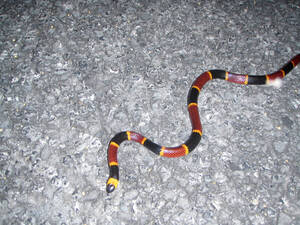
    A brightly coloured coral snake with red and black bands and yellow stripes to indicate it is dangerous.
    A coral snake showing it’s bright warning colours

    The colours can indicate a number of things, from tasting bad like the cinnabar moth, foul-smelling like skunks, aggressive like honey badgers, or venomous like the coral snake. Aposematism works because either predators have the instinct to avoid animals with these colours or they have learned the hard way to avoid them.

    Some species will mimic this kind of colouration to fool predators into avoiding them. Batesian mimicry is where an edible animal looks like a dangerous one such as hoverflies who resemble bees but have no sting. Müllerian mimicry means a number of species that resemble each other and are dangerous, so they’ve evolved in a similar way. This kind is common among bees and wasps, who are capable of stinging.

    Chameleons, Nature’s Mood Ring – Communication Strategies

    Anyone who grew up in the 80s or 90s will remember ‘mood rings’, the cheap rings with a gem that changed colour to indicate your mood. They weren’t exactly accurate but chameleons have this ability and it works really well.

    Panther Chameleon in Sapporo Maruyama Zoo, Japan

    While they do use their colour changing abilities to blend in, the main purpose for colour changing is to indicate their mood and feelings. The males are more flamboyant than the females but they can display a wide range of colours.

    Bright greens and yellows or blues usually indicate a happy chameleon. Black indicates anger, fear or distress. Reds and oranges can indicate excitement or readiness to mate. Again this is down to the presence of guanine crystals within the skin cells. Changing the distance between these nanocrystals shifts the wavelengths of light reflected and thus changes the colour of the skin.

    It’s such a cool ability, and it’s surprising how quickly the change happens. As a vet, I treated a few chameleons and they’re one of my favourite reptile species. The black colour means pain or anger, and it can be localised. If you give a chameleon an injection or if they have a wound, the skin around the area will turn black.

    Other reptiles have some capability for this colour change. Bearded dragons can turn their beard black and puff it out if they feel threatened. But none are more spectacular than the chameleon.

    Looking for Love?

    The most common reason for bright and flamboyant colours in animals is for selection of suitable mates. Most notably this happens with a lot of birds, you only need to look at the different kinds of bird-of-paradise and the peafowl. These colour strategies can make them more vulnerable to predators in exchange for sex appeal!

    photo of blue and green peacock demonstrating colour strategies to attract a mate
    A Handsome Peacock

    Peafowl have dramatic sexual dimorphism (where the male and female look different). Peacocks are brightly coloured with the distinctive massive fan tail, while peahens are brown and drab looking.

    You could spend hours looking at the different species of bird-of-paradise and see the fabulous fashion styles of the males compared to the females. They put on elaborate displays to impress the females enough to be allowed to mate with them.

    Another favourite of mine is the eclectus parrot. These birds have such dramatic sexual dimorphism that they were believed to be different species at one point. The males are bright green with red and blue highlights and an orange beak, while the females are red and purple with a black beak.

    Thanks for Reading!

    As you can see, the animal world uses colour strategies in so many ways. It’s a really interesting topic and worth considering if you are featuring creatures in your writing. Or designing your own. So have a think about the creatures environment, role in the ecosystem and diet before deciding which colours you should use.

  • Reproduction Strategies: Creature Features

    Reproduction Strategies: Creature Features

    Image contains the text "Creature Features: Reproduction Strategies" and is a blue background with decorative leaves. It features a photograph of two baby rabbits and some daisies.

    Reproduction Strategies

    So, we discussed last time the difference between prey and predator, and how this impacts animal behaviour and physiology. Different species employ different strategies to ensure their species survives, and nowhere is that more apparent than in reproduction.

    I know in school, lots of people spent this part of biology making crude jokes and stuff, but it really is a wildly interesting subject. No other system of living things is more varied than reproductive systems. Essentially every species has a different system. So let’s have a look at some examples.

    Good at Multiplying – Rabbit Reproduction Strategy

    A joke in Zootopia that probably went over most kids heads, but it’s well known that rabbits are good at making more rabbits. Does, female rabbits, reach sexual maturity between 3 and 8 months of age and can concieve at any time of the year for the rest of her life.

    They are induced ovulators, meaning that the mating process causes the ovaries to release eggs. The gestation period is short, around a month. The young are born blind and helpless, and are kept in the nest underground, only feeding once or twice a day. She leaves them to feed.

    The doe can get pregnant again the next day after giving birth. In theory, they can have 12-13 litters per year. With the young reaching maturity in a few months, it’s no wonder that left unchecked, rabbits reproduce exponentially. Just ask Australia!

    I’m not joking, either. Rabbits were introduced to Australia and New Zealand by European settlers, and having no natural predators, they multiplied and are considered a huge pest due to damage done to crops. Infectious diseases were deliberately introduced to try to control their numbers.

    So that’s one strategy – overwhelming numbers means that odds are, at least a few offspring will live long enough to reproduce. Even if there’s a high rate of mortality from predation and disease. It only takes a couple of buns to make more. So high reproduction rates ensure the species continue to exist.

    Safety In Numbers – Herd Reproduction Strategy

    Another common strategy is staying within the herd or flock. It’s rare to find prey species that live solitary lives. Most ruminants like deer, giraffes, cattle, goats and sheep will live in a large group or herd. This has a number of benefits for their offspring.

    Firstly, more eyes and ears mean it is harder for predators to go unnoticed and sneak up on the group. If all the adult animals are keeping an eye out, the offspring will be safer. Young animals can stay near the group and will be harder to isolate.

    These kinds of animals have young that are precocious, meaning they are quite mature at birth. Capable of standing, walking and running within hours of being born. They are born with their eyes and ears open. They are capable of keeping up with the adult animals of the herd if something happens.

    Embryonic Diapause

    You ever wish you could hit the pause button on life? Well, some animals can do that for developing embryos. Embryonic diapause means the mother can halt cell division in the blastocyst (a very early embryo) and delay implantation into the uterus wall.

    Why would they want to do this? Often it is to ensure the offspring are born at the best time of year for factors like availability of food and temperatures. This gives the offspring the best possible chance of survival. Some species always have a period of diapause but for others it happens in response to day length and controlled by melatonin production in the pineal gland.

    Species that have been observed to employ this strategy include marsupials such as kangaroos, bears, rodents and mustelids (weasels, skunks and badgers.) It is very common among insects, fish and other non-mammalian vertebrates.

    Essentially the mother can pause the pregnancy or development of the embryo until it suits her better. Not something humans can really do but it is a good strategy for ensuring survival of the offspring.

    Nests and Burrows

    A common strategy in smaller prey species, hiding the offspring away in burrows or nests puts them out of reach of predators. The nest may be well hidden or defended by adult animals.

    A lot of reptiles will bury their eggs. Sea turtles are a famous example of this. They go onto the beach, lay their eggs and bury them in the sand to keep them safe until they hatch. Once they hatch, the young ones must make the trek from nest to the water safely. This period of travel makes them vulnerable to predation of course, but they employ the overwhelming numbers strategy too.

    watercolor seascape background with a photograph of a baby sea turtle on a sandy beach

    Hiding evidence of newborn animals is another essential part of this. Contrary to popular belief, eating the placenta is a behaviour that has nothing to do with extra nutrition for milk production. Basically all animals that have a placenta do this, even herbivores.

    So why? To hide the evidence of a newborn animal. That’s it. Simple as that. Giving birth is a messy business, there’s blood and amniotic fluid and stuff and it gets everywhere. Licking off the newborn and eating the placenta helps remove the scents and hide it.

    Different Reproduction Strategies

    So we can see there’s a few different ways that animals will endeavour to protect their young and ensure their survival. Direct parenting varies by species but it really depends on the environment and the predators in question.

    Many prey species employ a few of these strategies. It’s really interesting to compare the differences, I think. Being able to pause development to ensure the young are born at the optimal time of year is really clever. Hiding young away, or keeping them safe within a large herd. Just reproducing at high rates, like rabbits do.

    Of course, if you are creating your own creatures, you should consider this factor. How often do they reproduce and how to they ensure their offspring survive long enough to reproduce themselves? Bottom line is the need for survival of the species, so you need to have an idea how they approach this.

    Thanks for reading, I hope you found this helpful. As always, any questions or thoughts, leave them in the comments. If you want some advice or help working through ideas, I’m happy to be of assistance. Subscribe to see more like this, and find me on my social media channels for behind the scenes.

  • Prey vs Predators: Creature Features

    Prey vs Predators: Creature Features

    Predators either ambush or chase prey
Predators have adaptations for catching prey such as strong teeth or claws
Predators will aim for injured, sick or young as they are easier to catch
Prey animals often live in large groups for safety
Prey animals will try to hide or flee if a predator is detected
Some animals are both prey and predator - like domestic cats!
Behaviour is always about ensuring survival

    Prey vs Predators

    I’m back with another creature feature for writers. Today we are looking at prey vs predators. I will discuss the difference between prey and predatory animals, and how this affects their behaviours and physiology. There’s a lot of interesting biology going on here, so let’s get into it.

    Predators

    Predators are defined by their feeding behaviour, where they kill and eat another organism. It is different from scavenging or carrion eating, meaning they eat animals that are already dead, although many predatory animals do this as well.

    There are two main types of strategy predators use to hunt their prey. Ambush predation means they lie in wait, often hidden or camouflaged and strike when the prey passes by their hiding place. Crocodiles are a great example of this, as they hide in the water, and catch animals as they stop to drink.

    The other method is pursuit predation, where the predator will stalk the prey and give chase. Sometimes this is solitary, other species work as a group such as we see with wolves and hyenas. Team work makes the dream work, at least if you want to take down larger prey animals!

    Predators are often opportunists, taking advantage of weakened or injured animals in a group of prey. Or seeking out younger animals that can’t spot them or evade them as quickly.

    Predatory species have a huge number of different adaptations to aid them in getting their prey. I’ll cover the details in a future article. They employ sharp teeth and/or claws, speed, strength and camouflage techniques to be able to hunt. Their senses are geared towards making hunting easier as well.

    Wild predatory species are used to not eating every single day and consume as much as possible at each meal to keep them going until their next catch. For this reason, many of these species are not fed every single day when kept in captivity such as zoo collections.

    Prey

    Prey species have two main aims in their lives. To avoid being eaten, and to reproduce enough to ensure their species continues. Prey species have a number of adaptations and tricks to keep themselves safe.

    Prey animals almost always live in large groups or herds, because there’s safety in numbers. A large group means more eyes, ears and noses on alert for nearby predators. It also helps if you can run faster than another member of your group.

    A lot of prey species will either hide when predators are active or flee. A lot of the larger animals like goats, deer, wildebeest, giraffes and other ungulates have speed on their side. Their offspring must be able to get up and walk within hours of birth, to ensure they can keep up with the herd.

    Smaller prey species will often hide underground in burrows or warrens, where their predators may not be able to reach them. Especially if they have young, as they are more vulnerable to predation.

    You may hear people touting the ‘benefits’ of eating the placenta after birth because animals do it. I’m afraid the reason for this isn’t because of any nutritional benefit. It’s because the mother wants to hide any evidence that there are newborn animals around, to protect them from predation. That’s why, so you really don’t need to eat your placenta if you don’t want to. I promise.

    Why Not Both?

    You might be surprised to learn that some animals are both prey and predator. I know, I know, Zootopia/Zootropolis made it clear it was one or the other. But plenty of animals are both, and this means there behaviour reflects this.

    Want an example? You might well have one or two of these fuzzy little chaos gremlins yourself. Yup, I’m talking about cats. I mean, all cats are cats, but specifically I mean small cats, including Felis domesticus. Cats prey on small rodents, birds, house spiders and hair ties. But larger predators can and will hunt cats, especially if you live somewhere where there are wolves, larger cats or really big snakes.

    Why does it matter? Because a lot of feline behaviour we find odd, is reflective of the dual role that cats play. If you ever wondered why your cat likes to sleep inside your sock drawer, or hide in that cardboard box… this is why. The reason a lot of cats bite if you rub their belly, is because they feel vulnerable.

    The cat-nap, or cats being light sleepers is another indication. They need to be able to be alert to flee or fight at any time, especially when they are vulnerable. This can be the reason for them burying their droppings in the litter tray too.

    Plenty of other species fit in to the ecosystem as both prey and predator. Seals are another example, as they eat fish but are also a common prey species for polar bears and orcas. Welcome to the real circle of life, it’s not as cute as Mufasa would have us believe. Nature is beautiful, but brutal.

    Why Does This Matter?

    A number of reasons. All animal behaviours are geared towards survival and reproduction. Survival meaning finding food, water and shelter. Reproduction obviously means mating, rearing offspring and the species continues to exist. Every aspect of their behaviour and physiology is designed to maximise these things.

    It can help in real life, if you have behaviour problems with a pet. But as a writer, it’s also quite important if you are going to include animals in your stories, whether real world ones or magical, mythical ones. If you are creating your own, you need to figure out where they fit in to the ecosystem of your world.

    Over the coming weeks I’ll discuss some of these strategies in more detail, with real world and possibly fictional examples of things that demonstrate these points. Even if you don’t believe in the Theory of Evolution (which is called that because there’s plenty of scientific evidence it is a thing, by the way), there’s no denying that each species has its role to play.

    I hope you find this useful when considering the creatures to include in your world. There will always be a prey vs predators scenario somewhere in the ecosystem so it’s worth considering how to include it. For more useful tips on creatures, check out my quick tips. Subscribe for more and check back regularly as the website will be updated monthly with new information for you. I also talk about this kind of thing on my YouTube channel, focusing on gaming.

  • Fallout New Vegas Act 3 – The House Always Wins

    Mr House Has Big Plans

    The House Always Wins, because House is determined to make sure he does. As we work with Mr House, we can question him about his plans for the future. He explains that he will use the additional power from Hoover Dam to further improve his technology. He wants to be an autocrat, the Chief Executive of the Free Economic Zone of New Vegas. Eventually, he wants to send humans out to colonise other worlds.

    Give me 20 years, and I’ll reignite the high technology development sectors. 50 years and I’ll have people in orbit. 100 years, and my colony ships will be heading for the stars to search for planets unpolluted by the wrath and folly of a bygone generation.

    Robert edwin house, 2281

    The NCR will fail, in his mind, as all democracies do. He does not want to be worshipped as a god or have absolute control over people. He wants to use Vegas to fund his plans. The dam is essential for its power, which he will still supply NCR with, for a price.

    The Courier must eliminate the Brotherhood of Steel, as House knows they will not tolerate him or his work. The Omertas have dangerous plans, so an intervention is essential. Other than that, House is happy to leave things as they are. The Boomers are valuable allies due to their weaponry, so getting them on side is also helpful.

    You’ll Know It When It Happens

    On top of a couple of easy tasks, installing override chips in substations and whatnot, there’s a problem. President Kimball, president of NCR, is due to visit Hoover Dam. House knows that there’s a high chance the Legion will attempt an assassination. House needs Kimball alive, because he will be blamed when House ousts the NCR from the region. If Kimball is dead, NCR will blame House and the citizens won’t visit and spend their money.

    Mr House has a real ability to assess statistics and anticipate what will happen. These projections allow him to plan and manipulate things to his liking. We must stay on side with NCR until the last moment. Only once the Legion are dealt with, will House inform the NCR of the terms of their surrender. His army of Securitrons don’t leave much room for argument.

    What Happens When The House Wins

    House plans to fix up the monorail to the Strip and get it working on time. The ending slide states that the Securitron army took over both the Dam and the Strip, pushing out both the Legion and the NCR. Mr House continues to run the Strip in his own way. The streets are described as being ‘orderly, efficient and cold.’

    The Courier lives a life of luxury at the Lucky 38, although the description varies based on your karma level. House is proud of a good karma Courier, while he fears an evil karma one. He sends Victor to Goodsprings as a gift, and as a spy. Other companions and factions may have different endings depending on the side quests completed.

    House is very upfront about his intentions and while there is clearly some benefits to his rule over Vegas, there are also downsides. Ultimately he is still all about making a profit from people. He doesn’t want to control every aspect of peoples lives, but he wants a monopoly over technology and resources. That’s why he wants rid of the Brotherhood of Steel.

    You can see the ending on my YouTube here.

    Conclusion

    Thanks for reading. I had never finished a Mr House ending before making this series on YouTube and here. It was interesting, and I enjoyed getting to know this man a little more. Given his inclusion in the TV show, I’m hoping we’ll find out more in Season 2 of that as well. What do you think about Mr House? Was he a good choice for leading New Vegas forward? I’d love to hear what you think.

    To see the in-game details, you can find my videos on my YouTube Channel. Next up we’re going to be covering the Legion side of things. This should be interesting, as the Legion are the ‘bad guys’ in New Vegas, but there’s more to them than first meets the eye. So hopefully you’ll join me for that. If you’re interested in reading more, I’ve already covered the Independent ending, here.

  • Fallout New Vegas Act 2: The House Always Wins!

    The House Always Wins!

    This is the series of quests Mr House gives you in Act 2 of Fallout New Vegas. So what does “the house always wins” actually mean? It’s a phrase that is often used around gambling, especially gambling in casinos. So thematically, it fits well with a game set in Vegas. It means that no matter how much you might win in a casino, the ‘house’ will still make more money than they lose.

    It’s true. Owning a casino is extremely lucrative, people spend hours feeding money into slot machines, buying chips and losing at roulette. Casinos employ a number of techniques to keep you playing as well. I’ve been to Vegas and I noticed that you couldn’t really see windows or doors from the casino floor. There were no clocks either. This means you don’t notice the passage of time.

    They also bring you free drinks, as long as you keep playing and tip the waitstaff. Every win you get, no matter how small, gives you a hit of dopamine. Dopamine is the neurotransmitter that is like a reward, so it compels you to keep playing to win more. It’s no wonder that gambling addiction is a thing that can ruin someone’s life.

    What About Mr House?

    Robert Edwin House was born on the 25th of June 2020, making him 261 years old in New Vegas. He was orphaned at the age of 2 when his parents were killed in a freak accident. His half-brother Anthony cheated him out of his inheritance. He went on to study at CIT (Fallout’s version of MIT) and founded RobCo in 2042, to astounding success. By 2050, he was worth $30 billion.

    Mr House is of the old world. Before the bombs, he was an extremely successful businessman and engineer. His technology was used all over, and really stands the test of time. Think about how many computer terminals and Pip-Boys are still functional, over 200 years after the bombs fell.

    Mr House is from Vegas, his brother ran a tool factory in the area. Anthony House stole the inheritance from Robert, and became extremely paranoid. He clearly loves the city and the profitability of having casinos, even in the post war world. He needs this profit to realise his dreams for the future of humanity.

    House’s Plan To Win

    If you work with House, you will eventually learn about his intentions and his long term plans for Vegas. His plan is to eventually have people going into space and colonising other worlds. He wants to set up a tech autocracy with him at the head, as a chief executive. House does not intend to control every aspect of peoples lives nor be worshipped as a god.

    “The city’s economy is a blast furnace in which can be forged the steel of a new rail line, running straight to a new horizon.”

    Robert house, 2281

    He thinks the NCR is doomed to fail because it is a democracy that is emulating the old world. That is a good point, as clearly the pre-War world failed, or else the nuclear apocalypse wouldn’t have happened. He does believe himself immune to corruption, which is an interesting take.

    “If you want to see the fate of democracies, look out the windows.”

    If you ask a lot of questions, you do learn quite a bit about House. He is shrewd and strategic. He understands politics, he understands people and he understands money. All of this on top of his tech abilities.

    RobCo Technology

    It’s clear that Mr House is a genius when it comes to technology. There is a huge list of products made by RobCo that you can find all over the Wasteland. I’ll link to the list here, but it includes the Pip-Boy, the Protectron robot, computer terminals and Liberty Prime. A portrait can be found in Camp Golf, of House standing in front of Liberty Prime, or a prototype.

    He has also created a life support system that allows him to control his network. This has kept him alive since the bombs fell. He doesn’t have access to the secret bunker at the Fort, nor Hoover Dam. This is because he needs the Platinum Chip the Courier was supposed to deliver. The chip was meant to reach him in the afternoon of the 23rd of October, 2077… So it didn’t make it since the bombs fell that same morning.

    House had predicted the nuclear war would happen, and he had made preparations to protect Vegas from the nukes. The chip contained the upgrade for the operating system, needed to prevent all the nuclear bombs from hitting the city.

    Post-War

    House still managed to protect Vegas from most of the bombs. But this put a massive strain on the system without the OS upgrade. He had to struggle with reduced power and system inefficiencies, even spending a long time in a coma. Yet, he got through it and woke up in 2138. He waited and planned, holding on until the right moment to reveal himself.

    This happened in 2274, when his Securitrons rolled out of the Lucky 38, after the NCR finding Hoover Dam. House recruited three tribes living in Vegas and they became the Three Families, rebuilding and running casinos on the Strip. He signed a treaty with the NCR, granting them McCarran Airport and protecting the Strip.

    At one point, House offered a gamble to the dwellers living in Vault 21, the Vault directly under the Strip. The experiment there was to resolve all issues and conflicts with gambling or games of chance. House won the gamble and took ownership of Vault 21, stripping it of technology. He intended to fill the vault with cement. Sarah Weintraub convinced House to leave the top section of the Vault and allow her to run it as a hotel.

    All the while, House was still searching for the Platinum Chip. Eventually it was found in Sunnyvale, and the Mojave Express was contracted to deliver the chip to the Lucky 38. Five other couriers had packages of related items, like a pair of fuzzy dice. This was to mask the importance of the Platinum Chip.

    Ain’t That A Kick in The Head

    Once again, the chip was delayed. This time it was the leader of the Chairmen, one of the three families, Benny. Benny found out about the chip, and used a modified Securitron to get data from the system. So caught the Courier, shooting them in the head and burying them in a shallow grave in Goodsprings.

    House found out from Victor, a Securitron House planted as a spy and was angry that Benny had betrayed him. Yet he waited, and watched to see if the Courier would take revenge and get the chip back. He is keen to work with you if you succeed.

    If you don’t want to work with House, then you will end up killing Mr House or disabling him. NCR and the Legion want House out of the picture and disconnected from his network. Yes Man needs to be installed on the network, so again you must kill or disconnect House.

    If you kill him, you will receive a note titled ‘A tragedy has befallen all mankind’, which is House’s obituary. He has written it himself. It’s not finished, because he doesn’t think he’ll need it any time soon. It’s a long one, and very arrogant, even stating that he is mankind’s only hope of long-term survival.

    Thanks for reading. Next time we’ll dig into Mr House’s plans for some of the smaller factions and what he makes you do. Hopefully you’ll join me for that. I’ve got coverage of the Mr House Act 2 and 3 on YouTube, so you can find that here.

  • Radiation In Fallout

    The most dangerous and insidious problem in a post-war nuclear wasteland is radiation. Fallout makes good use of radiation as a constant threat. The explosion and shockwave do the most damage up front, obviously, but that’s over in a few minutes. If you’ve survived that part, then the rads might get you instead.

    So what is radiation and why is it so bad? Radiation is emitted energy formed of waves or particles. It’s all around us, and we rely on several forms of radiation in day to day life. Sound waves and visible light are forms of radiation, which our senses have evolved to make use of. Plants use light to create energy by photosynthesis. Radio waves allow communication. Ultrasound and x-rays are used all the time in medical settings.

    That all sounds good, right? It is, but not all radiation is safe. We know now that excessive exposure to UV light in sunlight increases the risk of skin cancer significantly. Yet UVB light exposure is important for producing vitamin D in our skin.

    X-rays are used for diagnostic testing in hospitals, but excessive exposure can damage the thyroid, the reproductive organs and increase the risk of cancers. Some of the people who experimented with X-rays in the early days of its discovery ended up suffering hair loss, burns, cancers and even death.

    Nuclear Warfare

    Many elements of the periodic table are radioactive, such as uranium, plutonium, caesium. This means that they produce radiation. The energy contained in these elements can and has been harnessed for many purposes. Nuclear fission was discovered in 1938, atoms could be split to produce energy and a chain reaction. The first nuclear reactor was used in 1942 in Chicago.

    The reactor was developed as part of the Manhattan Project, the Allies plan to create atomic bombs. If you know your history, you know that this was in the middle of World War II. You will also know that just three years later, atomic bombs were used against Japan in Hiroshima and Nagasaki.

    These bombs killed up to 146,000 people in Hiroshima and up to 80,000 in Nagasaki over the next few months. Beyond this, many more were injured and died from burns, radiation sickness, illness and malnutrition. The impact was massive. Radiation exposure increases the risk of cancer formation and birth defects, which we have seen time and again.

    Effects of Radiation on Humans

    Have you heard of the ‘Radium Girls’? They were women who worked in a factories painting luminous watch faces and hands from around 1917. The glow in the dark paint contained powdered radium. They were told it was harmless, and were told to put the brushes in their mouths to make a fine point of the bristles. They also used the paint on their nails, faces and teeth.

    The companies scientists and chemists used protective equipment to prevent any exposure, while the women using the paint did not. Dental issues were the first to arise among the painters, with ulcers, tooth loss and failure of extraction sites to heal noted by dentists. Later, anaemia, bone fractures and necrosis of the jaw were reported, known as ‘radium jaw’ now. The women also reported loss of menstruation and inability to conceive, confirming the effect radiation can have on the reproductive organs.

    The first dial painter died in 1923, after her jaw fell off. Yes, really. More illnesses and deaths followed. The companies pushed for doctors to blame other causes such as syphilis, an STI, to damage the women’s reputations. Thankfully, the man who invented the paint died in 1928 from the same issue, affecting his hands due to handling the radium. This proved that the radium was responsible, and paved the way for increased health and safety legislation in the workplace.

    So what was going on? Acute radiation sickness is the culprit. High levels of exposure for a short period of time will cause illness quicker than low levels of exposure. Chronic exposure will lead to different illnesses. But let’s go over the known symptoms and effects of radiation exposure.

    Radiation Sickness (Acute Radiation Syndrome)

    Total dose higher than 0.7Gy (70 rad) within a few minutes. There are three types, depending on the body system involved. Parts of the body with rapidly dividing cells are more vulnerable, including the bone marrow and the gastrointestinal system.

    Haematopoietic – the bone marrow. Blood cells come from the bone marrow. There are cells there dividing constantly. Radiation damages these cells, leading to aplastic anaemia. Blood cells stop being produced to replace the what is lost naturally. Infection is a risk because white blood cell numbers drop. You will also see anaemia due to reduced red blood cells, and bleeding disorders due to lack of platelets. Wound healing is delayed.

    Gastrointestinal. This follows higher doses, 600-3000 rad. The person will experience nausea, vomiting, loss of appetite and abdominal pain. The gut is constantly renewing it’s inner lining, so again, rapidly dividing cells are present. Without aggressive treatment such as bone marrow transplant, death is common at this level of exposure.

    Neurovascular – the nervous system. Typically this happens at doses above 3000 rad, but it can be seen as low as 1000 rads. Neurological symptoms include dizziness, headaches, reduced consciousness and even seizures. These symptoms within a few hours with no vomiting, is almost always fatal even with aggressive treatment.

    Radiation Burns

    Skin changes after irradiation are common. Redness and itching will show up a few hours after exposure. Reddening, blistering and ulceration will develop over a few days to weeks. The skin can regenerate, but high doses on the skin can cause permanent damage and hair loss. This is why it’s called a radiation burn.

    We know a lot about these effects due to the discovery of x-rays, the Radium Girls, the bombs in Hiroshima and Nagasaki, the nuclear plant accidents in Chernobyl in 1986, Tokaimura in 1997 and 1999 and Fukushima in 2011.

    Chronic Radiation Exposure

    Chronic exposure to radiation can increase the risk of cancer and damage the DNA of the body’s cells, leading to mutations which could affect offspring. We are all exposed to some degree of radiation. There is background cosmic radiation, as well as the sunlight. Even bananas are radioactive, although it is far too low to cause any issues and it is physically impossible to eat enough bananas in a short enough time to cause radiation poisoning.

    For this reason, there are regulations about maximum annual exposure limits to ionising radiation in the workplace. These limits may depend on the type of workplace. Monitoring exposure is essential in certain jobs. When I worked as a vet, we had dosimeters to wear when doing x-rays to monitor our exposure. We also had annual inspections of our equipment to ensure it was safe.

    Radiation In Fallout

    So, we know what happens in the real world with radiation. What about in the game? Conveniently we always have a Pip-Boy with a built in Geiger-counter. This detects radiation. The lethal limit for rads is 1000 Rads. Reach that level and you will die. This fits quite neatly with what we discussed relating to acute radiation syndrome, as anything above 1000 rad seems highly likely to be fatal.

    The Fallout universe at least has RadAway and Rad-X available, to treat radiation sickness and increase your radiation tolerance respectively. You do have to assume, however, that most people not safely locked away in a vault, will be suffering from some degree of radiation sickness.

    Most food and water has radiation. It hangs around in the environment for a long time. There’s a good account of the immediate days after the bombs fell at Germantown Police Headquarters, where a nurse is caring for some people suffering radiation sickness. Her journal entries document the aftermath of the bombs and the radiation effects.

    In most settlements in Fallout, we don’t see a lot of children. While this could be because of a lack of resources and safety, it is likely that radiation is affecting conception and birth rates. We know that exposure can run the risk of birth defects, and damage to the reproductive organs.

    What About Ghouls?

    That’s the interesting thing. Ghouls were human, and after prolonged exposure to radiation, they changed. You can see that most ghouls have lost their hair, and there are extensive changes to their skin and eyes. They become immune to radiation, even healed by it or able to discharge it from their bodies in the case of Glowing Ones.

    While some ghouls retain their memories and ability to think and speak, a lot end up ‘feral’. We also learn that most ghouls seem to eventually end up becoming feral after a couple of hundred years. This process is documented in Kiddie Kingdom in Nuka-World.

    We don’t really know why some go feral immediately and some don’t. It could be an inherent resistance to radiation or some other factor. Some of the ghouls from Nuka-World, who were employees who sheltered at the park after the bombs, are searching for a cure for the ‘affliction’. Most people just think that it’s a thing that happens to ghouls eventually. This is why they are often excluded from society and ostracised.

    Ghoulification prolongs the persons life for over two hundred years is surprising, when radiation is usually more likely to reduce expected life span. So there must be something different about the people who become ghouls. Ghouls are created deliberately, such as Eddie Winters and Hancock in Fallout 4. We also know that odd things can happen with ghoulification, like with Harold who is a ghoul that has a tree growing out of him, that eventually takes over his body.

    Uranium Fever

    We can conclude that a lot of thought has gone into the design of the games to account for radiation. Radiation presents a real danger in the world of Fallout. So keep an eye on that geiger counter as you explore the wasteland and grab any RadAway you can find!

    For more science and story analysis of Fallout, watch this space. I will also be covering this topic in a video on YouTube, linked below. Any thoughts? Comment below. Thanks for reading and I’ll see you all next time! YouTube video is now live and can be found here.

  • Fallout New Vegas: Act 2 Wild Card

    Fallout New Vegas Act 2 – Wild Card

    So we’ve got to the Strip and dealt with Benny. We have to think about who we want to work with and decide the fate of the Mojave. For the most part, each of the four options want us to deal with the same things, but in different ways. I’ll cover each of the four options one by one. It may seem a bit repetitive but the options and outcomes are different for each. We’ll start with Wild Card, the Yes Man Route.

    Wild Card: Change in Management

    In order to secure an Independent Vegas, you need to get rid of Mr House and install Yes Man onto the mainframe. Once you have your hands on the Platinum Chip you can get down to where Mr House actually is. He’s used technology to keep himself alive all these years.

    You have to disconnect him from his systems, although you don’t need to kill him, opening his life support chamber will result in his death eventually due to exposure to germs. You will be able to kill him if you choose to and he publishes an obituary he had written for himself. He expresses a preference to be killed rather than just disabled from his cerebral control system.

    Once this is done, you can go back to Yes Man and install him on the network. This gives him access to everything on the network. Then you have a lot of work to do to prepare for the fight for Hoover Dam.

    Wild Card: You And What Army?

    This quest is centred around the secret vault under Fortification Hill, the Fort where Caesar’s Legion are set up. Luckily you get an invitation from Caesar himself to go and meet with him. Yes Man wants you to use the Platinum Chip to upgrade the Securitrons to the new OS. Caesar wants you to destroy whatever you find in the bunker.

    You get given your gear back and go into the Bunker at the Fort. There’s a few aggressive robots to deal with, then you get the choice of upgrading or destroying the securitron army. If you choose to destroy it, you get attacked by some sentry bots and Yes Man makes many passive aggressive comments about it. Upgrading it gives you the better outcome though.

    Luckily the noise of the upgrade makes Caesar think you did as he wished and you can leave without any problems. Your next task is to meet with a bunch of smaller factions and get them on board or out of your way.

    Wild Card: Side Bets

    Side Bets is a multi stage quest where you must meet with some smaller factions and decide what to do with them. On the Yes Man path you have the option of ignoring all of them. Or recruiting all of them to be on your side.

    The Boomers

    The Boomers are a group who left Vault 34 and settled at Nellis Airforce Base. They bombard anyone who gets close with long range missiles and heavy artillery. If you work with them and complete their quest, Volare, then you will have air support in the battle for Hoover Dam! The B52 Bomber from Lake Mead gets fixed up.

    The Brotherhood of Steel

    The Brotherhood of Steel are equally as wary of outsiders and it takes a lot of work to get in their good graces. You can get both the Brotherhood and the NCR to agree to a truce, with the Brotherhood then aiding in the battle for Hoover Dam. This means working for the NCR for a bit as well and keeping Elder MacNamara in place. If you choose to help Paladin Hardin become Elder, there is no possibility of a truce with the NCR.

    The Great Khans

    The Great Khans are a tribe that are based in Red Rock Canyon. They have a long history of enmity with the NCR. During the game they are on the verge of joining the Legion. You can get them to break this alliance and either convince the Khans to attack the dam or to leave and seek glory elsewhere.

    The White Glove Society

    The White Glove Society and the Ultra-Luxe have some issues going on due to their history of cannibalism. A brahmin rancher’s son is missing, and one of the leaders of the society wants them to return to cannibalism. You have a few options, including offering one of your own companions in place of the rancher’s son. or convincing a man named Carlyle St Clair to go to them and become their ‘dinner guest of honour’.

    The Omertas

    The Omertas in Gomorrah are planning something. You can help Cachino stop what the bosses are planning or you can help the bosses attack the Strip. Either way, you will be able to tell Yes Man and this will complete the Side Bets quest.

    By this point, the NCR and the Legion know you are not working for them. The Legion will become hostile to you, but NCR won’t unless you have done something to damage your reputation with them. NCR won’t officially work with you but if they don’t hate you, you will be allowed to do You’ll Know It When It Happens.

    You’ll Know It When It Happens

    This is optional for the Yes Man route, but it seems that House thought it was important to ensure that the President of NCR survived. There’s a planned visit from President Kimball and it is highly likely the Legion will attempt to assassinate him. You will be tasked with helping to prevent this.

    There’s a number of things you can do, from spotting and killing snipers to catching a fake engineer planting a bomb on the vertibird. Deal with one of them and tell Ranger Grant, and he will cut the visit short and ensure the President gets away safely.

    Wild Card Finishing Touches

    Finally you are tasked with installing an override module near Hoover Dam, so the securitrons outside of the Strip can be controlled. This is at the El Dorado substation. The NCR will warn you away, and if they see you they will turn hostile. But they can be fooled by an NCR disguise or using a Stealth Boy.

    After this, you are asked to convince the Followers of the Apocalypse to help the full region of Vegas. This means you need to reach idolised status with the Followers.

    The Eve of Battle

    You’re at the point of no return now. You need to finish off any side quests and tie up any loose ends before you go forward. The battle is imminent. The Yes Man route is interesting because it really has very few restrictions on how to approach it. You can ignore all the small factions, destroy the securitrons and refuse to help prevent the assassination of the President. Yes Man doesn’t like it, even if he can’t complain about it.

    You can have the smaller groups on your side and have an army of upgraded combat robots at your back. You can keep the NCR on side for the most part, as well as the Strip itself. Fallout New Vegas. Because the story really is what you make of it. Your character can be any kind of person you want. There is so little of the Courier’s back story that is set in stone.  

    Thanks for reading. Next up we’ll talk about Mr House’s route and how it differs from the Yes Man route. I hope you’ll join me for that. For more details on all of this, you can find my playthrough on YouTube here.

  • No Gods No Masters

    No Gods, No Masters: The Yes Man Ending

    Let’s talk about the Yes Man ending of Fallout New Vegas. The phrase “No Gods, No Masters,” really highlights the point of this ending. Your aim is to secure an independent New Vegas free of external rule. This means expelling both the Legion and the NCR.

    The interesting thing about this ending is the flexibility. Siding with Yes Man gives the Courier the most freedom to handle situations and factions the way they want. Join the Brotherhood of Steel, or destroy them? Upgrade the Securitrons at the Fort or destroy them? Yes Man is a sycophant by design, so he can’t say anything negative about your choices, even if he wanted to.

    Dealing with the Legion

    Progress far enough with Yes Man’s Wildcard quests and you will fail “Beware the Wrath of Caesar” and the Legion will no longer work with you. More than that, they want revenge and will send hit squads after you. The Legion are not very tolerant of those who would work against them.

    This means you will most likely fight the final Battle on the side of NCR, fighting against the Legion as you make your way across Hoover Dam. Eventually you will reach the Legate’s camp and prepare to confront the Butcher of the East. Here’s where there’s a problem.

    You Must Have Frontal Lobe Damage

    At the beginning of the game, you use a machine to set your SPECIAL statistics. Afterwards, Doc Mitchell will make a comment depending on your most extreme stat. For most players, it’s likely to be him muttering about you suffering frontal lobe damage, due to having the lowest possible Charisma stat of 1. There’s a reason for this.

    New Vegas, like all the Fallout games, uses stat and skill checks to determine your success in certain actions. Things like pickpocketing, repairing a broken machine or convincing an NPC through speech checks. In Fallout 3, the chance to succeed was calculated using your Speech skill level and a Charisma multiplier, which means even with high skills and stats, there was a chance to fail the most difficult checks.

    Along came New Vegas, where they got rid of the Charisma multiplier, so your chance to succeed was simply determined by having your skills above a certain threshold. This meant that Charisma is pointless. This is purely game mechanics, but it matters because you can still max out Speech at 100 points and pass any speech check in the game.

    So you confront Legate Lanius, the Butcher of the East. A man so fearsome and violent, he turned on his own men when they refused to fight any more. And a Courier with the lowest possible Charisma can talk him out of the Mojave by telling him that NCR is too big for the Legion to hold, if they want to hold on to their territory to the East as well.

    You don’t have to, of course, if you’d rather just fight him. But the thing everyone loves about this game is the freedom of choice at every turn. You can complete the entire game as a pacifist, killing nothing. You can kill every NPC in the game, except Yes Man. Killing Caesar does not stop you from completing the game on the side of the Legion. No, really.

    You And What Army?

    You’ve dealt with Legate Lanius, whichever way you chose to do so. The Legion will leave the Dam alone. Fantastic work. On your way out of the camp, the gate is blown off its hinges and a handful of NCR Rangers approach, along with General Oliver. Like Lanius, you have probably heard this guys name mentioned but you don’t meet either of them until the endgame.

    General Oliver is impressed and wants to clone you to defeat all of NCRs enemies. Until you tell him that the NCR is not welcome in Vegas any longer and you will be taking charge of the Dam. Or, if you destroyed the Securitrons at the Fort, you will have sabotaged the Dam so nobody wants it. Yes Man appears behind the General, who is angry and threatens you. Again, you could fight, but the other option is to have Yes Man throw him off the Dam.

    Afterwards, Yes Man tells you he found a software upgrade for himself, to be more assertive, so he’ll be out of commission for a while. You are left to see an ending slideshow of the outcome of your actions throughout the game. Every faction you had dealings with will get a slide, as will any companions you recruited. The ending they get depends on how you handled things.

    The thing I like is that no matter what, no ending is 100% perfect. I find the independent ending the best for the Mojave, but there is still some chaos following the second Battle of Hoover Dam. Goodsprings also does well out of this ending. Others, maybe not so much, depending on what you chose to do.

    No Masters – My Thoughts

    For me, I like this ending the best for Vegas, as I said. The Legion are clearly the villains, and the NCR represents a society that is as vulnerable to corruption as our current society. Mr House wants to resurrect the Old World to his liking, resurrecting capitalism. A world he did very well out of.

    The residents of Vegas don’t really seem to want an outside power coming in and taking over. The Dam produces far more electricity than Vegas needs, but if we allowed the NCR to continue to use it, would they demand more and more of it as their territory grew? At what point would we end up with a system where the power must be paid for, and private companies would start profiting and excluding people who couldn’t pay.

    Both Legate Lanius and General Oliver state that this isn’t over, assuming you didn’t fight them. Clearly they have no intention of letting Vegas be, so there’s always a risk of another conflict. War, war never changes. Men do, by the roads they walk. The road has ended for this Courier, so next time we’ll be returning to the crossroads and venturing into Alternative Universe B, where we decide to side with Mr House.

    Thanks for reading. If you want to follow along with me in the game, I’ve got full coverage on my YouTube Channel, which you can find below. The video that matches this article is here. I’m also working on some science episodes, covering Wasteland entomology. The first episode, covering Cazadores, drops tomorrow. I’d love it if you would check it out.