Tag: pronouns

  • Understanding Verbs Part 2: The Irregular, Helper and Reflexive Verbs

    Understanding Verbs Part 2: The Irregular, Helper and Reflexive Verbs

    Part 2 of Understanding Verbs

    Welcome back to understanding verbs. This is part two, where we will be covering irregular verbs, reflexive verbs, linking verbs and helping verbs. There are a lot of different kinds of verbs. So hopefully I can make this more straightforward to understand. Last time, we covered what verbs are, how to understand conjugation and tenses and how regular verbs work. Regular verbs follow a regular pattern, hence the name! Irregular verbs, as you can probably tell, do not.

    Understanding Irregular Verbs

    How many irregular verbs are there in English? Quite a lot! There’s around 200 of them. If you remember in the last part, we compared this to Japanese, a language I’m studying for fun, and found that in Japanese, there are only two irregular verbs. So, I’m not going to cover every single one here, but we’ll look at a few of the most common ones you’ll come across.

    With regular verbs, we saw that there’s a consistent pattern in how we conjugate these verbs for different tenses. With irregular verbs, there’s no pattern and the word can change drastically when we conjugate it for different tenses. This is where there can be difficulty in knowing which word we should be using.

    So let’s look at a couple of examples:

    To know:

    The past tense of to know is ‘knew’, the past progressive tense is ‘was/were known’, the past perfect tense is ‘had known’ and the past progressive perfect tense is ‘had been knowing’. The present tense is ‘know’. The present progressive is: ‘I am knowing’, ‘he/she/it is knowing’ or ‘you/we/they are knowing’. Present perfect tense is ‘has/have known’.

    So you can see from this that the word can change a lot depending on the tense you are using. The verb ‘to find’ can change to ‘found’ or ‘finding’ depending on the tense. The verb ‘to think’ can become ‘thinks’, ‘thought’ or ‘thinking’. It’s not intuitive, and unfortunately there’s not really a shortcut to remember these, you just have to learn them. For more, see the Blue Book of Grammar here.

    You might have noticed something else, in the above example for ‘to know’ and that is the various forms of the verb ‘to be’ used in the verb phrases. That leads us into the next section nicely, helping verbs.

    Helping Verbs

    We’ve used helping verbs in a lot of the examples already, as one of the things they help with is expressing the tense of a verb. They are used to form the progressive, perfect and progressive perfect tenses, and the verb ‘to be’ is the most commonly used one. So can you list the 8 forms of the verb ‘to be’? See below for the answers.

    Click here to see them.

    be, is, are, am, was, were, being, been

    Did you get them all? Do you know when to use each form? Let’s do a conjugation table to show you them, then we’ll discuss the uses of it in more detail. Remember that ‘being’ is the present participle and ‘been’ is the past participle.

    PersonPastPresentFuture
    Iwasamwill be
    He/She/Itwasiswill be
    Youwerearewill be
    Wewerearewill be
    You (pl)werearewill be
    Theywerearewill be
    Basic conjugation table for ‘to be’
    Main verb vs Helping verb

    ‘To be’ is a verb that can be used on its own such as “It is there.” It is also used alongside other verbs to help indicate tense. “I am going to the party.” In this example, the main verb is ‘going’ and ‘am’ is there to help the main verb ‘to go’. “She was leaving work.” In this one, ‘was’ is helping the main verb ‘to leave’ and indicates that this is past tense. “She is leaving work.” Present tense. Does that make sense? These helping verbs also have an impact when we look at using the passive voice, which was covered in a previous blog post here.

    Linking Verbs

    Guess what? ‘To be’ is also a linking verb! There’s a reason it’s the most commonly used verb in the English language. It’s so versatile! So, what do we mean by linking verb. Essentially, it’s a verb that links a noun to an adjective. “The ball is blue.” The noun is the ball, blue is the adjective, and the linking verb ‘is’ is basically telling us that the adjective is describing the state of the noun’s existence. You can use a form of ‘be’ to link a noun to adjectives, adverbs and adverbial phrases.

    There are a few other common linking verbs, such as ‘become’, ‘seem’, ‘feel’, ‘taste’. Note that most of them indicate something to do with our senses, which makes sense given you are linking adjectives.

    Reflexive Verbs

    Reflexive verbs are verbs used when the subject and object of a sentence are the same thing. Similar to when we talked about reflexive pronouns, reflexive verbs work in a similar way and are always used with reflexive pronouns. “The cat grooms itself.”

    The use of reflexive pronouns and reflexive verbs is often used for emphasis and can come with certain connotations. Take a look at these three sentences, which all say the same thing in essence, and see if you feel differently about them.

    • I cleaned the house.
    • I cleaned the house myself.
    • I cleaned the house all by myself.

    The basic meaning of all of them is the same. The subject ‘I’ performed a verb ‘to clean’ on the object ‘the house’. The addition of a reflexive pronoun does imply more feeling. It’s stating that the subject performed this alone, and depending on how you read it, it could indicate the person’s feelings on the matter. You could get a sense of pride, that they completed the task on their own, or you could read it in a bitter tone.

    The third sentence can have the same, but with a bit more emphasis on the fact that they did the task alone, and perhaps are unhappy that they were left to do this without help. Or extremely proud that they achieved it on their own for the first time. The context will give an indication of which kind of tone is implied, but you can see how using reflexive verbs and pronouns can change the meaning of a sentence and change the feeling, or ‘mood’ of what you write.

    Conclusion

    So we’ve covered quite a bit today, although there is plenty more to read on this subject. On Friday, part 3 will cover subject-verb agreement, split infinitives and implied subjects. If you missed the first part, you can read it here. If you have any thoughts or questions, feel free to comment. I’ve got a few interesting things in the works and I will soon be sharing updates on my novel, where I’ve been doing a lot of world building.

    Follow me on social media for more content and subscribe to the blog below to get an email whenever a new post goes live! See you next time!
  • Homonyms and Homophones

    Homonyms and Homophones

    Homonyms and Homophones

    What do I mean by this? Let’s get into it. Homonyms and homophones are words that are similar but have different meanings. Homonyms are a kind of catch all term for homographs, words that are spelled the same, or homophones, words that sounds the same (with different spelling) and have different meanings. Some words are both, and come under homonyms.

    ‘Homo-‘ is a prefix used in a lot of words, and it means ‘the same’. Homogenous, homosexual, homozygous, it’s used a lot. It’s opposite being ‘hetero-‘. These prefixes come from Greek. So let’s get into the definitions properly before we look at some common examples.

    Homograph: words that are spelled the same, although may have different pronunciations.

    Homophones: words that have the same pronunciation but may have different spelling.

    Homonyms: words that have the same spelling and pronunciation but with different meanings.

    Homograph Examples

    • Read: a verb which is spelled the same and pronounced differently depending on the tense. Pronounced like ‘reed’ for present or future tense, and pronounced like ‘red’ for past tense. Oh, look some homophone examples too!
    • Bow: can be pronounced two ways, one meaning a weapon designed to shoot arrows, another referring to a respectful gesture of dipping one’s head. There are other meanings too.
    • Tear: can be a rip in something or it can mean the fluid produced that protects the eyes, and falls when someone is crying.

    Homophone Examples

    • Lead and Led: lead meaning the heavy metal and led being the past tense of the verb ‘lead’ (which is a homograph of the noun, ‘lead’)
    • Sea and See: sea meaning coastal water between landmasses and see meaning to use ones vision to collect information.
    • Bear and bare: bear meaning a large grizzly animal and bare meaning to expose or reveal.

    Homonym Examples

    • Stalk: can mean both the upright portion of a plant and to follow someone
    • Bark: the protective outer coating of a tree trunk and a sound a dog makes
    • Left: the past tense of leave and the opposite of right.

    The Important Ones to Know

    You might be thinking I’ve left a few out of the lists above. That’s on purpose, because I want to address them here. These are groups of homonyms that are commonly mixed up and confused. So I want to highlight them to help you make sure you know which is which. To read more, please see previous blog posts on pronouns and apostrophes.

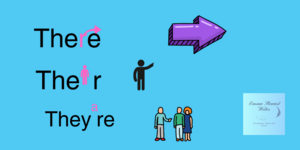
    Their, they’re and there

    These ones get confused all the time. They all sound the same, but have different spellings and meanings, making them homophones. So, which is which and how do you know which to use?

    Their: a possessive pronoun relating to either a group of people or a single person of unspecified gender. “It is their dog. They’re over there.”

    They’re: a contraction of ‘they are’. “It is their dog. They’re over there.”

    There: a demonstrative adverb referring to a place or position. “It is their dog. They’re over there.”

    infographic demonstrating the difference between there, their and they're.

    Your and You’re

    Again, very commonly confused, these two words. Your is a possessive pronoun, used for something that belongs to you. “That is your dog? You’re lucky.”

    You’re is a contraction of ‘you are’. “That is your dog? You’re lucky.”

    Remember the apostrophe post? You’re has an apostrophe because it’s a contraction of two words. Make sense?

    To, Too and Two

    And the third group of homonyms that are very frequently confused, is these three.

    To: a preposition expressing motion or approaching a place or condition. “Going to the supermarket.”

    Too: means either ‘also’ or excessively. “She was driving too fast. You thought so too?”

    Two: is the number 2.

    Conclusion

    I know this might all sound very simple and easy, basic English from primary school, but I’ve chosen to cover it for a reason. These are frequent mistakes seen everywhere from social media posts to academic essays. They’re easy to miss as well, as a basic computer spell check will not catch them, unless you have spelled the word wrong as well as using the wrong word. Modern grammar checks might catch them and realise you have used the wrong word, but they might not catch it either.

    That is where a good proofreader comes in, because part of our job is to spot these kinds of mistakes. Don’t get me wrong, modern software and AI tools are a lot better than they used to be in the early days of spelling and grammar checkers but they’re not perfect, a human eye is needed to be sure it is all correct.

  • Let’s talk about pronouns

    Let’s talk about pronouns

    Pronouns are important, so let’s talk about how to use them properly in all situations. Oh boy, is this a hot topic right now! As I have made it my mission to use language correctly and help other people do the same, I thought I would weigh in on the discussions around pronouns and what they actually mean. To be clear, myself and my work is 100% LGBTQIA+ friendly and no homophobia, transphobia or anything like it will be welcome here. This is a safe space for everyone, but let’s see if we can’t educate a bit as well. So let’s start with the basics.

    What are pronouns?

    Most people will be aware of what a noun is. A noun is a naming word, such as ‘toaster’ or ‘lollipop’ or ‘dog’. A proper noun is a name for a specific noun, such as ‘Steve’ or ‘Buckingham Palace’ or ‘Playstation’. It’s a word you use to identify a specific thing you want to talk about.

    When you are talking about a specific thing in detail, it can be tiresome to repeatedly use the noun over and over again. Especially when you are talking about a person. That is where pronouns come in. Pronouns are words used in place of nouns when you don’t need to repeat what or who you are referring to. Read the definition in the Collins Dictionary.

    An example: Steve is going on holiday next week. He is really looking forward to it.

    In this example, ‘he’ is a pronoun. We know we’re talking about Steve, so we can use a pronoun in place of his name in the second sentence. There are different types of pronouns used for different purposes.

    Personal Pronouns

    These are used for people and animals. They can be used as either the subject or the object of a clause. They include: I, you, he, she, it, me, him, her, they, them, we and us. It is almost impossible to talk about people without using pronouns. Everyone has pronouns. They are not a new invention, they have been part of the English language and many other languages for a long, long time. There are some languages where pronouns are not used, or are optional, but the context will indicate the subject being discussed.

    Some personal pronouns are gendered, and some are plural (sometimes!) but we’ll get into that in more detail later. English has a structure that generally requires a subject for clarity so pronouns are quite important. You may find other languages use pronouns differently. Japanese sentence structure means it is often possible in spoken Japanese to drop the pronouns, if it is clear who you are referring to. So while Japanese has words for I, you, he, she, they, etc, it is not incorrect to drop them entirely, allowing for a single verb to become a complete sentence in some cases. Indeed, it can be considered quite rude to use a word for ‘you’ in Japanese. In English, this doesn’t really work as well.

    Other kinds of pronouns

    There are other types of pronouns in English. Reflexive pronouns are used when the subject is performing the verb on itself (see what I did there!). Itself, myself, yourself are all good examples and are essential in some sentences.

    Possessive pronouns indicate ownership of something: mine, his, yours, theirs, hers, its (do not use an apostrophe here! See this post here.). ‘That is mine, you can’t have it.’ Look at all the pronouns! Obviously this sentence only makes sense with context around it.

    Demonstrative pronouns indicate nouns by their location or position relative to where you are. This, that, these, those. This is nearby, that is far away. Make sense?

    Relative pronouns link a modifier to a noun. ‘She’s the one who did it.’ Who, whom, that, and which are all relative pronouns.

    Interrogative pronouns are your question words. Who, whom, whose, which, and what are all interrogative pronouns. They are used to replace the noun when you are asking a question. ‘What is that?’

    Indefinite pronouns are pronouns that are used when you don’t need to be specific about who you are talking about so a personal pronoun isn’t needed. This includes words like everyone, anyone, someone, neither, much.

    Gendered Pronouns

    Getting into part of what has been an ongoing discussion regarding personal pronouns. In English, we have both gendered and non-gendered personal pronouns. She/Her and He/Him are gendered, for female and male respectively. What about the non-gendered ones? They/Them, I/m, You, We/Us. There are others out there, this list is not exhaustive as there are newer pronouns which some people who do not identify with a binary gender, feel is more suitable.

    It is important to be aware that you cannot always know what someone’s gender is by their appearance or their name. Some names are gender neutral. You can’t assume. So how do you navigate this? Simple. If in doubt, ask. If you make a mistake, apologise and correct yourself then move on. Don’t make a fuss about it. Be polite and respectful. If someone else uses the wrong pronouns for someone, politely correct them and move on.

    There is no need to argue about pronouns or tell someone who they are based on what you think you know. It’s basic human decency to respect other people by calling them what they want to be called. It’s no different from someone preferring to go by a nickname or middle name, or getting married and taking their spouses surname.

    ‘But ‘they/them’ is plural!

    Yeah, no, it’s not always. I have seen this argument a lot when it comes to non-binary people using ‘they/them’ pronouns. “It’s not grammatically correct.” That’s incorrect. Don’t get me wrong, ‘they/them’ are used in a plural form, referring to groups of people. This occurs in other languages too, some languages even have gendered group pronouns. In English, however, ‘they’ and ‘them’ can be correctly used for a single person of unspecified, unknown or non-binary gender.

    Don’t believe me? Collins Dictionary to the rescue: here. Or the Guardian’s Style Guide entry on pronouns: here. The Blue Book of Grammar, particularly Rule 11a and11b: here. Finally, this article from the Oxford English Dictionary, which is the most definitive record of the English language, which traces use of the singular ‘they’ back to the year 1375 which you can read here.

    Conclusion and Inclusion

    So, in summary, you cannot drag out the ‘basic biology’ argument when it comes to gender identities and ignore the ‘basic grammar’ of pronouns. Singular ‘they’ is correct. Plural ‘they’ is also correct. If you disagree, you’re transphobic, simple as that. Also, while this isn’t really the place to discuss it in detail, as a life sciences graduate with years of experience treating a large variety of animals, I hate to break it to you but there is no such thing as ‘basic biology’. It is never that simple. Ever. Biology does not have hard and fast rules about anything. Try some basic human decency and respect instead. It looks better on everyone.

    Thank you for reading. Feel free to comment, if you can be respectful. Discussion is welcome, as long as you remember that opinions are for pizza toppings and ice-cream flavours, not people’s existences. I reserve the right to moderate the comments and remove inappropriate or hateful ones. See you next time!