Tag: apostrophe

  • Homonyms and Homophones

    Homonyms and Homophones

    Homonyms and Homophones

    What do I mean by this? Let’s get into it. Homonyms and homophones are words that are similar but have different meanings. Homonyms are a kind of catch all term for homographs, words that are spelled the same, or homophones, words that sounds the same (with different spelling) and have different meanings. Some words are both, and come under homonyms.

    ‘Homo-‘ is a prefix used in a lot of words, and it means ‘the same’. Homogenous, homosexual, homozygous, it’s used a lot. It’s opposite being ‘hetero-‘. These prefixes come from Greek. So let’s get into the definitions properly before we look at some common examples.

    Homograph: words that are spelled the same, although may have different pronunciations.

    Homophones: words that have the same pronunciation but may have different spelling.

    Homonyms: words that have the same spelling and pronunciation but with different meanings.

    Homograph Examples

    • Read: a verb which is spelled the same and pronounced differently depending on the tense. Pronounced like ‘reed’ for present or future tense, and pronounced like ‘red’ for past tense. Oh, look some homophone examples too!
    • Bow: can be pronounced two ways, one meaning a weapon designed to shoot arrows, another referring to a respectful gesture of dipping one’s head. There are other meanings too.
    • Tear: can be a rip in something or it can mean the fluid produced that protects the eyes, and falls when someone is crying.

    Homophone Examples

    • Lead and Led: lead meaning the heavy metal and led being the past tense of the verb ‘lead’ (which is a homograph of the noun, ‘lead’)
    • Sea and See: sea meaning coastal water between landmasses and see meaning to use ones vision to collect information.
    • Bear and bare: bear meaning a large grizzly animal and bare meaning to expose or reveal.

    Homonym Examples

    • Stalk: can mean both the upright portion of a plant and to follow someone
    • Bark: the protective outer coating of a tree trunk and a sound a dog makes
    • Left: the past tense of leave and the opposite of right.

    The Important Ones to Know

    You might be thinking I’ve left a few out of the lists above. That’s on purpose, because I want to address them here. These are groups of homonyms that are commonly mixed up and confused. So I want to highlight them to help you make sure you know which is which. To read more, please see previous blog posts on pronouns and apostrophes.

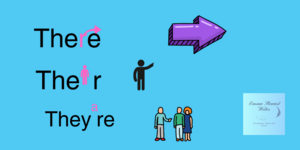
    Their, they’re and there

    These ones get confused all the time. They all sound the same, but have different spellings and meanings, making them homophones. So, which is which and how do you know which to use?

    Their: a possessive pronoun relating to either a group of people or a single person of unspecified gender. “It is their dog. They’re over there.”

    They’re: a contraction of ‘they are’. “It is their dog. They’re over there.”

    There: a demonstrative adverb referring to a place or position. “It is their dog. They’re over there.”

    infographic demonstrating the difference between there, their and they're.

    Your and You’re

    Again, very commonly confused, these two words. Your is a possessive pronoun, used for something that belongs to you. “That is your dog? You’re lucky.”

    You’re is a contraction of ‘you are’. “That is your dog? You’re lucky.”

    Remember the apostrophe post? You’re has an apostrophe because it’s a contraction of two words. Make sense?

    To, Too and Two

    And the third group of homonyms that are very frequently confused, is these three.

    To: a preposition expressing motion or approaching a place or condition. “Going to the supermarket.”

    Too: means either ‘also’ or excessively. “She was driving too fast. You thought so too?”

    Two: is the number 2.

    Conclusion

    I know this might all sound very simple and easy, basic English from primary school, but I’ve chosen to cover it for a reason. These are frequent mistakes seen everywhere from social media posts to academic essays. They’re easy to miss as well, as a basic computer spell check will not catch them, unless you have spelled the word wrong as well as using the wrong word. Modern grammar checks might catch them and realise you have used the wrong word, but they might not catch it either.

    That is where a good proofreader comes in, because part of our job is to spot these kinds of mistakes. Don’t get me wrong, modern software and AI tools are a lot better than they used to be in the early days of spelling and grammar checkers but they’re not perfect, a human eye is needed to be sure it is all correct.

  • Apostrophes and how to use them properly!

    Apostrophes and how to use them properly!

    Apostrophes – an easy guide to using them properly!

    Ah, the apostrophe, the bane of many a writer’s life. An elevated comma? Or an important punctuation mark that is chronically misused? It is definitely the second one. Apostrophes are commonly used where they shouldn’t be and not used when they should be. So welcome the the first part of punctuation, where we talk about how to use punctuation properly, beginning with how to use apostrophes.

    There are three main situations where an apostrophe should be considered. Simply put, the apostrophe is a punctuation mark that is used to indicate possession or to indicate where missing letters should be in contractions. There are a few rules regarding placement of apostrophes in certain situations which we will cover in detail below.

    First use of the apostrophe: Contractions

    Contractions are shortened words or phrases used for ease of speech or writing. They are extremely common in both written and spoken English and the majority of people know what they mean. However, using contractions can cause confusion at times, and it can lead to misuse of contractions. Do you know the difference between ‘your’ and ‘you’re’? We’ll be covering this in a later post in more detail, with useful ways to remember which one to use.

    Contractions are great, and for most casual written content it is perfectly okay to use them. However, they are considered quite informal so they should definitely be avoided in formal letters, formal writing and academic writing. Here’s a few examples:

    • don’t = do not
    • doesn’t = does not
    • should’ve = should have (by the way, it is not “should of”. Ever!)
    • it’s = it is
    • ’tis = it is

    Note the last two mean the same thing, but a different ‘i’ is omitted. The apostrophe goes where the missing letters should be. One apostrophe is all that is needed, even if you’re dropping ten consecutive letters, which would be an impressive contraction if you can do that!

    Second use of the apostrophe: Possession

    No, not the demonic kind. The belonging kind. Apostrophes are used to indicate possession. They are used after nouns and indefinite pronouns such as: the man’s house, the dog’s bone, the tree’s leaves. It should also be used after plural nouns that do not end in ‘s’: people’s, women’s, children’s. If the noun ends in an s sound, the extra ‘s’ can be left out if it makes the word more awkward to say and the apostrophe placed after the word.

    For plural nouns that end in ‘s’, the apostrophe should be placed alone at the end of the word to indicate possession: puppies’, classes’, horses’. It should also be used when stating a period of time: three days’ time, ten weeks’ time. This form of apostrophe use also applies to singular nouns ending in ‘s’ or ‘z’ followed by the word ‘sake’: for goodness’ sake (taken from New Hart’s Rules, the Oxford Style Guide, Oxford University Press).

    Apostrophes are not used with possessive pronouns such as ‘yours’, ‘hers’, and ‘theirs’. Remember ‘its’ is the possessive form of ‘it’, while ‘it’s’ is a contraction of ‘it is’. For more on pronouns, see a previous post here where I discuss pronouns and how to use them properly.

    There are specific rules and conventions for proper names and phrases where apostrophe placement matters. If in doubt, look it up and double check. I like the Blue Book of Grammar as it’s easy to use. Check the apostrophe rules here for more details and examples.

    Third use of the apostrophe: Plurals?

    Sneaky heading here, as you should not be using apostrophes to create plural words. This is sometimes known as the “greengrocer’s apostrophe” and it is incorrect. Apostrophes are not needed when making plurals of names, numbers, abbreviations and words being used as nouns when they are not normally nouns.

    For example: ‘dos and don’ts’ is correct. ‘do’s and don’t’s’ is incorrect. The first sentence contains a correctly used apostrophe in the contraction.

    There are some situations where you would want to use an apostrophe, usually using symbols, letters or numbers as objects. For example: “mind your p’s and q’s”. In this case, the apostrophe gives clarity to the objects of the sentence, saying “ps and qs” would be very confusing. Readers might figure out what you mean, but people who haven’t heard the phrase and people for whom English is not their first language would be very confused.

    Thank you for reading. Go forth and use your apostrophes properly!